


Being the first at doing something doesn’t necessarily mean that you’re doing it the best. Yet, when it comes to historical events – most people want to know about the first person who accomplished something important, while rarely acknowledging the guy or gal who came in second or third. So, for all you “first-timers” – here’s a page that picks up on some of the “firsts” of Johnson County and Iowa City.


Our “firsts” source for many of the facts that you’ll find here come from an article found in the 1924-1925 Yearbook (above left) of the Old Settlers’ Association of Johnson County – who, BTW, lifted many of these facts from the classic resource book – History of Johnson County (above right) – published in 1883.


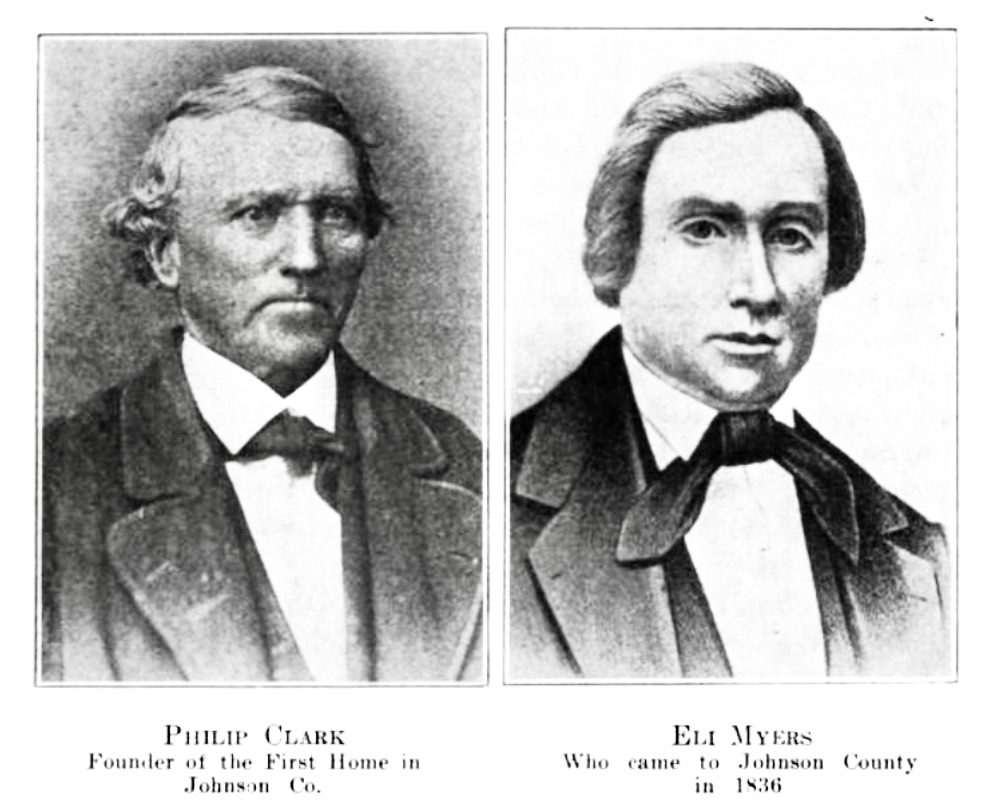

From the fore-mentioned resource guide – History of Johnson County (1883) – here is a run-down of those pioneer/farmers who followed in the footsteps of Philip Clark in 1837…


See more early maps of Johnson County and Iowa City here.

As you can see (below) – the ‘First Prize’ award for the first pioneer child born in Johnson County was argued over from the very beginning. Apparently, there were four potential winners – Lucinda Hawkins, Lewis Earhart, Loren W. Harris, and Elizabeth Cain – all born here in the fall of 1837…


Just as birth dates are important when tracking human history, so are weddings and funerals. So, once again, from the 1883 History of Johnson County volume comes these important “firsts”…

Read more about the four generations of the Stover family in Iowa City here.


Of course, Chauncey & Dolly Swan (below) are known to Johnson County historians as the “First Couple” of Iowa City. It was Chauncey Swan – the Father of Iowa City – who drove the wooden stake into the ground on May 4, 1839 – locating the historic site where Iowa’s new capitol building would be built. Read more here. And many forget that it was Dolly Swan who became the “Mother of Iowa City” as she served as the gracious host of The Swan Hotel during most of the first decade of Iowa City’s existence. Sadly, their little girl – Cordelia – represents the first death of a pioneer in Johnson County (September 1839), and Dolly suddenly passed away eight years later in 1847.


So – what’s a town without a doctor? Here are the “firsts” when it comes to the medical community of Johnson County. A tradition that, today, has blossomed into one of the nation’s finest hospital systems. Read more here.


As the OSA article indicates (below), the first Johnson County court proceedings actually occurred in the little town of Napoleon on May 13, 1839, just days after Chauncey Swan sealed the fate of that community by choosing a new county seat – Iowa City. Judge Joseph Williams (above left) and his secretary, Thomas Parvin (above right), rode into town on horseback, arriving from Bloomington (Muscatine) just in time to set up court in John Gilbert’s Trading Post (pictured middle)…


By 1842, a new court house (pictured above) opened in Iowa City, and young pioneer lawyers like Gilman Folsom (above) – who built the first bridge over the Iowa River – moved from the East to set up their legal practices. In May 1840. writer J.B. Newhall, after a brief visit here, offered this first “inventory” of Iowa City – population 700.
A spacious city hotel, three or four brick buildings, and several others in progress, ten drygoods, grocery, and provision stores, one drug store, one saddlery, two blacksmiths, one gunsmith, three or four coffeehouses, four lawyers, three physicians, one church, and one primary school.


By July 4, 1839 (more on that later), the City of Iowa City had been laid out on a map (see above) and on August 18th, the first big land auction was held…

With many land-investors coming into town for the auction, some of the early settlers – like F.M. Irish and others – took advantage of the opportunity, throwing together a large temporary building called the Lean Back Hall.


But wait! Before Lean Back Hall was built – there was another “first” in Iowa City…


Of course, technically speaking, the first buildings of Johnson County were the trading posts of fur-traders Stephen Sumner Phelps and John Gilbert. Next came the ‘claim cabins‘ (above left) – simple, lean-to buildings that were later either enlarged and improved, or replaced completely with one-room log cabins. But, when it comes to Iowa City’s first permanent home – the prize goes to…


The first frame house and the first brick building in Iowa City came along in 1840. And thanks our community’s first brick-maker – Mr. Red Brick, Sylvanus Johnson (above left) – dozens of brick buildings were built for both Iowa City and the State University of Iowa. Read more here.

Speaking of Iowa City “first” entrepreneurs, there were the Switzer Brothers – David & Joshua – who built Johnson County’s first flouring mill – on Clear Creek, very near where it meets with the Iowa River.
And then, there’s Walter Butler – who set a few “firsts” as well – not only providing the land used to build the Coralville Mill & Dam – the first dam on the Iowa River (1843)…


…but, Butler also saved Iowa City from losing its “Capital City” status by building 1) our city’s first legitimate hotel/tavern on the corner Washington and Clinton Streets (see map above), and 2) “Butler’s Capitol” – a large two-story hall (above left) that served as the first home of the Iowa Territorial Legislature in 1841. You can read more here, but without this hall, a handful of partisan politicians from Des Moines & Henry Counties had threatened to pull the legislature away from Iowa City since the new capitol building – still under construction – was not yet ready to host the 1841-1842 Territorial Legislative sessions.

So, thanks to Walter Butler, Iowa City hosted its first Territorial Legislature in December 1841.


Of course, the 1924-25 OSA Yearbook couldn’t forget to mention its own “firsts”…


We, simply, can’t talk about Johnson County & Iowa City firsts without mentioning some of the first celebrations…


And apparently, in 1867 – because of that same railroad line into Iowa City, which became the Rock Island Railroad (1866) – we have yet another “first” – but unfortunately, it’s not a “happy” one…


In the fall of 1845 – the lawn service industry of Iowa City had its first “first”…


In closing – here’s a tip of the old hat to Johnson County & Iowa City firsts. My, how you’ve grown!


Kudos to the amazing resources below for the many quotes, photographs, etc. used on this page.

Sundry First Things – Chapter IV – Part 2, History of Johnson County, 1883, pp 302-307
Some First In Johnson County History, editor, OSA 1924-25 Yearbook, pp 23-26
First Bride and Groom, Iowa City Press-Citizen, July 1, 1939, p 7
1876 Letter – William McCormick, OSA 1886 Yearbook, pp 46-48
OSA Members Arrival In Iowa, editor, OSA 1887 Yearbook, pp 53-59
Mary H. TenEyck & Hannah Cole, OSA 1896 Yearbook, p 139
Click here to go on to the next section…
Click here for a complete INDEX of Our Iowa Heritage stories…