


On another post, we give you the full story of Iowa City’s noted historian – Benjamin F. Shambaugh. So here, on this page and on two others (see links below), we’d like to share some of his writings that focused on Iowa City’s first years of existence – 1839-1842.

On this third and final page, let’s focus on Benjamin F. Shambaugh’s favorite subject. From the very first spade of dirt dug out of the ground in July 1839 to the opening of the first Territorial Legislative session in December 1842, here’s a brief overview of Iowa’s new capitol building (today’s Old Capitol) – from the pen of Shambaugh…


Professor Benjamin F. Shambaugh was a dynamic administrator and teacher at The State University of Iowa (1896-1940), and authored three books – the best known of which is The Old Stone Capitol Remembers (1939). Let’s start here with Shambaugh’s introduction to Iowa City’s oldest building…


You can’t tell the story of Old Capitol in Iowa City without talking about the Iowa River valley in Johnson County, and Chauncey Swan – the Territorial Representative from Dubuque – who was one of three men chosen by the Territorial Legislature in the spring of 1839 to identify, and then, designate the exact location for Iowa’s new capitol building. You can read the full story here, but suffice to say that on May 4, 1839, Swan and his team picked the exact spot where the capitol building would be built, marked it with a wooden stake, and then returned back home.


But wait – there’s more! Chauncey Swan was not done with his involvement with Iowa City, but by June 25, 1839 – was given, what turned out to be, the unenviable assignment of Acting Commissioner of the building project. Shambaugh tells us more…


Once the land was cleared, the job of designing the new capitol building was assigned…


The earliest days of planning the new capitol included the active involvement of Father Samuel Mazzuchelli (above left) – a Dominican missionary priest assigned to Iowa Territory, and who actually designed a number of churches in Iowa and Wisconsin. Though it’s proven that the good Father didn’t design Old Capitol, it is true that in the earliest days – prior to the architect, John F. Rague’s involvement – there were other “designs” considered. Above is a sketch of one of those ideas – as it was used by Leander (L.) Judson on his 1839 map of Iowa City! Read more here.


Shambaugh writes a more extensive article that describes this special July 4th celebration – with Territorial Governor Robert Lucas laying the new capitol’s cornerstone. You can read about that eventful day here.


As it turned out, nine days after the joyous July 4th celebration – the building’s architect – John F. Rague – and his on-site construction team decided to walk away from the project, citing 1) poor quality of construction materials, and 2) inadequate funding…


Going into the winter of 1840/41, the building project was plagued with financial shortages, and as you can see from Shambaugh’s writings (below), the construction schedule bogged down when some mean-spirited politicians from Burlington stepped in to question Chauncey Swan’s integrity…


As it turned out, the new setup with Chauncey Swan focusing on the building project, while Jesse Williams focused on the finances, worked out fairly well. As a matter of fact, Williams’ creative approach to financing literally saved the day for this Territorial project that nearly fell through. Read more here.

Records indicate that the word went out – all across the region – looking for qualified craftsmen who could add their construction skills to this massive project.

On another post, we have a copy of correspondence (see below) between William Brownell – a well-respected and highly-experienced construction man in nearby Bloomington (Muscatine) and George Matlock – a construction man in St. Louis, discussing a list of potential construction workers being recruited for the big job in Iowa City. Read more here.


The Iowa Territorial Legislature – which had been meeting in Burlington since its inception in 1838 – announced that they would continue meeting in Burlington until the folks in Iowa City, basically, got their act together. They knew that the construction of the new capitol building was moving along at a snail’s pace, and with the new governor, John Chambers, who was never a big fan of Iowa City, choosing to remain in Burlington throughout his term (1841-1845), there was in no big hurry to move things along. In January, 1841, the Assembly passed a rather back-handed act, stating that the next Legislative Assembly would meet in Iowa City on the first Monday in December, 1841 if …
“other sufficient buildings shall be furnished for the accommodation of the Legislative Assembly – rent free.”


And so, the challenge was on. And this is where one of Iowa City’s most generous pioneers – Walter Butler – steps in. Apparently, as soon as word reached Iowa City about the possibility of hosting the Territorial Assembly in December, Butler not only volunteered to lead the charge, but he also, immediately, went to work, building a suitable meeting hall on his property – Lot 6 in Block 80 (see map above) – with the full intention of offering it to the Assembly at no charge, even though that decision ended up being a very costly one for him personally.


So, thanks to Walter Butler, the Fourth Iowa Territorial Legislature (1841-1842) – the first in Iowa City – held its meetings in Butler’s Hall. Which brings us now to 1842…

So, all’s well that ends well. The Legislature met in Iowa City in December 1841, and did so, annually, until the fall of 1857, when the State of Iowa moved the capital from Iowa City to Des Moines. Read that story here.


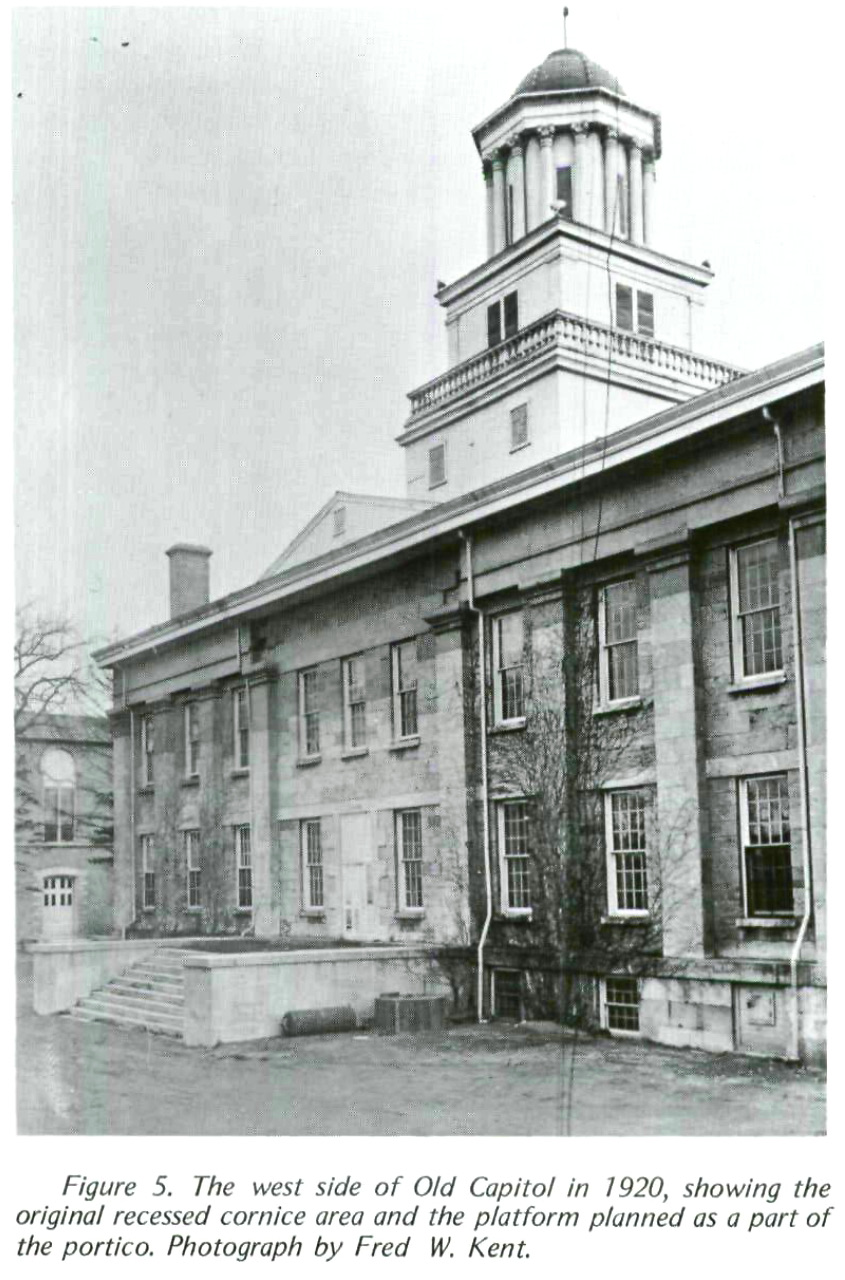
In December 1842, the new capitol in Iowa City – while not fully completed – was still able to serve as host to the Fifth Iowa Territorial Legislature. You can read more here, but suffice to say that it would be another ten-plus years before the capitol was “finished”. Yet, as you can see here from Shambaugh’s writings from the turn-of-the-century, the west portico of Old Capitol (below) had still not been completed. In fact, that project wouldn’t be accomplished until the 1920’s, when the building was rehabilitated for university purposes – a role it played on campus until the 1970’s when the Old Stone Capitol was finally restored into the museum it is today. Read more here.


Click here to go on to the next section…
Click here for a complete INDEX of Our Iowa Heritage stories…