
Throughout history, whenever a special event occurs, we human beings will tend to find a way to commemorate that event, by many times, placing a physical object at the exact location where that special event occurred.

In biblical times, God’s people, who generally had a miserable track-record when it came to remembering big God-events, used what one biblical author (Samuel) calls an Ebenezer – a stone of remembrance that would help jog their memories – pointing to a special time or event in their past when God interacted with them, working on their behalf. So, it is today.
Throughout America, in both secular and sacred settings, you will find countless “Ebenezer” remembrance stones scattered across the land, though in our generation, we use more advanced “stones” such as plaques, statues, gravestones, monuments, or even at times, large buildings to commemorate, or remember, special people, places, or events from our past.


On December 21, 1837, Johnson County officially came into existence, by an act of the Wisconsin Territorial Legislature, meeting in Burlington, Iowa. At that point in time, there were only a handful of “claim cabins” (see pic above) made of timber and scattered on a few acres of untamed prairie land adjacent to the Iowa River.


The one building of any significance was John Gilbert’s log-cabin trading post. From 1837 to 1839, this trading house served as the main gathering place for early settlers, even becoming Johnson County’s first post office in 1839.


Over the last 175+ years, the good people of Johnson County, Iowa have established many such Ebenezers – remembrance “stones” that have been placed here and there with the hope that when you and I see them, we will stop and remember the person, event, or story that lies behind the monument we’re looking at. Allow me now to give you a healthy selection of such examples…


Long before any human being walked the earth, Iowa was formed with bedrock layers of sedimentary rock called Devonian Limestone. These limestone deposits of the Johnson County Gorge were deposited in a shallow ancient sea that covered much of the Midwest during the Devonian Period – about 382 to 389 million years ago – and are composed mainly of calcium carbonate (lime) derived from the skeletal hard parts of sea-dwelling animals and plants. These markers are located north of Iowa City in Johnson County near 2850 Prairie Du Chien Road NE. Read more here.


Allow us to open this post by introducing you to Remembrance Park – a new Ebenezer that a handful of Johnson County folks are developing. In 1837, as we mentioned earlier, Johnson County was nothing more than a few log cabins and a central meeting place – John Gilbert’s Trading Post. In January of 1838, Johnson County residents had their very first “business” meeting and it was not only historical because of its timing, but more importantly, it’s worth remembering because of the beautiful diversity that was present for that first gathering. Click here to read the full story and the vision for Johnson County Remembrance Park.


In Iowa City’s City Park, there are two log-cabin replicas, the second of which is built in remembrance of John Gilbert’s 1837 Trading Post (left above). These two cabins were built in 1889 and 1913, respectively, by the Johnson County Old Settlers Association and are great reminders of Johnson County’s earliest days. Click here for more details.


As long as we are at City Park, here’s a stone – see pic above – with an attached bronze tablet that was placed in the park by the Pilgrim Chapter of the Daughters of the American Revolution (DAR) in 1939.

The stone commemorates the 100th anniversary of one of Chauncey Swan‘s most memorable decisions. Swan was a Dubuque statesmen chosen by the Iowa Territorial Legislature in 1839 to lead a three-man commission assigned to secure land where Iowa’s new territorial capital city – Iowa City – would be built. In May, 1839, Swan and handful of others canoed up the Iowa River, about two miles north of John Gilbert’s trading post, and chose a beautiful piece of land overlooking the Iowa River – which now brings us to our next Ebenezer…


In telling you about this next Ebenezer, allow me to share the words of Iowa historian Benjamin Shambaugh…


As best we know, this “post or slab” that Swan and Ronalds drove into the ground on May 4, 1839 has been lost – possibly even removed when construction of the capitol building began later that same year. Historian Bertha Shambaugh sketched what she imagined it might have looked like (above).


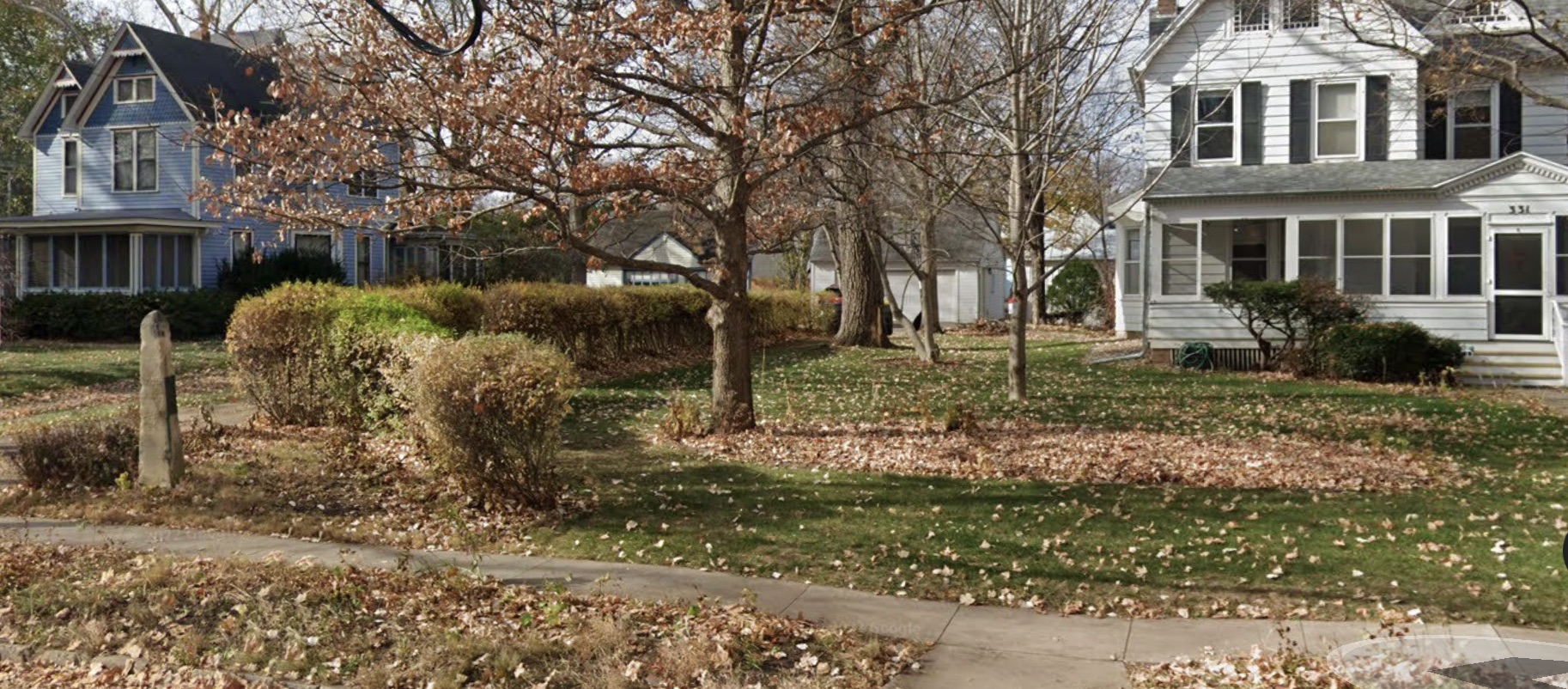
Almost immediately after Chauncey Swan chose the location for Iowa City, the difficult work of surveying and platting of the new city began. Iowa City, in 1839, was laid out within one-square-mile, with Capitol Square, of course, being the focal point, sitting atop a grassy hill overlooking the Iowa River. After the surveying was completed and the map drawn up (see below), the good people of Iowa City placed a large limestone marker at the very southeastern corner of the city – today’s 331 Summit Street (corner of Summit & Court Streets) – the key starting point for the 1839 survey.
Click here to read more about the original layout of Iowa City and its street names.

Below, we find the words inscribed on this Limestone Marker – the oldest remaining structure in Johnson County – erected in the summer of 1939…


Over time, the inscriptions carved into the limestone in 1839 became unreadable, so on May 4, 1935, the Pilgrim Chapter of the Daughters of the American Revolution (DAR) and the State Historical Society of Iowa worked together to place two new plaques on the original limestone monument – serving as a reminder of the “original” one square mile of land called Iowa City. Read more here.



On September 19, 1839, Chauncey & Dolly Swan’s five-year-old daughter Cordelia, died, becoming the first white settler to die in Iowa City, and the first burial in, what is today, Oakland Cemetery in Iowa City. The burial site had been largely forgotten until the Pilgrim Chapter of the DAR (Daughters of the American Revolution) placed a marker at the site in 1935. Since then, an even larger memorial has been placed on the gravesite, honoring Cordelia and her pre-mature death in 1839. Read more here.


Click here to read more about the Old Stone Capitol. There are five different “remembrances” located within Old Capitol…


Old Capitol Remembrance – located on the west side of the building.


Old Capitol Remembrance – located on the east side of the building.


Old Capitol Remembrance – In 1976, after a complete restoration of Old Capitol, the National Park Service designated the building as a National Historic Landmark. The marker is mounted on the east stairway (see pic above).


In 1843, approval was given to Iowa City’s founding father – Chauncey Swan – and a group of investors calling themselves The Iowa City Manufacturing Company to build a dam and mill on the Iowa River – about two and one-half miles northwest of Iowa City. Opening for business on January 1, 1844, this new dam and grist mill – the largest in Iowa Territory at the time – became the birth place of today’s Coralville. Read more here.


Isaac A. Wetherby (1819-1904). In July 1854, Isaac Wetherby arrived in Iowa City, opening a photography shop in a small second-floor office on Clinton Street. Throughout that first fall in Iowa City, when he wasn’t pre-occupied with customers, Isaac would venture about Clinton Street, experimenting with “non-professional” outdoor pictures – photos which, at the time, had little market value. But today, these outdoor shots have become Wetherby’s best known photographs, and the most history-laden pictures of early Iowa City. In 2021, Iowa City honored Wetherby by naming a 24-acre park on the city’s south side – 2400 Taylor Drive – in his honor. Click here to read more.


Just east of the entrance to Calvin Hall on Jefferson Street in Iowa City, you’ll find a marker declaring the State University of Iowa to be the first state university to admit women on an equal basis with men in 1855. That year, the student body had 124 students – of which 41 were women. Read more here. In 1873, Mary Beth Hickey became the first woman graduate from the SUI School of Law, in 1879, Alexander Clark, Jr. was the first African-American graduate, and that same year – Moung Edwin, from Burma – became the first graduate from another country! Read more here.


Fondly known today as OId Brick, this classic landmark building started life here as North Presbyterian Church in 1856 and is one of the few surviving local structures from that period. It has been on the National Register of Historic Places since 1973 and has been fully remodeled. Owned by the Episcopal Diocese of Iowa, it now serves as a popular wedding venue and community gathering space, offering subsidized rental rates for non-profit organizations through the diocese’s non-profit incubator. You can find it in the heart of Iowa City along East Market Street with its historic plaque near the front doors. Read more here.


In 1856, 3,000 European immigrants – converted to the Mormon faith – gathered in Iowa City to trek from here on foot to Salt Lake City. The most familiar marker commemorating this gathering is the signage (above left) at Mormon Handcart Park located off Hawkeye Court in Iowa City. But a lesser-known historical marker – erected in 1936 by the Iowa Daughters of the American Revolution – is attached to a large stone at S.T. Morrison Park in Coralville (facing Fifth Street near the park pond) – memorializing the spot near the banks of Clear Creek where Mormons encamped prior to their 1,300 mile journey west to Utah. Read more here.


Located in Coralville in Johnson County, this marker for Iowa’s Civil War Governor – Samuel J. Kirkwood is at the intersection of 5th Street and 3rd Avenue. It was erected in 1978 by the Iowa State Historical Department – a division of the State Historical Society – and by the Johnson County Historical Society. Read more about Samuel Kirkwood here.


Camp Pope, established in August 1862 on land next to Ralston Creek, north of the Mississippi and Missouri Railroad, bordered on the west by present day Summit Street, on the east by Oakland Avenue and on the north by Seymour Avenue. The southern boundary of the camp extended beyond the tracks, to Governor Kirkwood’s house on Wyoming Road (today Kirkwood Avenue) and that that portion of the camp was used as a parade ground. It may be that the land for the camp was owned and donated for that purpose by Samuel Kirkwood.


A mass rally was held in Iowa City on August 9, 1862, to encourage enlistment. Local enthusiasm, plus the threat of a draft, ultimately brought out more than twice Iowa’s quota for this particular call for volunteers. The regiments that mustered at Camp Pope – the 22nd, 28th, and 40th Infantry Volunteers – were formed in response to Abraham Lincoln’s call for 300,000 volunteers in July of 1862. In 1926, a plaque commemorating the camp was attached to a large boulder and placed in the front yard of Longfellow School at what would have been the northern edge of Camp Pope. Click here to read more about Iowa and the Civil War.


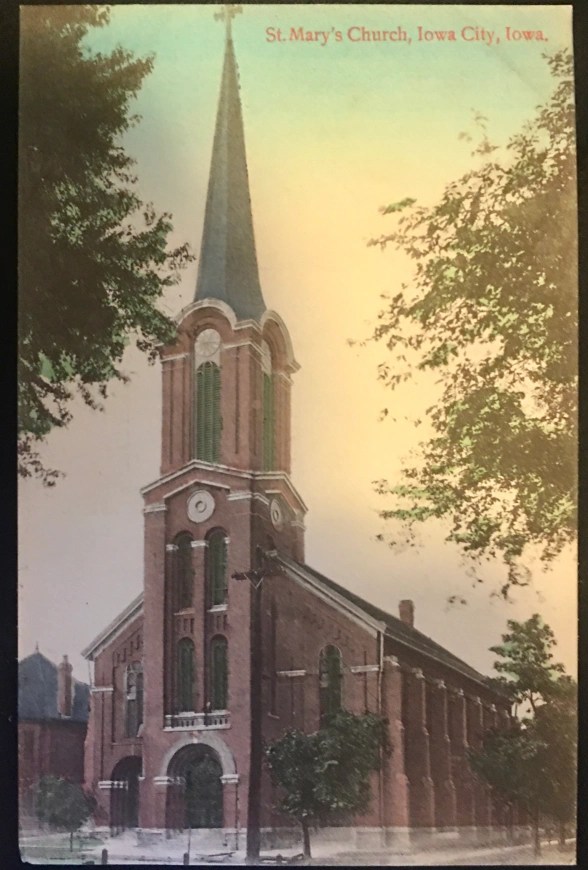

The first Mass in Iowa City was celebrated by a frontier missionary, the Rev. Samuel Charles Mazzuchelli on December 20, 1840. It was attended by 28 people in a building that doubled as a private home and a hotel owned by Ferdinand Haberstroh. The previous day, Mazzuchelli had arrived from Burlington, securing two lots on which St. Mary’s church and rectory still stand today – 220 E. Jefferson. St Mary’s parish (a small wooden structure) was established here by Mazzuchelli in 1841, named St. Mary of the Assumption, and was largely completed by 1842. A larger church was completed by 1865, and the current structure (above right) was built around the existing one in 1869. The 140-foot steeple was added in 1874 and St. Mary’s was designated by Bishop Martin Amos as a pilgrimage site for the Year of Mercy, as promulgated by Pope Francis on December 8, 2015. Read more here.


Part of the university’s medical department since 1870, the College of Dentistry was granted department status in 1882, becoming the first dentistry program established west of the Mississippi River. In 1894, the Dental Building was erected on University Square to house SUI’s Dental School, which was located here until 1916 when a larger dental building opened. In 1975, Old Dental – after 80 years of university use – was razed, thus removing the last extraneous building from the Pentacrest. Read more here.


Opened in 1902, the Hall of Liberal Arts was later renamed Schaeffer Hall for Charles A. Schaeffer, the University of Iowa president who turned the first spadeful of earth for the new building shortly before his death in 1898. The first of the four buildings erected to anchor Old Capitol, Schaeffer Hall was designed to echo the grand architectural style of the 1893 Chicago World’s Fair. Read more here.


On East Market Street in Iowa City – in front of the Pomerantz UI Visitors Center, you will find a large stone marker dedicated to Major Bird T. Baldwin and his pioneering work with SUI’s Iowa Child Welfare Research Station. Originally placed next to Old Brick, the memorial by sculptor R. Stites was moved to its more visible location at 56 E. Market Street and serves as a reminder of the good work of Baldwin and his ICWRS team. Read more here.


The SUI Electrical Engineering Department demonstrated ‘television’ with an exhibit at the Iowa State Fair in Des Moines on August 28, 1931. At the conclusion of the fair (1932), the television experiment was set up in the communications laboratory of the Electrical Engineering Building. By 1933, SUI received an FCC license for an experimental TV station W9XK, later W9XUI, providing twice a week video programming, with WSUI-AM providing the audio channel. A marker has been placed near the entrance of the Biology East Building celebrating this historical event. Read more here.


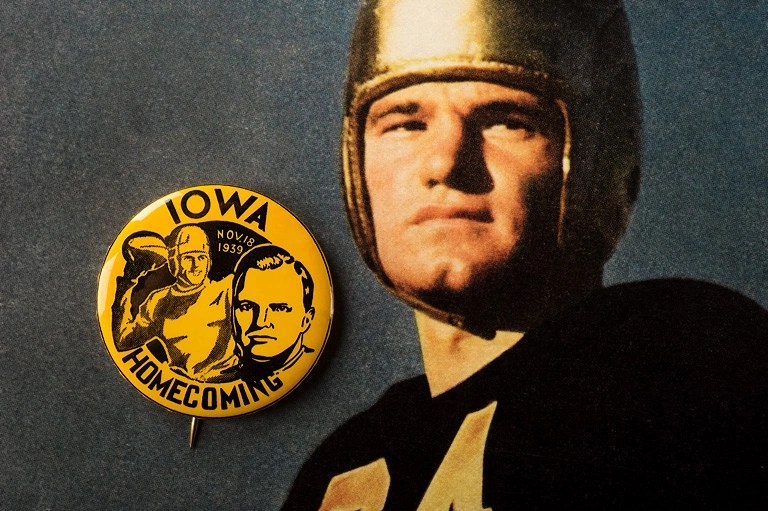
In 2006, on the south side of Kinnick Stadium, a 16-foot-tall bronze statue of Nile Kinnick, the University of Iowa’s only Heisman Trophy winner (1939) was dedicated. Created by artist Larry Nowlan, the statue depicts student/athlete Kinnick, not dressed in pads or a jersey, but street wear and his letterman’s jacket, characteristic of the time, casually holding textbooks. Tragically, Kinnick was killed in 1943 during WWII. Click here to read more.


James Alan McPherson (1943–2016) was an American essayist and short-story writer. He was the first African-American writer to win the Pulitzer Prize for Fiction, and was included among the first group of artists who received a MacArthur Fellowship. At the time of his death, McPherson was a professor emeritus of fiction at the Iowa Writers’ Workshop. In March 2021, The Iowa City City Council approved the renaming of Creekside Park to James Alan McPherson Park, located at 1856 7th Avenue Court. Click here to read more.


There is a magnificent bronze statue depicting Irving Weber, located on Iowa Avenue in downtown Iowa City, appropriately very near where the University of Iowa’s first classroom (1855), the Mechanics Academy, first stood. The statue was donated by Steve Maxon and Doris Park in 2003, along with sponsors; Iowa City Host Noon Lions Club, Iowa City Public Art Program, Quality Chekd Dairies, and Friends of Irving Weber. Click here to read more.


The University of Iowa remembers the tragedy of November 1, 1991. This memorial is dedicated to those who died and those who were affected by the tragedy; their legacy of caring and distinguished service to the campus community will be remembered forever. The marker is located on the UI Pentacrest – beside the walkway nearest the northeast corner of Old Capitol. Read more about the UI Pentacrest here.


DYK-March 20, 2023
DYK-March 29, 2023
DYK-October 5, 2023

Kudos to the amazing resources below for the many quotes, photographs, etc. used on this page.

What does the term Ebenezer mean in the Bible?, GotQuestions.org
Historic Markers, Iowa City – Pilgrim Chapter, Daughters of the American Revolution (DAR)
Old Stone Capitol Marker #1, HMdb.org
Old Stone Capitol Marker #2, HMdb.org
D.A.R. Marks ‘Capitol’ Site, Iowa City Press-Citizen, May 4, 1935, p 2
Monument Of Grey Limestone Marks Founding Of City, Iowa City Press-Citizen, May 22, 1937, p 64
Surveying Capital Site Occupied Midsummer Of Year 1839, Iowa City Press-Citizen, July 1, 1939, p 26
1839 marker, South Summit Street District, NPGallery
Some Historic Markers in Iowa, Susie Webb Wright, State Historical Society of Iowa, 1943, pp 78-79
Johnson County, Iowa Parks, Genealogy Trails
Where Was Camp Pope?, CampPope Bookshop
Camp Pope Plaque, Johnson County, Iowa Civil War Monuments
Nile Kinnick, Art on Campus, University of Iowa Facility Management
Wetherby Park, City of Iowa City
Remembrance Park Dedication, Johnson County Remembrance Park
Click here to go on to the next section…
Click here for a complete INDEX of Our Iowa Heritage stories…