

We have had the honor of presenting this talk on other occasions:
Sunday, October 20, 2024 – Johnson County Historical Society Annual Celebration
If your organization would be interested in having Marty Boller give this informative presentation, drop him a note at mjbhawkeye@gmail.com
Johnson County, Iowa was first organized in 1837, but of course, there have been countless Native Iowan tribes who called these 613 square miles of prairie ‘home’ for many centuries.


So, without a doubt, the subject of The Transportation History of Johnson County is a huge topic – one that could take hours and hours to unpack. Thus, here, on this page, we are simply going to give you a brief overview – breaking our 185+ year Johnson County transportation history into six major themes. We’ll then offer you a few facts and figures about each era, followed by some page links for more study. So, here goes. Enjoy the ride…
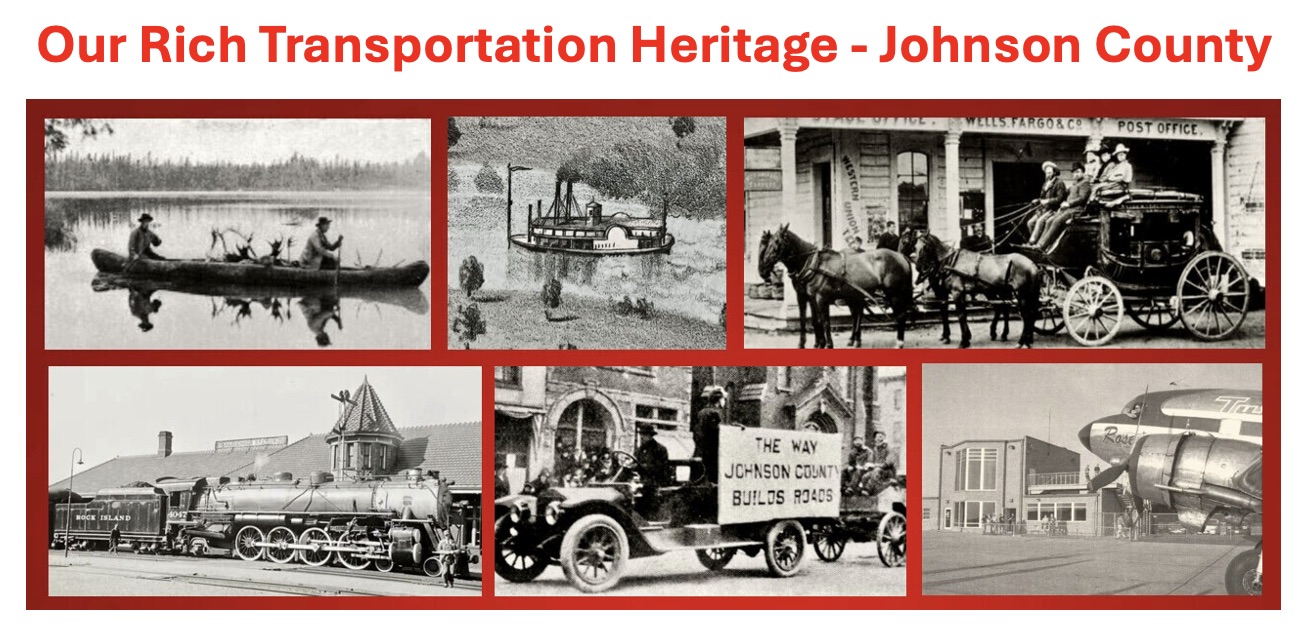
The Steamboat Era
The Stagecoach Era
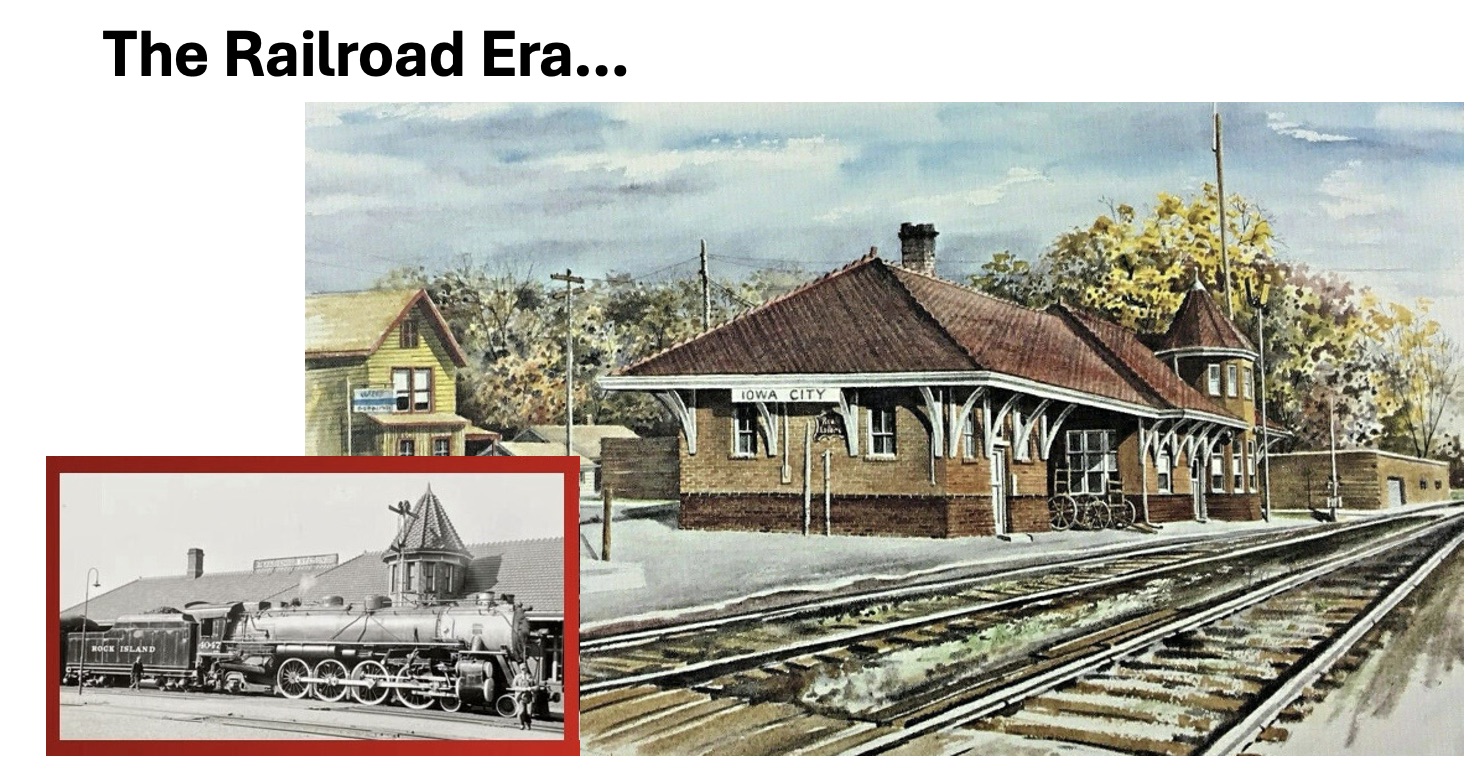
The Railroad Era
The Automobile Era
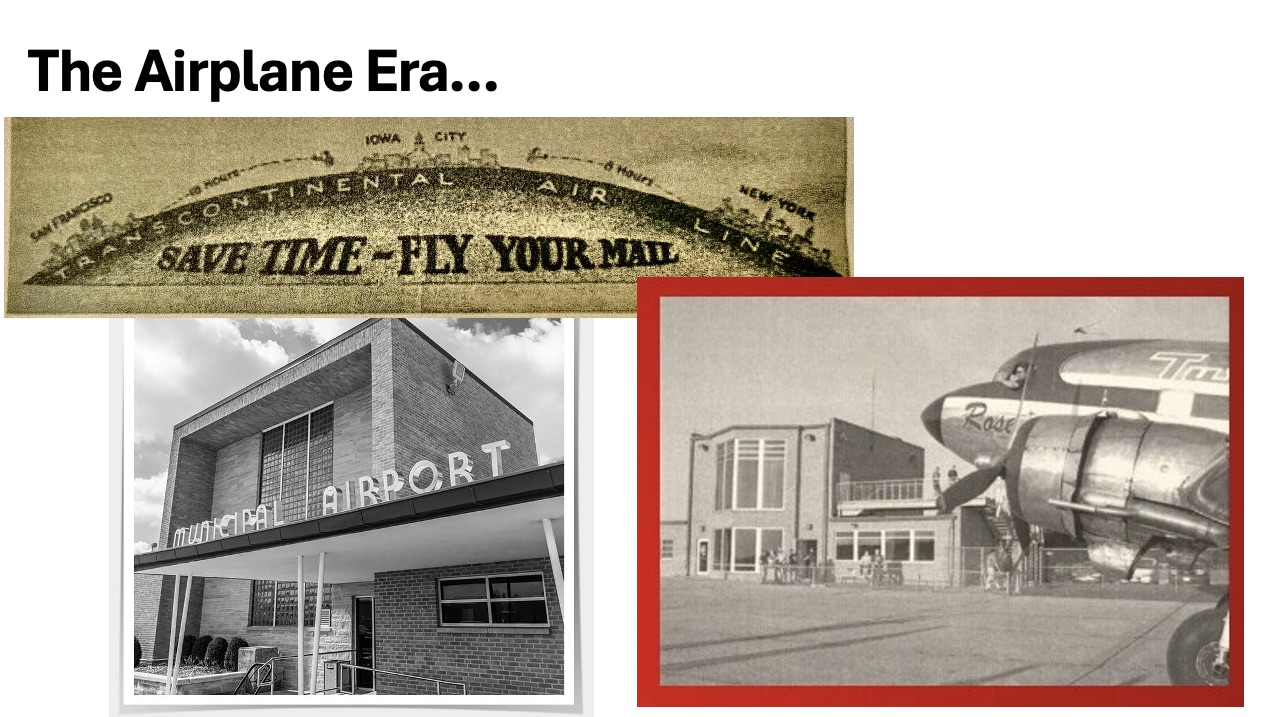
The Airplane Era
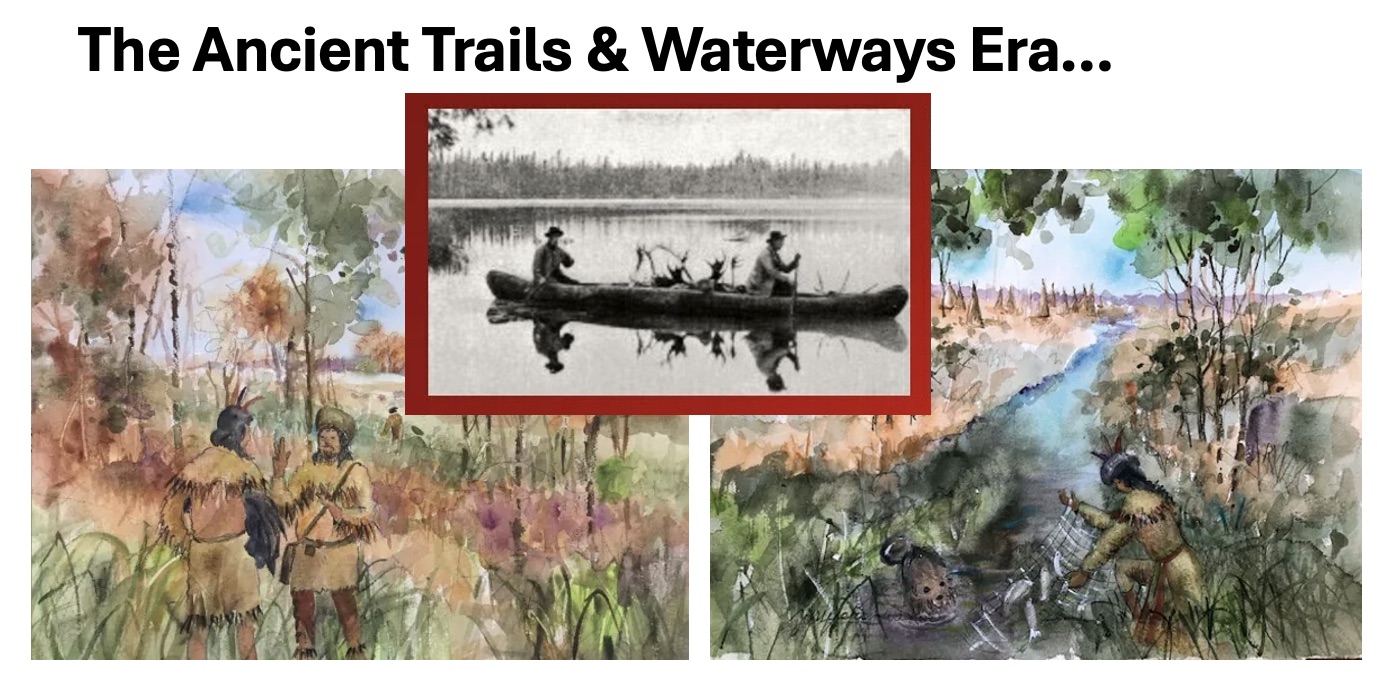
Ancient Iowa – Exploring The Land. Archaeologists believe that the first inhabitants of what is now the state of Iowa were Paleo-Indians, the earliest ancestors of Native Americans. They occupied ice-free land during the time when the Des Moines lobe was covered by glaciers, up to 14,000 years ago. The earliest archaeological evidence of settlement, however, dates from about 8,500 years ago, with many different tribes, speaking various different languages inhabiting Iowa.
Honoring The Ioway Tribe Of Johnson County. Elders in the Ioway Tribe have said that before white people came, no other nation could put a moccasin inside the land between the Missouri River and Mississippi River without the Ioway knowing about it. Nearly 200 years after the 1838 treaty that forced the tribe from the state, the Ioway people once again have land in Iowa – seven acres in Johnson County! Read the full story as shared here from The Iowa City Press-Citizen.
Meskwaki People – True Native Iowans. At the time of the American Revolution, the Mississippi River Valley was lush prairie-land occupied by several Native American tribes: The Meskwaki (Fox), the Sauk, the Sioux, and the Ioway. Since Our Iowa Heritage website focuses primarily on eastern Iowa, here we give a tip of the hat to the Meskwaki people who migrated to the Iowa River Valley as white settlements began to emerge.
Iowa – The Discovery 1673-1803. In 1673, Father Jacques Marquette and Louis Jolliet embarked on an expedition to explore the Mississippi River. On that trip, Marquette and Jolliet became two of the first Europeans to set foot on the beautiful land we now call Iowa.
The first era, of course, goes back long before Johnson County ever existed. From the time fur traders and early pioneers first arrived here in the 1820’s & 1830’s, our Native Iowan friends – the Ioway tribe, the Sac & Fox tribes (Meskwaki), and others had marked out familiar trails that moved north to south, east to west, and of course, many of those trails ran parallel to the rivers of Eastern Iowa – which for us, here in Johnson County – meant the Iowa River, as it connected to the Father of Waters – the mighty Mississippi.
So, between 1833 (when Iowa was first open to settlers) until about 1840 – these ancient trails and waterways were the major highways everyone used in getting around Iowa Territory. Anybody got a canoe? Or a horse?
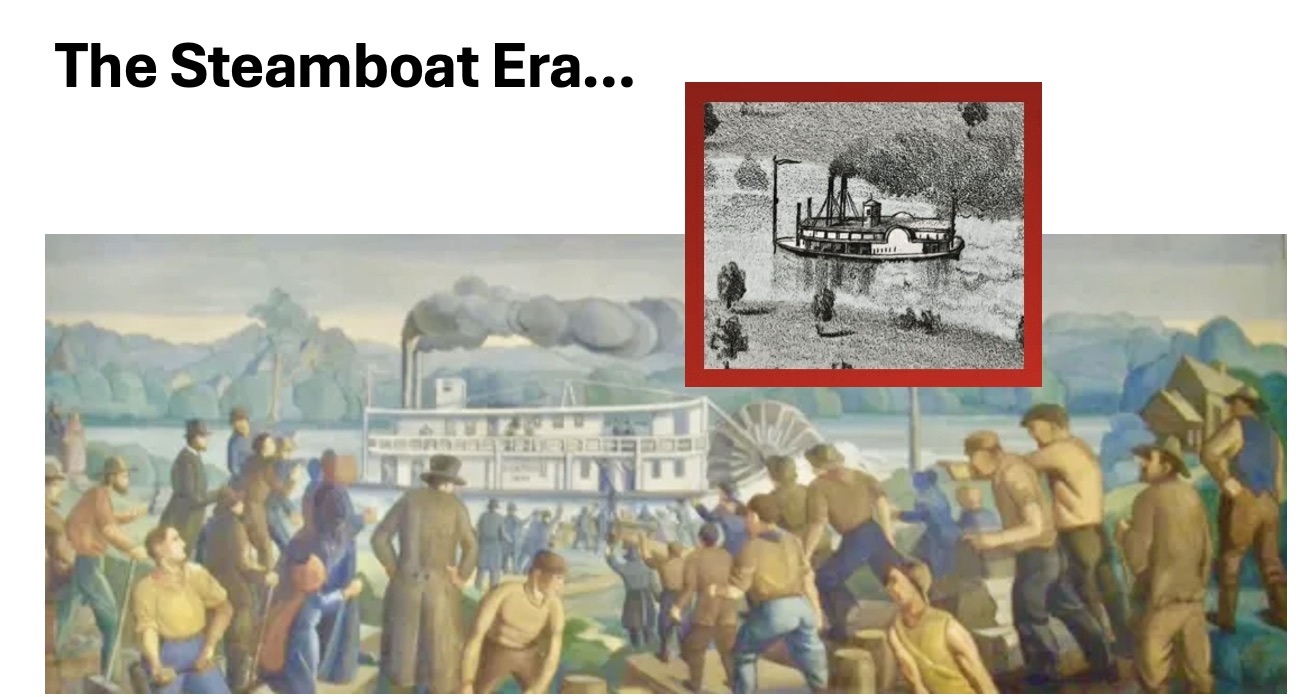
Let The City-Wide Celebration Begin: 1841. During the early summer of 1841, the residents of Iowa City had the thrill of their lives when Captain Dan and his steamboat Ripple came chugging up the Iowa River, delivering a group of explorers and tourists to Iowa’s new Territorial capital. On the evening on June 21, at the National Hotel, the city’s elite gathered for a grand dinner celebrating this whole new era in transportation – with the glimmering hope that steamboats would now give Iowans a reliable way of interacting with the rest of the civilized world. Read all the details and join the fun here.
Gilman Folsom – Crossing The Iowa River. In Iowa City’s earliest days, crossing over the Iowa River was no easy task. Several flatbed ferry boats came into service in the 1840’s, but thanks to Gilman Folsom, a lawyer from New Hampshire, the first toll bridge was constructed, connecting both sides of the river on the National Road – which today is the Iowa Avenue Bridge.
Folsom’s Fury – Building A Bridge Over Troubled Water. In the early 1850’s, Iowa City was growing rapidly, and with the flood of Easterners flocking to California to pursue golden opportunities, traveling through Iowa’s capital city on The National Road was a must. Iowa City’s own Gilman Folsom offered to build a bridge over the Iowa River, but needed the state legislature to approve it. That part came easy, but in 1851, Governor Hempstead vetoed the plan, setting off a firestorm, and keeping Iowa City bridge-less until 1854!
The Bridges of Iowa City. The Iowa River played a major role in why Iowa City is where it is today. In the earliest years, crossing the river was no easy thing to accomplish. Here’s the story of how Iowa City became a City of Bridges – all beginning with the Burlington Street Bridge in 1860. FYI: This page was nominated as Page of the Year by The BridgeHunter’s Chronicles in 2021!
William J. Petersen – Iowa’s Steamboat Bill. Raised on the banks of the Mighty Mississippi, this young man from Dubuque went on to become world-renowned as a history professor at SUI (1930-1968) and as the long-time supervisor for the State Historical Society of Iowa (1947-1972). Taking after Samuel Clemens, Petersen became famous because of his writings about life and steamboating on the Father of Waters.
This brings us to our second – and shortest – era in Johnson County transportation history. From the very beginning of Iowa Territory in 1838, there was great hope that steamboats – which were chugging up and down the Mississippi – would be able to navigate the larger rivers of eastern Iowa – the Des Moines, the Skunk, the Iowa, and the Cedar.
On Sunday morning, June 20, 1841, there was huge commotion in Iowa City. On the banks of the Iowa River, where, today, Iowa Avenue crosses at the foot of Old Capitol, the good people of Johnson County had built Iowa Landing. And on that Sunday morning, The Ripple – under the leadership of Captain Dan Jones – came steaming into town – with its riverboat bell ringing. And over the next 48 hours – Iowa City partied! It was, truly, our city’s first big city-wide celebration.
Over the next 20+ years – steamboats would occasionally make their way up the Iowa River. In 1860, Iowa City city ordinances demanded that any bridge built over the river had to be high enough for steamboats to pass underneath! But in truth, the river just wasn’t reliable enough – year round – for heavier steamboats to cut through, so by 1867, the Port of Iowa City closed up forever.
Lyman Dillon – Plowing the Straight & Narrow. When Iowa became a U.S. Territory in 1838, transportation options were very primitive. Governor Lucas asked the U.S. Senate to fund a Military Road running the length of the Territory from Dubuque to the Missouri border. After surveying the land, Lyman Dillon, a farmer from Cascade, was hired to take his team of five oxen and plow up a furrow from Dubuque to Iowa City (86 miles). Get the straight story here!
1840 – The Road From Bloomington To Iowa City. When Napoleon was Johnson County’s only pioneer settlement, a roughly-cut trail made its way eastward through the Iowa prairie to Bloomington – on the Mississippi River. But now, in 1840, with Iowa City becoming the new Territorial capital, a new and improved road was needed to connect these two growing communities. Here’s a rare look at the early stages of development on one of Johnson County’s oldest roads.
Ansel Briggs – The Stagecoach Driver Who Became Governor. In 1839, a 33-year-old businessman came to Iowa, started a small stagecoach operation, driving most of the coaches himself. By 1842, he was elected to represent Jackson County at the Iowa Territorial Legislative Assembly in Iowa City, and by 1846, when Iowa became the 29th state in the Union, the Democrats nominated him to become Iowa’s first state governor. Meet Ansel Briggs – Iowa’s only senior leader who began his career as a stagecoach driver!
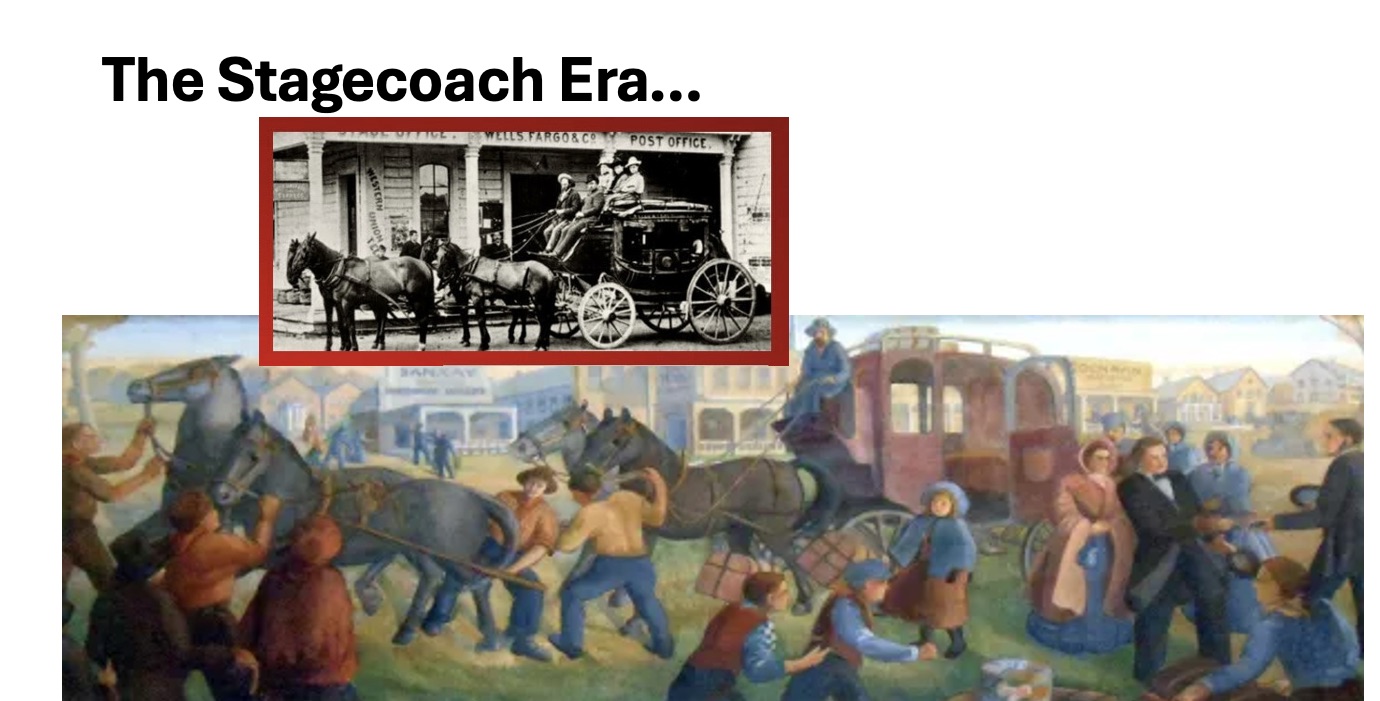
Iowa City Stage Ready – 1840-1870. When Iowa City was established as Iowa’s new territorial capital, the priority was getting accessible transportation in and out of Johnson County. With the Iowa River too unpredictable for riverboats, stagecoaches were the wave of the future. Thus, between 1840 and 1870, the stagecoach business was a-rolling all over the Hawkeye State, with Iowa City being right in the center of the action.
This brings us to the Stagecoach Era. Of course, the first roads in Johnson County were built early on. A well-worn trail from Bloomington (Muscatine) to Iowa City was well-traveled by 1837, and in 1838, Territorial Governor Robert Lucas steer-headed Iowa’s first “official” road – The Military Road – 86 miles from Dubuque to Iowa City – which eventually stretched south to the Missouri border. Lyman Dillon’s famous Farrow is, of course, a part of that history – today’s Highway One. So, when it became obvious that the riverboats weren’t going to work, the best option that sprang up was the stagecoach. And with Iowa City being the Territorial and State capital, all stagecoach lines eventually came here.
1840 – Frink & Walker is the first company to bring stagecoach service into Iowa City. $3 will buy you a seat on the thirty-mile trip to Bloomington (Muscatine) via a two-horse stagecoach. Records indicate that it took 10 hours to travel from Davenport to Iowa City, with the average speed – between 5 and 8 miles per hour.
1842 – Chauncey & Dolly Swan manage Swan’s Hotel, located on the National Road right in the heart of Iowa City. A stagecoach stop/tavern/inn, The Swan becomes a major point of interest in early Iowa City history.
1846 – Our first state governor – Ansel Briggs – came to be elected because he was a well-known stagecoach driver throughout eastern Iowa.
1854 – The Western Stage Company opens a regional center on Iowa Avenue near Clinton Street, hiring one-hundred mechanics here, while housing coaches, horses, supplies, and a blacksmith and carpenter shop.
1870 – Times change, and new forms of transportation take a huge toll on the stagecoach business. So on July 1, 1870, Western Stage Company‘s last coach leaves Des Moines, and by month’s end, coaches that once cost $1000 to make, are now being sold for scrap for $10 each.
The 1850’s – The Birth Of Iowa Railroads. The dream of a Transcontinental Railroad began as early as 1838, but by the 1850’s, serious investors were putting big money into that dream. Chicago was becoming the nation’s new railway center and with the dream of reaching California, the bridge to getting there went directly through Iowa. In 1856, the Iowa Land Bill opened up our state to four competing railroads and now, the race to the West was on!
The Mississippi & Missouri Railroad – Volume I – 1845-1855. With its headquarters in Davenport, the M&M Railroad had lofty goals of building three lines in Iowa – the first running east/west from Davenport to Council Bluffs via Iowa City, the second running south from Muscatine to the Missouri border via Oskaloosa, and the third running north from Muscatine toward Minnesota via Marion/Cedar Rapids. Over the first ten years, much of the work entails casting vision, partnering with eastern-based railroads, and raising funds.
The Mississippi & Missouri – Iowa’s First Railway System. It’s 1853, and with the M&M Railroad now “officially” incorporated, job one – outside of raising funds – is to hire Peter A. Dey and Grenville M. Dodge as surveyors. Their job is to layout the 300-mile M&M route across Iowa – from Davenport to Iowa City to Des Moines to Council Bluffs. And, BTW – don’t overlook Muscatine!
1853 – The $50,000 Investment In Iowa City’s Future. When the Mississippi & Missouri (M&M) Railroad announced its plan to build their line from Davenport to Council Bluffs, the competition was on for communities like Iowa City and Muscatine to bargain for the number one station stop. In May 1853, two Iowa City businessmen – LeGrand Byington and William Penn Clarke – were sent to Chicago to twist a few arms. Armed with a $50K promise if M&M made it to Iowa City by January 1, 1856, the deal was cut and Iowa City’s long-term future was secured.
Fifty Locomotives Of The M&M Railroad. Here’s an overview of 50 steam locomotives, built in the 1850’s for the Mississippi & Missouri (M&M) Railroad. These were the engines that pulled M&M’s many passenger & freight cars around the State of Iowa over its eleven years of service (1855-1866).
The Survivors: Ten Locomotives Of The M&M Railroad. In an earlier post (above), we offered you an extensive overview of 50 steam locomotives, built in the 1850’s for the M&M Railroad. Sadly, none of these beauties have survived to today, but the good news is that ten of these classics were photographed before their demise. Come take a colorful look at these iconic steam locomotives from the past.
The Mississippi & Missouri Railroad – Volume II – 1856-1866. As the year 1855 came to a close, the M&M management team was under the gun. Originally, the plan was to have the east/west line into Iowa City completed by December 1, but construction had fallen far behind schedule. Spurred on by a $50,000 prize if M&M could bring an engine into Iowa’s capital city by January 1, 1856, we now come to the most dramatic part of the M&M Railroad story.
Railroading & The Winter Of 1855/56. The M&M Railroad – which began its trek westward from Davenport toward Iowa City in the fall of 1855 – was just one of America’s railroads to experience hardship during the Winter of 1855/56. Known to most Iowa pioneers as one of the harshest winters the Midwest experienced during the entire 19th century, here’s one scary story of travelers trying to get to Iowa City from Detroit.
Let The City-Wide Celebration Begin: 1856. Two days after the M&M Railroad completed their track into Iowa City, a party to end all parties was held in the Old Stone Capitol. Seven train coaches rolled into town on January 3rd, filled with bigwigs from back East, and while the temperatures were cold enough to keep everybody home, the whole town turned out for Iowa City’s Grand Railroad Festival.
1856 – Bridging The Father Of Waters. In January 1856, the M&M Railroad rolled into Iowa City from Davenport, but it wasn’t until April when the final link of our railroad connection to the East was complete. On April 22, 1856, the very first railroad bridge over the Mississippi River opened, and now, the people of eastern Iowa could travel non-stop – reaching New York City by rail in no more than forty-two hours!
Iowa City’s Railroad Depot – Grand Central Station. In preparation for the coming of the railroad, the good people of Iowa City built a small depot at the south end of Johnson Street. While it faithfully served the city for 40+ years (1856-1898), it was replaced by a state-of-the-art facility that still stands today. Without a doubt, over 70+ years (1898-1970), this depot became Iowa City’s Grand Central Station.
Riding The Five Rails Of Iowa City. Over a 120-year period (1850-1970) there were five different railway systems that attempted to serve the good people of Iowa City with passenger rail service. Today – there is none. Come reminisce with us as we review the amazing stories behind these five railways from our past.
A M&M Railroad Timetable. The idea of building a railway system across Iowa goes back to our earliest days when we were still only a U.S. Territory. Here is a timetable that begins with John Plumb’s visionary meeting in Dubuque in March 1838 and ends with the completion of the Transcontinental Railroad and the Rock Island Railroad’s arrival in Council Bluffs in May 1869.
All Aboard Iowa RPO’s. As railroads became the fastest and most efficient way to move both freight and people, so the United States Postal System wisely used the rails to get mail across the country. RPO’s (Railway Postal Offices) were the mobile offices that made it all happen.
Two Iowa City Presidential Whistlestops – 1948 & 1952. The Presidential races of 1948 and 1952 brought the campaigns of President Harry S. Truman (1948) and General Dwight D. Eisenhower (1952) right to the front door of Iowa City. Read these first-hand accounts of two unforgettable Whistlestops that drew huge crowds to the CRI&P Railroad Depot on Wright Street.
May 31, 1970 – An End Of An Era In Iowa City. After 114 years of passenger rail service in Iowa City, the last two Rock Island Rockets pulled into town on a Sunday afternoon in May 1970. One was headed west to Council Bluffs, the other eastward to Chicago. Fortunately, one man took a few photographs on that iconic day when the railroad era ended in Iowa City.
Irving Weber & Iowa City’s Rock Island Railroad. On March 31, 1980, a 125-year Iowa City tradition came to an end when the last Chicago, Rock Island & Pacific (CRI&P) Railroad freight train rolled through town. Nine days later, Iowa City historian Irving Weber published his classic article: Requiem for the Rock Island Line in Iowa City. Come re-visit Weber’s love of Iowa City’s long-standing Rock Island Railroad heritage.
It’s hard to imagine that, for a good portion of Iowa City and Johnson County’s history – 114 of our 185+ years – the hub for most transportation in and out of our region was one small building located just a few blocks south of Old Capitol.
In 1855, the good people of Johnson County raised a purse of $50,000 and built a small depot at the end of South Johnson Street in order to entice The Mississippi & Missouri (M&M) Railroad to build their first line into Iowa from Davenport to Iowa City. On January 3, 1856, the first passenger train rolled into Iowa City, and over the next 42 years, this little building became Iowa City’s Grand Central Station.
In 1898, The Chicago, Rock Island, and Pacific (CRI&P) Railroad – which bought out the M&M in 1866 – worked with Iowa City to build a state-of-the-art railroad depot four blocks west of the original station on the newly-built Wright Street. When it opened on September 29, 1898, thousands of Johnson County citizens gathered to celebrate what was called, “the handsomest depot of its size in the United States – (unequaled by any another depot) anywhere in the world.”
So, from January 3, 1856 to May 31, 1970 – 114 years – not one day went by in Johnson County when at least one or more M&M or Rock Island passenger train – affectionately named The Rocket – powered their way in and out of our Iowa City railroad station.
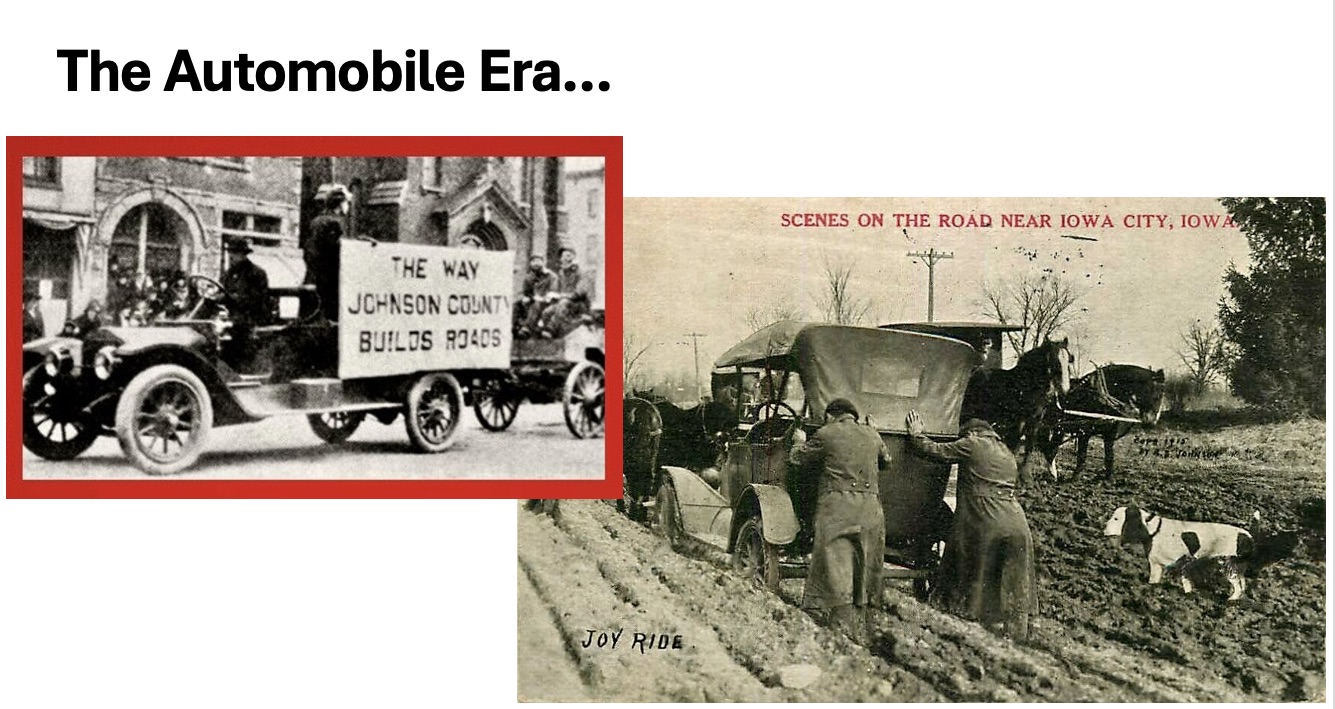
The Streets Of Iowa City – From Mud To Bricks. Prior to the late summer of 1895, Iowa Citians, very often, found themselves stuck in the mud as they attempted to travel the streets of our fair community. But, all that began to change with the eight-city-block brick-paving project of 1895 – beginning with Clinton Street across from Old Capitol.
Henry County to Iowa City – The Red Ball Route. The Boller family lived in Henry County from 1896-1966. There were two main highways that we used to connect to the outside world. Here is the story of one of them, The Red Ball Route: a road paved with a lot of rich Iowa history.
Mapping Out My Iowa – 1951. This “official” State of Iowa Highway Map takes us back to 1951 – no interstates – no rest stops – no cruise control. Come drive across the Hawkeye State with this roadmap!
Beginning near the turn-of-the-century (1900), America fell in love with the horseless carriage – the automobile, and, of course, that passion continues to today. But many forget that for the first twenty or thirty years of its existence, the automobile had very few places it could travel without being stuck in the mud. Roads across Johnson County were made for horses, oxen, and farm wagons, while Iowa City streets consisted of nothing but hardened clay and a bit of crushed rock, when lucky.
In 1895, Iowa City began a street-paving project that brought brick streets to the downtown district, and in 1911, after the American Automobile Association had urged national legislation for a transcontinental highway, one of AAA’s members, Robert N. Carson of Iowa City, became the primary promoter and advocate for what he called the Red Ball Route – a north-south network of gravel and paved roads running from St. Louis to St. Paul, going through Hannibal, Missouri and Quincy, Illinois, to Keokuk, Mount Pleasant, Iowa City, Cedar Rapids, and Waterloo, and finally ending up in St. Paul, Minnesota. That road eventually became Highway 218, and today, is known as the Highway of the Saints. Interestingly, today’s newly-updated intersection of Interstate 80 and I-380 (The Avenue of the Saints) handles over 120,000 vehicles on a daily basis.
1919 – Bremer’s Golden Eagle Aeroplane Promotion. On July 11, 1919, thousands gather at the Peter Lenz farm southwest of Iowa City to see U.S. Army Lieutenant David L. Behncke land his Curtiss bi-plane – The Society No. 2 – loaded with several hundred pounds of Society Brand clothes – fresh from Chicago. Dubbed “one of the most gigantic publicity stunts” in our city’s history, the Bremer’s “Golden Eagle Aeroplane Express” brought the “latest styles in coming season apparel for men” for the downtown store’s display windows.
The Iowa City Airport – A Rich Aviation History. Did you know that Iowa City hosted one of the earliest commercial airports in the country – serving as one of the strategic stops in America’s first cross-country air mail route? As a matter of fact, today, Iowa City’s airport is the oldest airstrip west of the Mississippi River that’s still in its original location – with many of the early pioneers of flight landing here – including Wiley Post, Jack Knight, Charles Lindbergh, and Will Rogers.
The U.S. Navy Comes To Iowa City – 1942-1944. Not many know that the U.S. Navy came to Iowa City during WWII, working alongside Paul B. Shaw and his esteemed pilot training team at the Iowa City Airport. Over a three-year period (1942-1944), 2,500 pilots were trained here – with many joining the war effort in the Pacific, helping America win the war.
Taking To The Skies – Iowa City 1943. Meet two young men from Michigan – Sterry B. Williams and William G. Parfet. Thanks to a digitized version of a rare Kodak 8mm color movie, we can enjoy a quick trip to Iowa City in July 1943. Williams & Parfet have just completed their 3-month assignment here at the U.S. Navy Pre-Flight School, and this “home movie” gives us a beautiful glimpse of what it was like to be a part of this historic, yet little-known, part of Iowa City & SUI history.
Meet Vincent Harris – Iowa City’s High-Flying Traveling Salesman. In 1955, United Air Lines produced a 30-minute promotional film encouraging Americans to fly with the theme: The Sky Is For Everyone. One three-minute segment features the fictional traveling salesman from Iowa City – Vincent Harris. In this entertaining story, family-man Harris has now found a “new way of life” since using United and Hertz Rent-A-Car for his long-distance sales calls. Come enjoy this high-flying tale!
A Bird’s Eye View Of Iowa City. Back in 1868, a panoramic artist named Albert Ruger produced our first look at Iowa City from above. Over the next ten decades, high-flying photographers, like SUI’s Fred Kent and others, gave us an exciting array of pictures – all offering a viewpoint of our favorite city – as seen from above. Enjoy this bird’s eye collection.
Iowa City Airport – Flights Through Time. In 2018, the Iowa City Airport celebrated its centennial birthday. Five years later (2023), a U of I graduate from the School of Art – Jenna Brownlee – completed a massive mural that commemorates and celebrates the rich 100-year history of aviation in Iowa City. Come take a deeper look at this colorful masterpiece.
Preserving Iowa City’s Rich Airport Heritage. In 2024/2025, the Iowa City Airport Commission looks to expand and update its aging facilities, and one idea is to replace the iconic Administration Building & Terminal with a new, larger building. Designed by Iowa City’s famed architect – Henry L. Fisk – the terminal opened in 1953, so today, our hope is to find a creative way to preserve the past while looking ahead to the future. Come join the conversation.
Preserving Iowa City’s Rich Airport Heritage – Vol. 2. Take a look at what the Iowa City Press-Citizen had to say about the brand new Iowa City Airport Administration Building. From the start of construction in April 1952 to the big dedication on Flag Day, June 14, 1953 – read all about it!
The story of the airline industry in Iowa City just might be one of the most under-looked, under-appreciated transportation stories in Iowa. Did you know, for example, that from 1918 to around 1955 – Iowa City had the busiest airport in Iowa? And did you know that our airport is the oldest one – west of the Mississippi River – still operating in the U.S. today?
And, did you know that the Airport Terminal Building (pictured above) – which opened in 1953 – is one of the last remaining airport terminals in the United States that has the rare architectural honor of representing both a pre-WWII deco style that is artistically combined with a post-WWII modern design? It’s so rare, in fact – designed by one of Iowa City’s first registered architects, Henry L. Fisk – we are working right now on having it placed on the National Register of Historic Places!

Well, that just about does it for our brief introduction to The Transportation History of Johnson County. We hope you’ll utilize the many links we provided along the way to go a bit deeper into each of these six transportation eras we’ve discussed here.

Right now, we here, at Our Iowa Heritage, are working alongside The Johnson County Historical Society (JCHS), The City of Iowa City, The Friends of Historical Preservation (FHP), and other interested parties to secure the CRI&P Railroad Depot located at 115 Wright Street in Iowa City, re-storing and re-purposing this iconic treasure into a historical center where many – both young and old – can come and re-visit our rich Johnson County transportation heritage. Click here to learn more and find out how you can join the team.

Kudos to the amazing resources below for the many quotes, photographs, etc. used on this page.
Early Johnson County Trails & Waterways artwork, courtesy of Iowa City artist, Jo Myers-Walker
Steamboat & Stagecoach artwork by Iowa City artist, Mildred Pelzer, 1934
Iowa City Rock Island Depot artwork by Iowa City artist, Stan Haring, circa 1980s
Click here to go on to the next section…
Click here for a complete INDEX of Our Iowa Heritage stories…