Recalling pleasant things and taking the time to dwell on them.
Tracking The History Of SHSI.
In January 1857 – ten years after the establishment of the State University of Iowa (SUI) – the Third Constitutional Convention gathered in the capitol building in Iowa City, and in their draft of a new state constitution, added two articles (below), both of which greatly impacted not only Iowa City, but the entire state…
Article XI, Section 8, provided that: The seat of Government is hereby permanently established, as now fixed by law, at the city of Des Moines, in the county of Polk; and the State University at Iowa City, in the county of Johnson.(You can read more here)
Article IX, Section 11, provides as follows: The State University shall be established at one place, without branches at any other place; and the University fund shall be applied to that institution, and no other.(You can read more here)
In a separate decision (1856 Iowa Acts – Chapter 203 – January 28, 1857) made by the Sixth General Assembly of Iowa – meeting in the Iowa City capitol building at the same time as the Third Constitutional Convention – the state established annual provision for a State Historical Society (see below), charging it with the assignment of collecting and preserving Iowa’s history, formalizing its creation “in connection with, and under the auspices of the State University of Iowa”, thus setting the stage for its ongoing role in statewide historic preservation here in Iowa City.
With these landmark decisions being made by state legislators in Iowa City, on February 7, 1857, the State Historical Society of Iowa (SHSI) was officially formed, writing up its own constitution and putting into place an organized plan to recruit a company of like-minded Iowans who would help build and maintain a historical repository that would provide grants, education, and outreach to the citizenry of Iowa.
Interestingly, the organization’s first president and curator was Governor James W. Grimes, who later became one of Iowa’s most influential U.S. Senators during the Civil War. Read more here.
(BH-147)In Our Iowa Heritage collection is a very rare 1861 publication – a 14-page booklet that spells out the Constitution of the State Historical Society of Iowa as adopted in 1857.
As we mentioned earlier, in February 1857, upon the creation of SHSI, state legislators were very clear that the organization would have a very close working relationship with the State University of Iowa (SUI). Thus, over the last 168 years (1857-2025), Iowa City and the University of Iowa have always served as a welcoming host to SHSI offices and its growing collection of historical resources.
In his publication A Brief History of The State Historical Society of Iowa 1857-1907, Benjamin F. Shambaugh reminds his readers how “the act of 1857 aimed to secure the permanent location of the Society at Iowa City”.
So now, let’s take a quick look at those seven different Iowa City locations used by SHSI over the last 168 years (1857-2025).
During SHSI’s first five years (1857-1862), Old Capitol(above left) hosted the earliest efforts of the Society. Yet, as the capitol building transitioned more and more into the hands of the expanding University, SHSI’s second location (1862-1866) was in Mechanics Academy (above right), sharing space with the fledgling SUI Library.
In October 1866, North Hall (above left) opened just north of Old Capitol. A large chapel and library filled the second floor and for about two years (1866-1868), SHSI shared space here. But as the SHSI collections grew, more space was desperately needed, so over the next fourteen years (1868-1882), the Old Stone Church (above right), located on the south side of Burlington Street – one half-block west of Clinton Street – became the fourth Iowa City home of SHSI.
Built in the early 1840’s, the Old Stone Church provided the room SHSI needed to grow its collection, but the building’s environment (wet and damp) was just opposite of what is needed for healthy storage of aging collectibles. So, when the tin and stove retailer – Maresh & Holubar– opened their two new iron buildings at 212 & 214 E. Washington Street (see above), a large open retail space became the fifth Iowa City location for SHSI (1882-1901). Interestingly, this prime retail space was eventually purchased (1915) by the movie mogul, Billie Englert. He remodeled it into a movie house (The Garden Theatre), combining it with his live shows performing across the street at his very own Englert Theatre. You can read more here.
When SHSI was located in the heart of the business community in downtown Iowa City, a young graduate student named Benjamin F. Shambaugh (above left) began spending his extra time there. After earning his Master’s degree in history at Iowa (1893) and his Ph.D in political science at the University of Pennsylvania (1895), SUI invited Shambuagh to return to Iowa City, offering him a teaching position in history and political science. He quickly accepted, then went off to Germany to pursue some post-doctoral studies before taking his post at SUI in January 1896.
Five years later (1901), Shambaugh – now a strong advocate for SHSI – negotiated with the University to find a suitable space for the Society in the new Hall of Liberal Arts (above right) – today’s Schaeffer Hall. So, in September, 1901, Professor Shambaugh helped move SHSI into its sixth Iowa City home – with offices located directly across the hall from his very own Political Science Department! Here, SHSI settled in for the next 58 years (1901-1959).
As a member of the SHSI Board of Curators, Benjamin F. Shambaugh voluntarily assumed the duties of editor and set scholarly standards for the Society’s publications. In 1907, the organization established the Office of Superintendent and Editor and unanimously elected Shambaugh to the position, a role he held until his sudden passing in 1940.
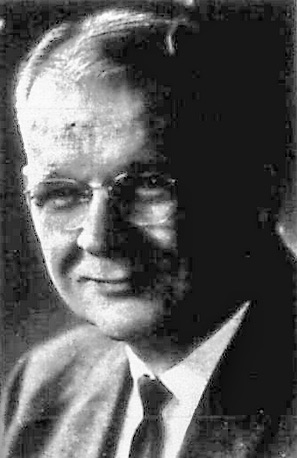
When Benjamin Shambaugh unexpectedly died (April 7, 1940), leaving his SHSI Superintendent position open, another highly-qualified historian was at the ready to pick up the work. Throughout his thirty-eight years (1930-1968) – serving as a history professor at the University, William (Bill) J. Petersen (above left) had worked directly with Shambaugh. So, in 1947, after volunteering 17 years as a research associate, Petersen was appointed SHSI Superintendent. Under Bill’s leadership, SHSI membership grew from 1,100 members (1947) to nearly 11,000 in 1972, and he not only convinced state legislators to fund a new building to house the state’s growing historic collection, but he also raised a healthy portion of the nearly $400,000 needed as well.
The result of Petersen’s efforts was the SHSI Centennial Building(1959-2025), which in September 1959 became the seventh Iowa City home for the Society. The photo (above right) was published in July 1959, two months before it was occupied. The three-level structure (26,408 square feet), located on the corner of Gilbert Street and Iowa Avenue in Iowa City was built at a cost of $385,000.
To review, here’s a fairly complete timeline for SHSI – from its inception in 1857 through to today…
1857 – SHSI incorporates (February 7, 1857) as an independent organization with state funding and support, appoints its first President (Gov. J.W. Grimes), and opens its first office in Old Capitol on the SUI campus.1862 – SHSI relocates from Old Capitol to SUI’s Mechanics Academy.1863 – SHSI publishes the first edition of The Annals of Iowa, a thought-provoking history journal which explored countless stories in Iowa’s past. Annals was faithfully published on a quarterly basis through 2024. You can access past issues 1863-2024 here.1864 – SUI Professor and Iowa historian – Thomas S. Parvin – becomes SHSI Secretary/Curator and serves as a prolific editor for the The Annals of Iowa. Parvin came to Iowa Territory with Gov. Robert Lucas in 1838 and was the Territory’s first librarian, securing many important volumes for both the Territorial and University libraries housed in the capitol building in Iowa City.1866 – SHSI relocates from Mechanics Academy to SUI’s North Hall.1868 – SHSI relocates from North Hall to the Old Stone Church near the corner of Burlington & Clinton Streets. It’s at this point (1867/1868) when the Society dropped its close-knit affiliation with SUI, and actually re-organized under a newly-written constitution and by-laws. This new arrangement lasted only until 1872 (see below), but years later (1974), as the state was re-shuffling legal agreements between Des Moines and Iowa City, this 1867/1868 constitution caused some serious legal delays.1872 – SHSI is reorganized by Iowa’s Fourteenth General Assembly, making it a full-fledged state organization. (1872 Iowa Acts, chapter 109, HF 418–State Historical Society Act)1882 – SHSI relocates from the Old Stone Church to the newly-constructed Maresh & Holubar retail buildings located at 212 & 214 E. Washington Street.1892 – SHSI opens a new Historical Department in Des Moines, with offices in the Iowa State Capitol Building. Soon a small museum opens, followed by a library, a newspaper and census department, and the State Archives.1896 – Benjamin F. Shambaugh – sometimes known as the cornerstone of the State Historical Society – joins the teaching staff at SUI and becomes actively involved with SHSI activities around Iowa City and the State of Iowa.1901 – Knowing that the original SHSI charter stated clearly that the Society was to be closely associated with the state’s university, Benjamin F. Shambaugh arranges with SUI for SHSI to relocate from the Maresh-Holubar building on Washington Street to the University’s brand-new Hall of Liberal Arts – today’s Schaeffer Hall. This cozy relationship between SHSI, the University of Iowa, and Schaeffer Hall lasted for 58 years (1901-1958)!1903 – With the encouragement of Benjamin F. Shambaugh, SHSI publishes The Iowa Journal of History and Politics: a quarterly journal that will continue publication until October 1948.1907 – SHSI celebrates it’s 50th anniversary. The newly-appointed Superintendent Benjamin F. Shambaugh publishes his Brief History of The State Historical Society of Iowa 1857-1907.1920 – SHSI begins publication of The Palimpsest – an Iowa history magazine published on a monthly basis from 1920 until 1972, bimonthly from 1973 to 1985, and quarterly until its last issue: Vol. 76 No. 4, Winter 1995. You can access past issues of The Palimpsest 1920-1995 here.1939 – SHSI’s Historical Department in Des Moines reorganizes as the State Department of History & Archives.1940 – At age 69, Benjamin F. Shambaugh suddenly dies on April 7, leaving the role of SHSI Superintendent and Chief Editor open. Dr. John Ely Briggs (1940-1943) and Ethyl E. Martin (1943-1947) filled these positions until William (Bill) J. Petersen was appointed in 1947.1949 – With the encouragement of the new SHSI Superintendent William (Bill) J. Petersen, the Society renames the quarterly publication begun in 1903 and releases the first volume of the Iowa Journal of History: a quarterly journal that will continue publication until April 1961.1955 – After the strong and steady leg-work of SHSI Supervisor William (Bill) J. Petersen, the Iowa Legislature approves a capital improvement bill, which includes a $200,000 appropriation for a proposed Centennial Building in Iowa City, if Petersen and the Society can raise at least another $100,000.1957 – With over $300,000 raised, SHSI advertises for bids to build the Centennial Building on Iowa Avenue – just blocks from the central campus of the University of Iowa in Iowa City.1957 – SHSI celebrates a century of service to Iowa on February 7, 1957. A tribute was printed in the Centennial dinner program: “Iowans have always been a breed apart from other Midwesterners. The first settlers – God-fearing farmers from older parts of the country – gave Iowa a character it has never lost: a Puritan cast manifest in fervor for evangelical religion, temperance, moral reform, and above all, education. In 1847, a year after Iowa came into the Union, a state university was founded; 10 years later, the legislature chartered a state historical society and made an appropriation for its support. In order to ‘rescue from oblivion’ the memory of the early pioneers, the State Historical Society of Iowa was charged with establishing a library, promoting the study of history and publishing information relating to the description and history of Iowa.”
“During the past century,” Superintendent William (Bill) J. Petersen states, “the society has fulfilled its obligations to the people of Iowa in its continuous program. It has fulfilled the purpose – as set out by its creators – the order to rescue from oblivion the memory of the early pioneers.”1959 – By the summer of 1959, the Cedar Rapids Gazette reports…”More than 80,000 books, 30,000 pamphlets, 10,000 bound volumes of newspapers and 3,000 publications of the society will be moved in the next 90 days from Schaeffer Hall to the society’s new building at Iowa City. In all, 30 truckloads will be moved.” In September, SHSI opens the Centennial Building – the Society’s first major research center located at 402 Iowa Avenue in Iowa City.1960 – Dedication for the new Centennial Building – originally set for October 1959 – is finally celebrated on August 31, 1960.1967 – In February, The Palimpsest publishes a special edition volume called Iowa City Through The Years. In it, there are nine short stories written by Benjamin F. Shambaugh – with a summary piece offered by the Superintendent of SHSI – William J. Petersen. Visit 1967 Iowa City – Then And Now where we re-visit the entire volume which offers us a wonderful look at the beginnings of Iowa City (1839) as seen through the eyes of 20th century historians.1974 – The Iowa Legislature authorizes (HF1491) the merger of the Des Moines-based Department of History & Archives with the Iowa City-based State Historical Society of Iowa – with the intent of forming a single State Historical Department. But a problem developed, and as it turned out, the name the state planned to use for the one new organization already belonged to the Iowa City Society when it incorporated independently in 1867/1868. The legal problems were finally resolved on Feb. 18, 1975, as six members of the State Historical Society in Iowa City join six members of the Department of History & Archives in Des Moines, coming together as a singular State Historical Department.1975 – SHSI publishes the first issue of The Goldfinch: an Iowa history magazine for children – ages 8 to 13. Published until 2000, each issue focused on a theme – such as immigrants, diaries, home and family, and “Iowa’s Kid Heroes” – and included articles, games, photos, and fiction.1977 – According to the Iowa City Press-Citizen, after a lawsuit, the original Iowa City-based historical society deeds the Centennial Building to the State of Iowa “with the proviso that if the Iowa City facility closes, the old society takes over the building and its contents.”1986 – As part of a comprehensive statewide reorganization, the State Historical Department is dissolved, and the two original divisions (Iowa City & Des Moines) merge into the State Historical Society of Iowa, under the Department of Cultural Affairs (DCA). (1986 Iowa Acts, chapter 1245, SF 2175–State Government Reorganization Act)1987 – The new, modern SHSI Museum and Library located near the State Capitol at 600 E Locust Street – built at a cost of $25 million – opens in Des Moines, significantly expanding the Society’s presence in the capital city.
With the opening of the new Museum and Library in Des Moines, Gov. Terry Branstad announces that he will seek minimal funding for the Iowa City library, with plans to cut its staffing from eight to three. David Crosson, Director of the State Historical Department, counters Branstad, stating that unless the General Assembly cuts appropriations – which it had never done before – those staff reductions will never happen. It was during this crisis that the Iowa City staff began to worry that things were going to start changing and that the Centennial Building might be closing. Crosson, at the time, tried re-assuring everyone, stating firmly that the Iowa City facility would always stay open.1996 – SHSI publishes the newly-named Iowa Heritage Illustrated: a quarterly historical magazine edited by Iowa City’s Ginalie Swaim. Replacing the popular Palimpsest magazine, the last issue of IHI was Vol. 93 No. 2, Summer 2014.2000 – Construction and remodeling work close the SHSI Centennial Building in Iowa City for six weeks – July (above left), but by September (above right), Floyd Pearce of Cumberland, Iowa is compiling material under improved, brighter lighting. (CR Gazette archives)2015 – Long-time Iowa City SHSI staffer & Special Collections coordinator Mary Bennett (far right) talks about various points on an old map of Iowa during a University of Iowa history class at the SHSI Centennial Building in Iowa City. (CR Gazette archives)2023 – More administrative changes occur as the Department of Cultural Affairs (DCA) dissolves and the State Historical Museum and Library and the Archives Bureaus of SHSI become a part of the Department of Administrative Services, while the State Historic Preservation Office becomes a part of the Economic Development Authority. (SF 514)2025 – In June, the SHSI Board in Des Moines suddenly announces that 1) the Centennial Building in Iowa City will close at the end of the month, 2) all remaining Iowa City staff will been released, and 3) only a portion of the priceless Iowa City collection will be moved to Des Moines, with the remainder being parceled out to other collections or discarded in some manner.
Fortunately, ensuing lawsuits have prevented some of these shocking decisions from happening immediately, although the small remaining staff has been released, and the building has been closed to the public effective December 31.
Several legal challenges continue, with a district court judge citing state law, granting a temporary injunction in October to prevent the removal of any more materials from the Iowa City building to Des Moines. You can keep abreast on this battle and join the fight by reading more here and by visiting the SAVE IOWA HISTORY website.
In closing, allow me, your humble author, to add my personal thoughts…
January 28, 1857 – The Sixth General Assembly of Iowa, meeting in Iowa City establishes annual provision for a State Historical Society, charging it with the assignment of collecting and preserving Iowa’s history, formalizing its creation “in connection with, and under the auspices of the State University of Iowa”.
February 7, 1857 – After receiving a vote of confidence and a guarantee of annual funding from the Sixth General Assembly of Iowa, the State Historical Society of Iowa (SHSI) is birthed in Iowa City.
January 1, 1863 – The State Historical Society of Iowa (SHSI) publishes the first edition of The Annals of Iowa – a thought-provoking history journal which explored countless stories in Iowa’s past. Annals was faithfully published on a quarterly basis through 2024.
September 9, 1882 – The Iowa City Daily Republican announces that the State Historical Society (SHSI) will be moving into a “large hall” in the newly-built Maresh & Holubar building located at 212 & 214 E. Washington Street.
February 7, 1907 – The State Historical Society of Iowa (SHSI) celebrates it’s 50th anniversary and the newly-appointed Superintendent Benjamin F. Shambaugh publishes his Brief History of The State Historical Society of Iowa 1857-1907.
July 1, 1920 – The State Historical Society of Iowa (SHSI) publishes the first edition of The Palimpsest – a monthly magazine focusing on interesting stories within Iowa’s past. Faithfully published on a monthly basis until 1972, The Palimpsest went bimonthly from 1973 to 1985, and quarterly until its last issue: Winter 1995.
February 7, 1957 – The State Historical Society of Iowa (SHSI) celebrates 100 years of service to Iowa and Superintendent William (Bill) J. Petersen states, “During the past centurythe society has fulfilled its obligations to the people of Iowa in its continuous program. It has fulfilled the purpose – as set out by its creators – the order to rescue from oblivion the memory of the early pioneers.”
August 31, 1960 – The State Historical Society of Iowa dedicates the Centennial Building on Iowa Avenue in Iowa City.
February 1, 1967 – The Palimpsest publishes a special edition volume called Iowa City Through The Years. In it, there are nine short stories written by Benjamin F. Shambaugh – with a summary piece offered by the Superintendent of SHSI – William J. Petersen.
Kudos to the amazing resources below for the many quotes, photographs, etc. used on this page.