
On an earlier post, we present the history of the Iowa City Airport’s Administration & Terminal Building. Designed by Iowa City’s famed architect – Henry L Fisk – the terminal opened in 1953.


On this page, we offer an article written by our good friend Richard (Dick) Hakes for the Iowa City Press-Citizen. It appeared on November 19, 2026 and celebrated the fact that our Iowa City Airport Administration & Terminal Building (see above) has now become the 96th iconic building in Johnson County, Iowa to be added to the National Register of Historic Places (NRHP)…
Drive east from the interstate on Highway 1 in Iowa City and you might notice an open expanse of runway-laced flatland to the right with the occasional small plane taking off.
“There’s a nice small airport,” one might think.
Not so small. The Iowa City Municipal Airport is much busier than the public may realize and has an enthralling historic past as a national hub for early air traffic.
And now, a new honor.
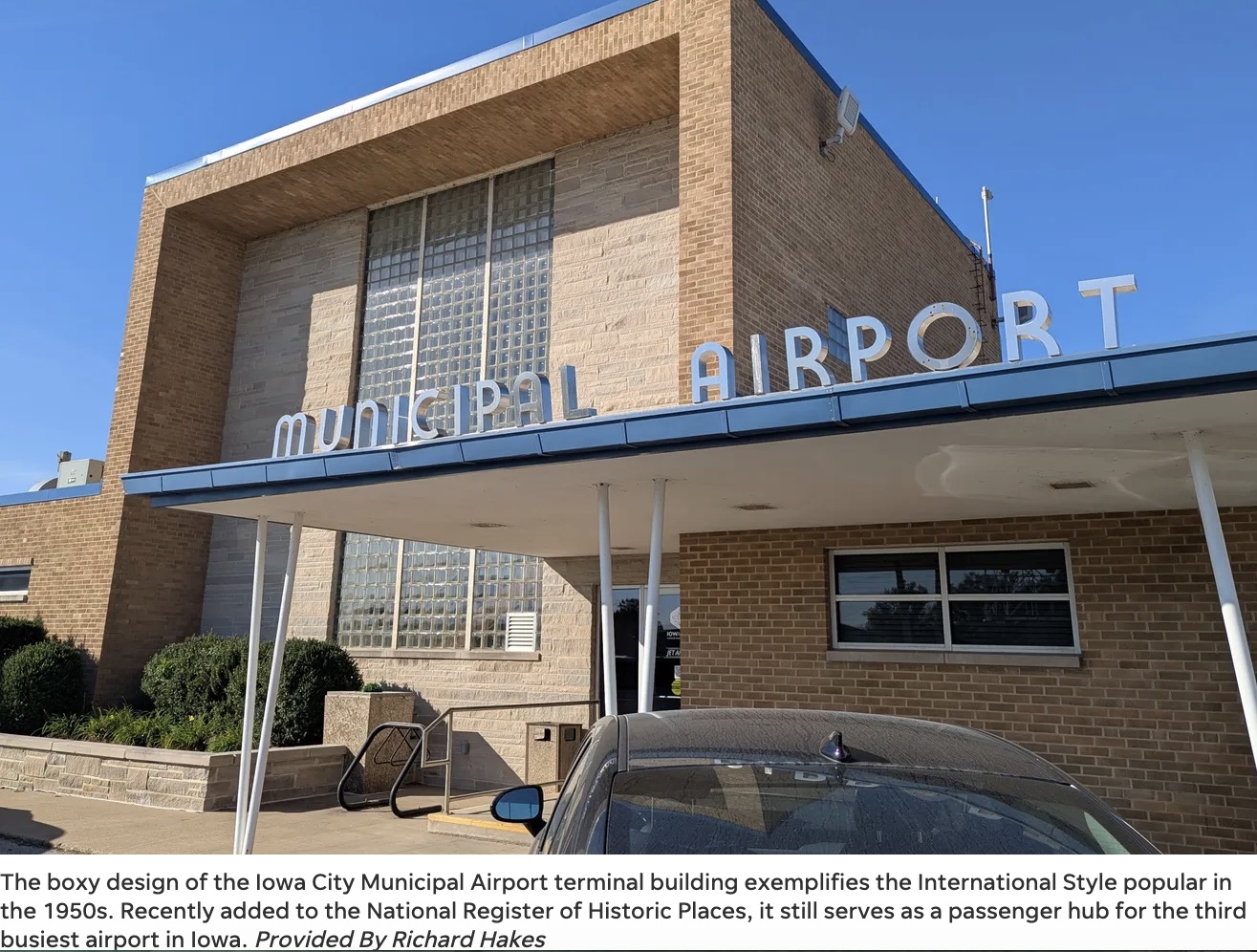
The airport’s unique 1950s-era terminal building was recently named to the National Register of Historic Places (NRHP).
“This airport is very historic, and it amazes me how little people know about it,” said Marty Boller, a local historian and promoter of the airport terminal’s national recognition. His website at www.ouriowaheritage.com is packed with details and photos about the airport’s prominent past, not to mention the other 95 historic sites in Johnson County.
Boller is a past board member of the Johnson County Historical Society, which supported the local Friends of Historic Preservation (FHP) in its lengthy application to recognize the terminal.
Iowa City Airport terminal’s 1950s style
The airport terminal’s boxy appearance and crisp and angular lines might be considered an unusual choice for National Register status, considering the usual ornamentation, pillars or Victorian looks of many others.
The International Style was a modernist architectural movement popular from the 1920s through the 1970s and influenced the terminal’s design by local architect Henry Fisk.
When the building was completed in 1953 for a cost of $145,500, there was so much activity that one wing originally included a restaurant that could seat 30 people. United Airlines offices were located in the other wing.
Boller said from the end of World War II until 1959, when United left, Iowa City was one of the state’s busiest airports for passenger traffic.
Today, the exterior of the terminal remains remarkably intact, with its sunlit staircase to the second floor located just behind the huge glass-block wall that dominates the main entrance. The design has been referred to as “a rare surviving example of mid-20th-century American aviation architecture.”
Boller said the architect’s drawings labeled the second level as a dance floor, with the idea it could be used for weddings, meetings or other events, essentially a community room.
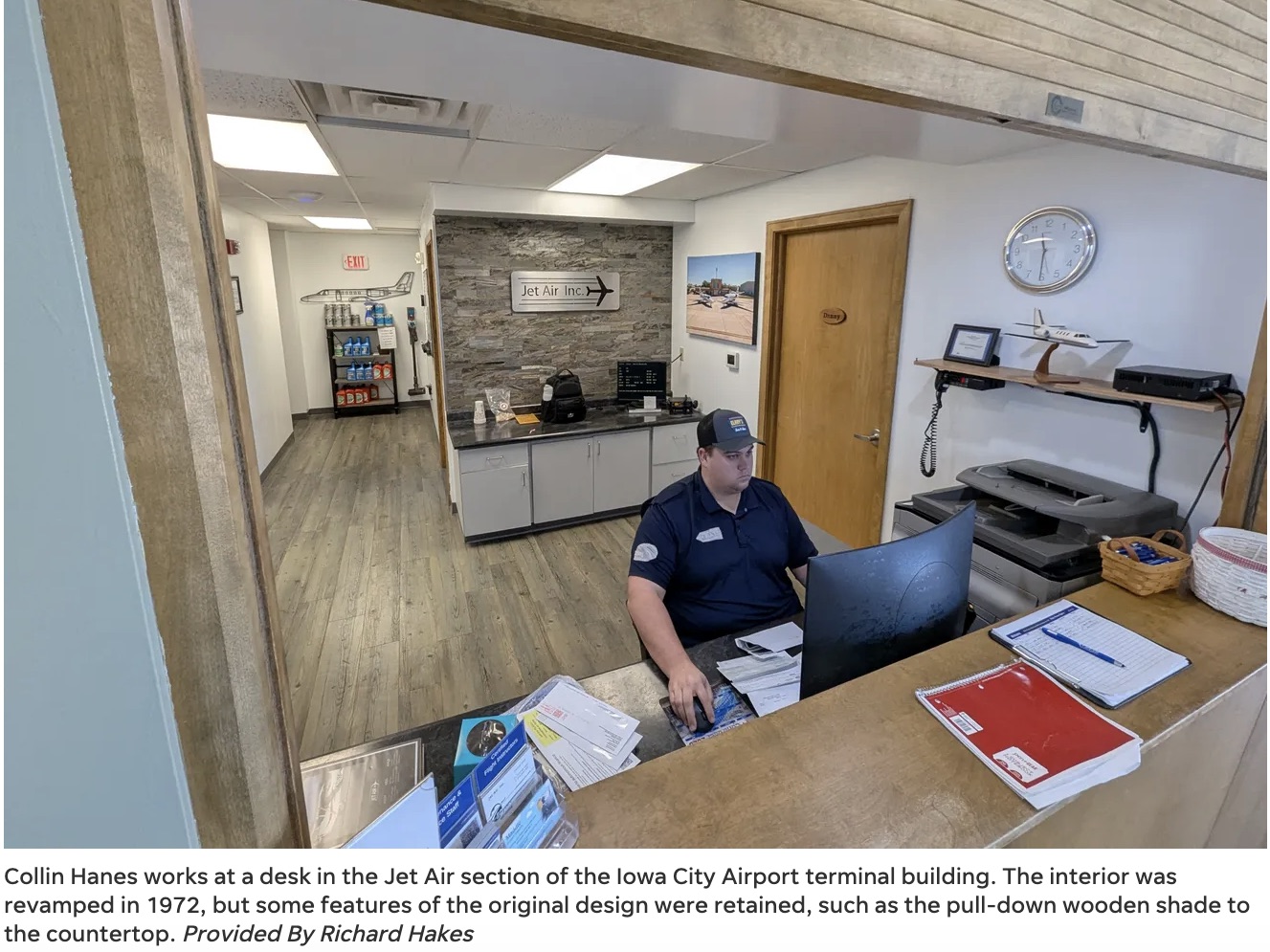
Though the interior received a major renovation in 2007, Boller said architects largely preserved its original look. That included the historic spatial arrangement of rooms and hallways, as well as the huge windows on both floors that allow waiting passengers to observe the planes, taxiways and runways.

“I love the open glass and the open feel on both the first and second floors,” he said. “It’s a beautiful view of an operating airport.”
That was echoed by David Woodruff, president of the local Friends of Historic Preservation.
“It is a box,” Woodruff said. “But as you move through the building, the building moves. It’s in motion, even when it looks square. It’s a living piece of history.”
Iowa City Airport was a regional hub
When the Iowa City airport opened in 1918, it was one of the nation’s first airstrips west of the Mississippi River. Many of the early pioneers of flight landed in Iowa City – including Wiley Post, Jack Knight, Will Rogers and Charles Lindbergh.
Transcontinental airmail service began that same year and mail-hauling biplanes used Iowa City as their primary stop.
Jeff Slothower, another aviation historian, grew up on a farm west of town his father purchased from Irving Marshall, one of the original airmail pilots. He said he learned a lot talking with Marshall, especially how weather was the big danger for the early mail pilots.
“They were open cockpit biplanes, with the bag of mail in the second, unused cockpit,” Slothower said. “The Iowa City airfield was lit at night by burning oil barrels. I don’t know if it’s true, but Irving Marshall told me that our farm was sometimes Plan B in bad weather. Over 100 feet higher than the airfield, it might be just clear enough for a landing in the fog.”

Slothower said Boeing Air Transport began passenger service in Iowa City in 1927, before merging with National Air Transport, Varney Air Lines and Pacific Air Transport to become United Airlines in 1931. During the growth boom after World War II, United made Iowa City one of its primary Midwestern stops with daily flights to and from Chicago and Omaha.
“It was the most important airport in Iowa during the first half of the 20th century,” Boller said.
He said that in the late 1950s, what he called “a short-sighted city council” in Iowa City failed to approve funding to expand the airport’s facilities for United, so the airline ended up in Cedar Rapids. When United left, Ozark Airlines took over, but struggled to make a profit and air passenger service in Iowa City ended in 1972.
Private air traffic continued after commercial passenger service ended and has grown since.
Iowa City’s airport is the third busiest in Iowa
The Iowa City airport, in 2026, is the third-busiest in the state, with 30,000 runway uses each year, according to Woodruff. Only Cedar Rapids and Des Moines have more traffic.
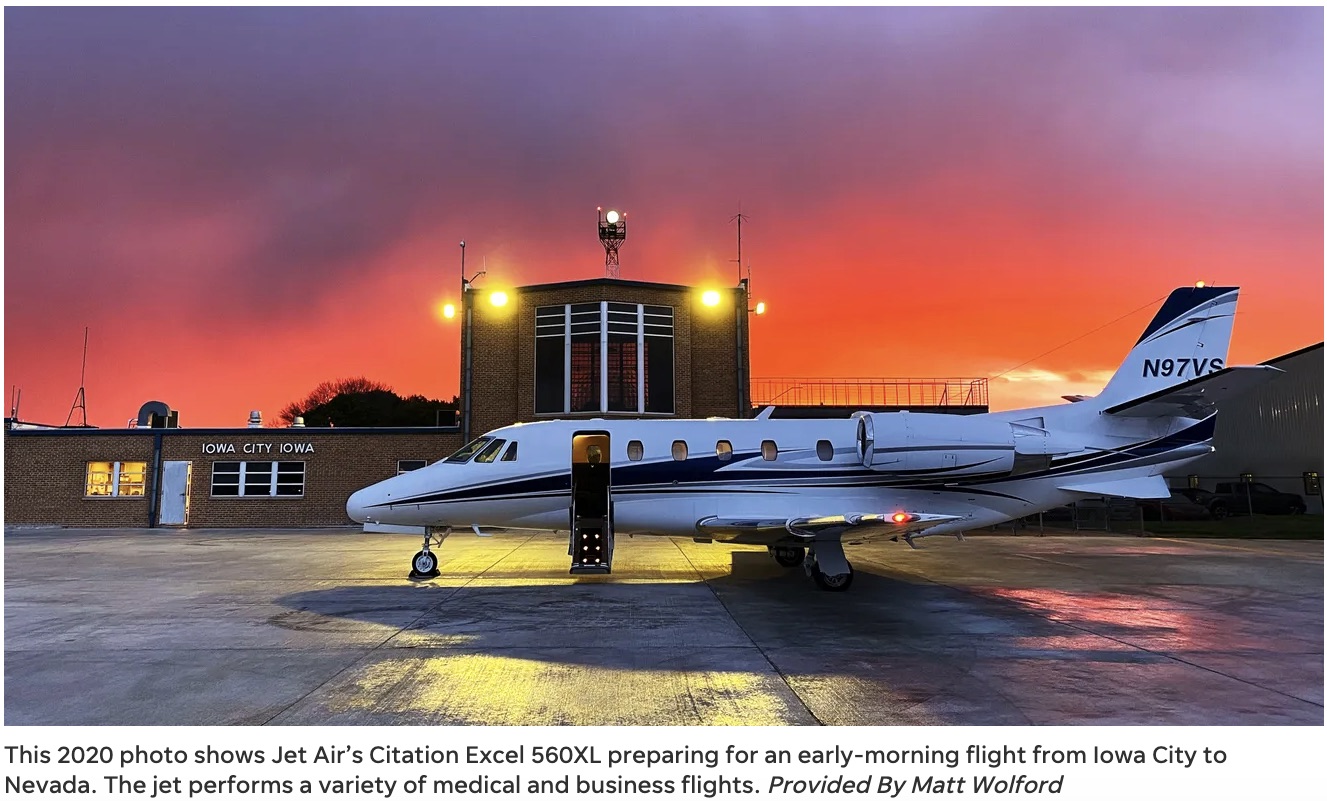
Ninety private aircraft are housed in 15 hangars in Iowa City. Jet Air operates a charter service and serves as the airport’s fixed-base operator. The company has a total of six full-service fixed-base operations within 100 miles of Iowa City. It owns, operates or manages a total of 20 turbine aircraft, primarily Cessna Citation and Beechcraft King Air models, in addition to a large fleet of training aircraft. Most of its planes can hold up to nine passengers, plus two pilots.
Iowa City Airport manager Michael Tharp says the airport can handle bigger jets, usually of the 30-passenger variety. Jet Air transports emergency patients to and from University of Iowa Health Care facilities, plus the company flies organs for transplant operations and serves several large area businesses. The university’s Operator Performance Laboratory is also stationed at the airport.

“This airport is a vital piece of the economic vitality of Iowa City and Johnson County,” Tharp said. That impact has been estimated to be $24 million, he added.
Boller credited Friends of Historic Preservation student intern Keiran Reynolds’ research and Paula Mohr’s work on the application with helping secure the terminal’s National Register designation.
Terminal architect Fisk is known for many other buildings and homes in the Iowa City area, including the original Iowa City Press-Citizen building and the Scattergood Friends School in West Branch.
Richard Hakes is a longtime feature columnist for the Iowa City Press-Citizen.
Click here to return to Preserving Iowa City’s Rich Airport Heritage – Vol. 1.
Click here to visit the followup page – Preserving Iowa City’s Rich Airport Heritage – Vol. 2.
Kudos to the amazing resources below for the many quotes, photographs, etc. used on this page.
Click here to go on to the next section…
Click here for a complete INDEX of Our Iowa Heritage stories…