


On another page, we offer you the amazing story of Iowa City’s own Sherlock Holmes. His name is Deputy Marshal Lewis (L.A.) Clearman (1847-1934). Above left, you see him pictured as an adult, and above center, as he appeared around 1865 when he returned from serving in the Union Army. Records show that Clearman enlisted – December 1863 – when he had just turned 16, and was assigned to Johnson County’s Company H of the 2nd Iowa Cavalry Regiment, which participated in major battles throughout Tennessee. Records also indicate that he was wounded in battle in Memphis, but continued with his company until April 1865, when the war ended.
Now, allow me to introduce you to Lewis A. Clearman’s oldest son – Frederick William Clearman (1871-1968). Sadly, we’ve only recovered a couple of pictures of Fred (as he was known), and the one seen above (right) is Fred with his father when they were both much older.
According to family records, the William & Semantha Clearman family moved from Ohio by covered wagon to Iowa – settling on farmland in Union Township of Johnson County – in 1855/1856, when Lewis A. Clearman was about 8 or 9 years old. It’s our belief that Lewis moved into Iowa City soon after his marriage to Isabelle Harriett Lloyd (1870), and as we said earlier, Frederick William Clearman was the couple’s firstborn – entering into the world on September 1, 1871. Which brings us now to our father and son story that takes place from September 1886 to February 1887, when Lewis was 38 years old and young Fred had just turned 15…


The rite of passage is an age-old ritual or ceremony signifying an event in a person’s life -indicating a new and different status, usually in reference to adolescence. Rite of passage rituals are prevalent across different cultures and societies, marking significant moments such as birth, reaching puberty, marriage, or even death. It’s our belief that the story we are about to share is an example of a rite of passage – in this case, for 15-year-old Frederick (Fred) William Clearman.

In May 2025, as we were writing up the story of Deputy Marshal Lewis A. Clearman, his great, great grandson Paul Valdick, who had provided the valuable material that got us started, also provided us with a typed-out version of an old logbook (journal) that Valdick had in his family collection. The title of the log: Frederick W. Clearman’s Trip Down The Mississippi River in 1886. Below left, you see the title page…


Sadly, there is only one photograph (see below) from this 138-day, 1200+ mile father-son excursion. Most of the other pics you see on this page (except a handful of family photographs taken much later) are stock photographs inserted to help you envision the Clearman journey.


Yet, we believe if one asked Papa Clearman the reason for the trip, we’d find a completely different set of answers. First of all, as we mentioned, this was a father-son rite of passage excursion – a 138-day, 1,200+ mile journey that took a 15-year old city boy into the wilds of the Mississippi River Valley, offering him a “grow up before you grow old” opportunity. We know, with fairly good certainty, that the Clearman’s didn’t need to raise money back in Iowa City, especially in such a manner as this! At the time, Louis Clearman was working – at least part-time – with the City of Iowa City as a police officer, and his family still owned and operated a fairly successful farm in Johnson County. We also know, from Clearman’s records, that Lewis was an excellent outdoorsman who had no problem living off the land and finding odd jobs in order to survive. We also know that this trek down the Mississippi River to Tennessee and Arkansas brought Lewis (and his son) face-to-face with his past Civil War experiences, including Memphis – the city where, it’s believed, he was wounded 22 years earlier (1864). And finally, we find it interesting that Papa Clearman was the one who suggested Fred keep a log throughout the trip. Sounds like a very wise father making sure his son keep these memories for a lifetime – which, in this case, Fred did!
Fred’s preface continues (below) by explaining the three boats, the traveling party (Lewis Clearman, Fred Clearman, family friend – Henry Hawley, and Fred’s dog – Jack) used on the long journey. FYI – a fourth boat – a dugout canoe – was added when the team arrived at Realfoot Lake in Arkansas.


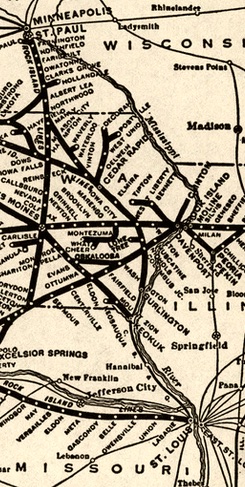
Throughout the 138-day, 1200+ mile journey, we will provide maps – like the ones above – so you might visualize the cities and locations Fred mentions along the way. Keep in mind, the Clearman roadway from Iowa City to St. Helens (Helena), Arkansas in 1886 was 1) The Iowa River, and 2) The Mississippi River – roughly a distance of 600 miles using today’s highway mileage.


Below – When Fred was 94 years old, he recalls another story from the time the team was in Burlington…


Pope’s Canal is also referred to as New Madrid Canal, and was dug in the Mississippi River area during the Civil War by Union forces under the command of General John Pope. It was constructed in 1862 to bypass the Confederate stronghold located on Island Number 10, and allowed Union gunboats and transports to reach New Madrid, Missouri (see map below left – Red #4 and below right), and ultimately, to capture the island. Obviously, Papa Clearman, who joined the Union Forces in December 1863, knew of these war stories, and this re-visiting of this Civil War battlefield – twenty years later – must have brought him a mix of emotions.


Below, Fred Clearman adds this Island Number 10 remembrance to his log when he was 94 years old…


On November 30, the team finally leaves Reelfoot, heading toward Cotton Wood Point, Missouri (below right). And on the following day – which Fred decides to call November 31 – the team ends up in Hickman, Arkansas (see map below left – Red #6 and below right).


Today, the “Big Mile” refers to a section of the St. Francis River known as the St. Francis Sunken Lands Water Trail, and if one draws a straight line from Hickman Landing to the north end of the St. Francis “Big Mile”, it is indeed around 65 miles, as Fred mentions. But, here’s the rub. Since we know that the team took their boats with them, we don’t find any easily-accessed waterway between these two points. Regardless, Fred’s story picks up in early December, somewhere along the St. Francis River – which runs from the Missouri border in the north to its mouth near Helena in east-central Arkansas. It’s somewhere along this long and winding St. Francis River valley where the Clearman’s meet the Blake family living on a large plantation located on the bank of a bayou. Here, the team stays for about six weeks – through Christmas and into mid-January – earning money by picking cotton for the Blakes.


One editorial note here: throughout Fred’s journal, there are four short references to African-Americans that Fred encounters along the way. Obviously, Clearman’s language concerning these individuals was written during the height of the Jim Crow era, and, in our view, is not appropriate for today’s publication. Nor, in our opinion, do these short entries actually add to the overall story’s content. Suffice to say that in each of the four removed references, Fred – a northerner from Iowa, and whose father fought for the Union Army during the Civil War – is noting the very harsh treatment that blacks are receiving from white Southerners. One example, is that on the Blake farm, there are a number of former slaves – now free – who are “contractors” with Mr. Blake. Sadly, Fred comments on how poorly these men and women of color are still being treated by their former slave-owner.


We’re assuming that Papa & Fred’s traveling partner – Henry Hawley – either returned to Iowa City on his own, or possibly joined up with the Clearmans while they were living with the Blake family on the St. Francis River.



138 Days – 1,200+ Miles – Two Tired Clearmans – One Unforgettable Journey!


Deputy Marshall Lewis A. Clearman (1847-1934) returned to Iowa City and made a name for himself becoming the Sherlock Holmes of eastern Iowa and beyond. You can read his full story here…
As for Frederick W. (Fred) Clearman (1871-1968), he returned to Iowa City, married Annie Donaldson on November 16, 1899, and soon after the turn-of-the-century, moved westward to Miles City, Montana, where Fred became a well-respected building contractor. Below, The Miles City Independent reports on Fred’s work in 1910, and as you can see, his father – L.A. Clearman, left Iowa City (1906) to join his son there, teaming up to form Clearman & Company…


Here is some additional biographical information we found on Fred & Annie Clearman, who moved to Longview, Washington in 1923, and then Seattle in 1939…


Above left: Papa Lewis A. Clearman (1847-1934) died, at age 87, on November 7, 1934. Read more here.
Above right: Fred & Annie Clearman are pictured at their home in Seattle with Fred’s brother – Lewis C.W. & Cora Clearman of Iowa City (far left) and his sister – Isabelle & Cash Cross (middle) of Union Gap, Washington.
Annie Donaldson Clearman (1879-1966) passed away on February 4, 1966, at age 86, and Frederick W. Clearman (1871-1968) died on December 23, 1968, at age 97. Both are buried in Washington Memorial Park in Seattle.


Thank you, Fred, for leaving us this very entertaining journal that takes us back to an age long gone. It seems the life lessons you learned on this Mississippi River adventure remained with you for the rest of your days. Here’s to Papa Lewis & Fred Clearman, Henry Hawley, and Jack the Dog! Godspeed!

Kudos to the amazing resources below for the many quotes, photographs, etc. used on this page.
L.A. Clearman Quits Office, Iowa City Police Department Press Release, April 8, circa 1904, from the family records of Clearman’s gg grandson – Paul Valdick of Grants Pass Oregon.
G.L. Thomas, Photographer-Muscatine, The Muscatine Journal, September 16, 1892, p 1
Then and Now: Pope’s Canal To New Madrid, Craig Swain, Monitor.com, March 27, 2012
Island No. 10, David J. Gerleman, EssentialCivilWarCurriculum.com
Clearman & Company Certificate, Miles City Independent, August 15, 1913, p 4
Family Dinner For 55th Anniversary, Tacoma News Tribune, November 24, 1954, p 14
Lewis Abrams Clearman, Find-A-Grave
Isabelle Harriett Lloyd Clearman, Find-A-Grave
Mrs. F. Clearman, Former Resident, Dies In Seattle, February 7, 1966, p 2
Annie Donaldson Clearman, Find-A-Grave
Fred Clearman Dies At Age 97, Longview Daily News, December 24, 1968, p 5
Frederick William Clearman, Family Search
Frederick William Clearman, Find-A-Grave
Click here to go on to the next section…
Click here for a complete INDEX of Our Iowa Heritage stories…