Recalling pleasant things and taking the time to dwell on them.
Meet Iowa City’s Mayors – 1853 To Today – Volume I.
This is the first page in a series of six – covering the long history (1853 to today) of the mayors of Iowa City. You might want to return to the introductory page to read all of the preliminary information before proceeding here with Volume I…
At the time of this writing (2025), Iowa City – over our 172-year-history as an incorporated city – has had 65 different mayors serving 73 separate terms. Our three main resources for these webpages are 1) Irving Weber’s articles from March 1985 (above left), which at that time, covered 56 different mayors, 2) the listing of city mayors found in the records of the Iowa City Library (above right top), and 3) a list of mayors (1853-1882) taken from The History of Johnson County -1882 (above right bottom).
So here, for your reading enjoyment, are some updated facts and figures on each of our 65 illustrious city leaders – beginning, of course, on this page one…
Iowa City Mayor #1 – When Iowa City was first incorporated as a city, our first mayor was Jacob P. DeForest (1791-1854) – sworn in on April 6, 1853…
According to his records in Find-A-Grave, Jacob Peter DeForest was born on December 2, 1791 in Rensselaer County, New York and served in the War of 1812 as a Major.Records indicate that J.P. DeForest and his family moved to Johnson County in the early 1840’s, and from what we find in this March 8, 1845 edition of The Iowa Capital Reporter (below), DeForest (now a Colonel) must have been an eloquent speaker – offering the audience gathered in the Capitol building for the February 22nd George Washington birthday celebration, an “able, eloquent and truly patriotic address”.
DeForest – while involved in local politics – might have been a farmer, or minimally a land investor, since in the March 30, 1853 Iowa (City) Republican (below), we find that he – along with many other Iowa City pioneers – were involved in the formation of the first Johnson County Agricultural Society, just days before being named our city’s first mayor.Below are Mayor’s Proclamations published in July & August 1853 editions of The Iowa Capital Reporter…Records indicate that Col. Jacob Peter (J.P.) DeForest was the son of Peter Jacob DeForest and Ptertie Van Aalsteyn; and the husband of Elizabeth Eliza Eddy. DeForest died on February 18, 1854 (age 62), and is buried in Oakland Cemetery – Block 4, Lot #43 – in Iowa City. Historian, Irving Weber, tells us that DeForest Street is named for our first mayor, and while it is only ten blocks long, running from Marcy on the west to Lower Muscatine Avenue on the east, its one claim to fame is that it’s the location of Mark Twain Elementary School, located at 1355 DeForest Street.Interestingly, one of J.P. DeForest’s sons – Clinton DeForest (1821-1908) has an intriguing history in Johnson County as well. You can read his story here.Iowa City Mayor #2 – The April 5, 1854 edition of The Iowa (City) Republican (below) announces Joseph E. Fales (1829-1887) as Iowa City’s newly-elected mayor, who served for one year – 1854 to 1855. At age 25, Fales is the youngest person ever elected mayor of Iowa City!Joseph E. Fales was born at Bowentown, N. J. in 1829, came with his parents to Dubuque at the age of six (1935), relocating to Iowa City in 1848. In 1860, Fales – a commissioned merchant – was appointed to the position of postmaster by President Buchanan and he discharged his duties with credit to himself and satisfaction of his patrons. He was married on July 5, 1859, to Mrs. Betty Crummey (Crummey House) and became residents of Clarinda, Iowa in 1872. Fales died in 1887 and is buried in the Clarinda Cemetery (see below).
Iowa City Mayor #3 – According to the April 4, 1855 edition of The Iowa Capital Reporter, George D. Woodin (1827-1903) of The Know Nothing Party was elected mayor. As you can tell from the article (below left) the Democratic-leaning Capital Reporter didn’t think much of the Know-Nothings. The American Party was referred to as the Know Nothings and was an anti-Catholic political movement in the United States in the 1850s. Members of the movement were required to say “I know nothing” whenever they were asked about its specifics by outsiders, providing the group with its colloquial name. The forward-looking young man (unknown) pictured below (right) was used in literature in the 1850’s to promote the American Party. You can read much more about George D. Woodin here.
Iowa City Mayor #4 – John M. Carleton was elected mayor in 1856. Below is an article from the June 30, 1856 edition of The Iowa City Republicanthat points to the building of our first Ward Schools. No further information on Carlton has been located at this time.
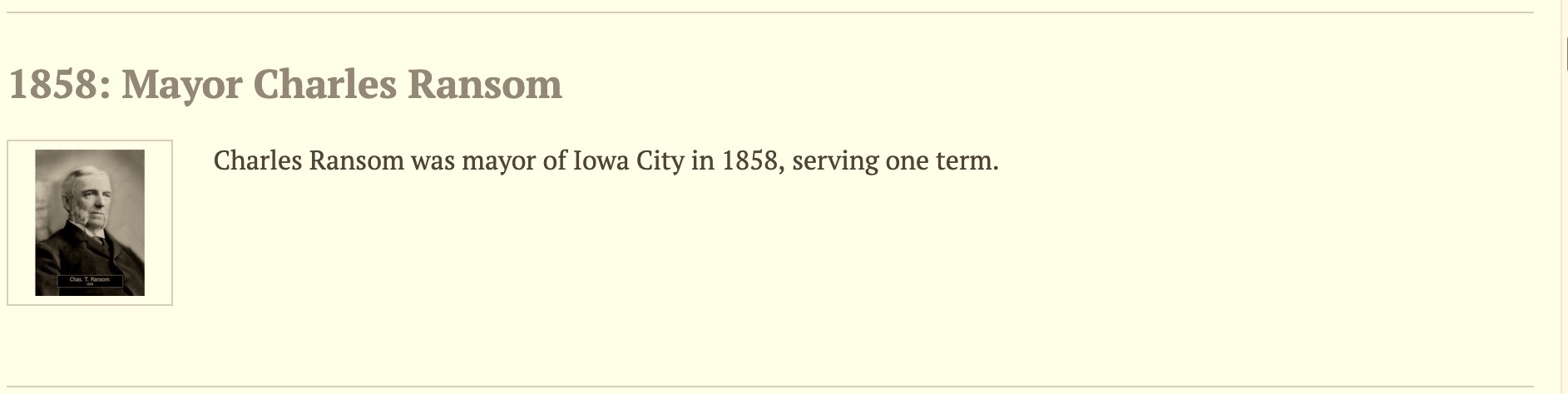
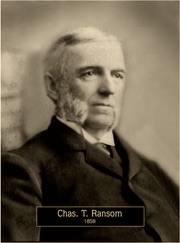
Iowa City Mayor #5 – Morgan Reno, Sr., (1816-1869) who was prominent in early Iowa history, was elected mayor of Iowa City, its fifth, in 1857 – the year the capitol of the state was moved to Des Moines. Records show that Renocame to lowa City in 1839, the year the site for the new capitol and the city of Iowa City were selected. He engaged in the banking business with J.C. Culbertson (see below), was appointed Treasurer of the Territory of Iowa, and later, after Iowa achieved statehood, was elected Treasurer of the State, on the Democratic ticket.Reno Street, in Iowa City is named in remembrance of both Reno, Sr. and his son, Charles M. Reno, who served as mayor in the 1880’s and 90’s.Iowa City Mayor #6– In the July 7, 1858 edition of The State Reporter (below), it’s reported that Mayor Charles T. Ransom (1831-1888) and the City Council were involved with the big July 4th city-wide celebration of 1858. Ransom lived at 812 College Street and in a 1883 publication was listed as a local attorney for the Chicago, Rock Island and Pacific Railroad.
Iowa City Mayor #7– The March 23, 1859 edition of The Weekly State Reporter (below) shows Moses J. Morsman (1812-1898) as the Democratic Party’s nomination for mayor.Records indicate that Morsman was a physician and that he came to Iowa City in 1849, and had an office shared with Col. Trowbridge’s drug store. Later, Morsman was a director on the Board of the Davenport & Iowa City Railroad Co. (1850-1853), Vice President on the Board of Trustees for the State University of Iowa (1855-1858), and a Johnson County commissioner in 1870.Morsman also was part owner ofWelton & Morsman Boots & Shoes in Iowa City.
Iowa City Mayor #8 – Iowa City mayor, Peter A. Dey (1825-1911) had an illustrious career as a railroad construction engineer, and played an important role in building the Mississippi and Missouri Railroad into Iowa City. His engineering career started on the Erie Canal, and then transitioned to railroad construction – first, with the Michigan Southern from Detroit to Chicago, and then, with the Rock Island across Illinois and Iowa, and the Union Pacific from Omaha to Utah. When the railroad reached Iowa City in 1855, Dey decided Iowa City was to be his home. His sweetheart, Catherine Thompson of Buffalo, N.Y., was apprehensive about moving to the frontier, but Dey convinced her otherwise, drawing up plans for the mansion he would build her on a bluff above the Iowa River. They were married on October 23, 1856, moved into their mansion at 507 N. Clinton Street on September 11, 1857, and made it their home the rest of their lives, raising six children. Dey died in 1911, and the Dey House – located at 507 N. Clinton Street in Iowa City – is still standing today, beautifully maintained by the university, and used for the UI Writers Workshop.
Did you know that Peter Dey served as Board President with SHSI for twelve years prior to his death in 1911?Iowa City Mayor #9 – In the April 10, 1861 edition of The State Press (below), we find that George W. Clark (1821-1885) has been inaugurated as mayor, and that John T. King – an editor from Muscatine – has come over to Iowa City to visit his “old and valued friend.”Mayor George W. Clark, a lawyer by trade, married Nancy Boal Young in Iowa City in 1853. They had at least nine children: George Jr., Winona, J. Lenox, Mary (Molly), Rush, Berry, Anna, Susan and Grace. Clark was commissioned Captain of Company “K”, 22nd Iowa Infantry, on August 14, 1862. Company “K” was composed in large part of immigrants from “Bohemia” — now the western regions of the modern-day Czech Republic –and was known as the “Bohemian Company”. Clark was wounded severely at the Battle of Cedar Creek, Virginia on October 19, 1864, and resigned from the Army on March 13, 1865; he suffered from the effects of his wounds for the rest of his life. Interestingly, his obituary doesn’t mention his one-year term as mayor of Iowa City.
Iowa City Mayor #10 – The April 2, 1862 edition of The State Press (below left) reports that G. H. Collins is the Democratic candidate for mayor, and the June 7, 1862 edition (below right) reports on Collin’s results at a recent Trap Shoot, followed by the article that indicates that Mayor Collins has lost a dark iron gray mare! Sadly, no other information is available on Collins. Iowa City Mayor #11– Elected in 1863, the December 3, 1863 edition of The State Press (below left) shows that Mayor Joel (J.B.) Buttles and the City Council are addressing the on-going problem of swine running “at large” on the streets of Iowa City! Records show that Buttles was a local Judge in Johnson County, but no other information has been found.
Interestingly, it was this problem that caused the State University of Iowa to hire a groundskeeper for University Square.Notice the fencing in this picture (above) taken around 1860. Historical records indicate that during those first few years when Old Capitol housed the University’s only classrooms, one of the primary duties of the custodian was to drive all livestock off the campus. Apparently the responsibility was not an easy one, for in 1862, the University president recommended the following resolution: “That hereafter no horses, cattle or other stock shall be allowed upon the university grounds; and that until otherwise ordered the grounds and buildings of the university shall be under the control of the faculty of the university.” You can read more here.Iowa City Mayor #12– Mayor George W. (G.W.) McCleary (1807-1873) was actively involved in Territorial/State government prior to becoming Iowa City’s mayor in 1864: Speaker of the House (1845-1846), Secretary of State (1850-1856), and Adjutant General (1855-1857).
The July 18, 1866 edition of The Iowa City Republican (below center) indicates that McCleary was also President of the Board of the State Historical Society of Iowa. The January 8, 1868 edition (below left) tells us that McCleary was also involved with Insurance and Real Estate in Johnson County.
(JP-094)Postmarked August 4, 1865, this rare postal cover comes from the Iowa Central Insurance Company in Iowa City when George W. McCleary was both the President of the company and the city’s mayor!McCleary was our city’s first multi-term mayor, serving for five years (1864-1869).Did you know that Mayor George W. McCleary served as a Board Secretary with SHSI?
February 22, 1845 –The Iowa Capital Reporter reports that Col. J.P. DeForest – Iowa City’s first mayor (1853) – was an eloquent speaker, offering the audience gathered in the Capitol building for the February 22nd George Washington birthday celebration, an “able, eloquent and truly patriotic address”.
January 24, 1853 – Fourteen years after our founding, the City of Iowa City is incorporated.
March 30, 1853 – The Iowa Republican announces the first gathering of the Johnson County Agricultural Society which will include our first Iowa City mayor – J.P. DeForest.(2)
April 6, 1853 – Three months after Iowa City was finally incorporated, our first mayor – Jacob P. DeForest – and his city council are installed.
June 30, 1856 – The Iowa City Republican reports that Iowa City’s 4th mayor – John M. Carleton – has approved a public vote on building of our city’s first Ward Schools.
September 11, 1857 – Iowa City businessman and railroad contractor – Peter Dey and his wife Catherine, move into their newly-built home at 507 N. Clinton Street. Today, the Dey House hosts the University of Iowa’s famed Writer Workshop.
December 3, 1863 – The State Press reports that Mayor Joel (J.B.) Buttles and the City Council are addressing the on-going problem of swine running “at large” on the streets of Iowa City!
July 18, 1866 – The Iowa City Republican (above center) indicates that Mayor George W. McCleary was also President of the Board of the State Historical Society of Iowa.
July 8, 1869 – Iowa pioneer, State Treasurer, and Iowa City’s 5th mayor – Morgan Reno – dies, at age 52, in Iowa City.
Kudos to the amazing resources below for the many quotes, photographs, etc. used on this page.