

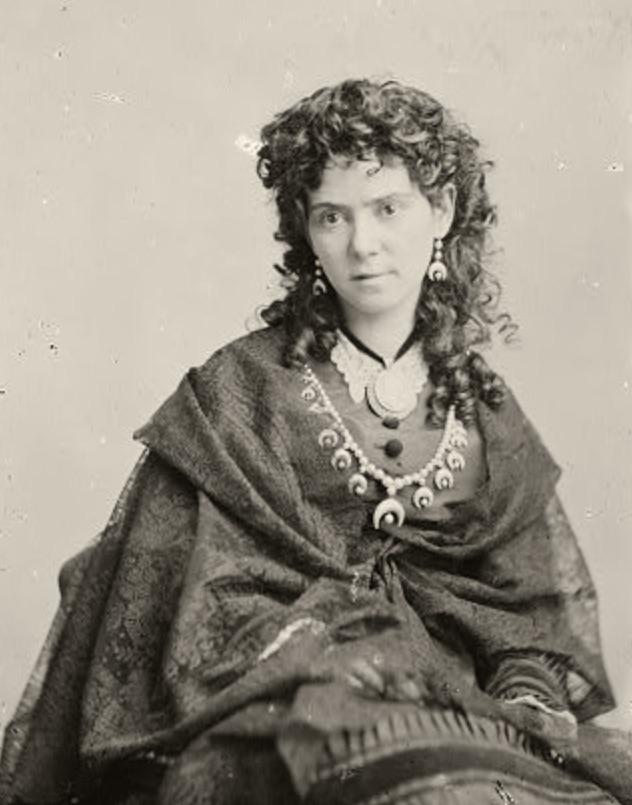
Between 1878 and 1914, Brigadier General Richard L. Hoxie and his wife, the famed sculptor – Vinnie E. Ream, spent their summer months here in Iowa City. Over those 36 years, the Hoxies – well-known in Washington, D.C. as a high-society couple – were content to be their down-to-earth, easy-going selves, welcoming friends and neighbors into their two-story home on South Lucas Street.

Richard Leveridge Hoxie was born on August 7, 1844 in New York City. A tragedy hit the Hoxie family around 1858 when Richard’s mother – Jacqueline B. Hoxie – died as the family was on their way to Pisa, Italy. And then, his father – Joseph Hoxie – died on the return journey when their ship caught fire! Richard, age 14, was soon re-located to Iowa City to live with his extended family: his aunt & uncle – Jane E. (Hoxie) and Thomas M. Banbury, who came to town around 1842 – and his grandmother – Electa Norton Hoxie – who had re-located here with her husband – Ichabod R. Hoxie – in the early 1850’s.

According to family records, Ichabod Hoxie was a local merchant, and his daughter, Jane, and her husband, Thomas M. Banbury (see above), owned one-square block in the southeastern section of town (see map below), with their home located near today’s 310 S. Lucas Street. Upon their deaths, the large property was given over to their only heir – Richard L. Hoxie.


Lavinia (Vinnie) Ellen Ream was born on September 25, 1847 in a simple log cabin in Madison, Wisconsin – the youngest daughter of Robert L. and Lavinia E. Ream. Robert Ream was a surveyor and a Wisconsin Territory official, and the family operated a stage coach stop, one of the first inns in Madison – with guests sleeping on the floor! Growing up as a friend of the Winnebago tribe of Wisconsin, Vinnie was taught to paint and draw by her indigenous neighbors, and as it turned, it was these early childhood experiences that opened Ream’s eyes to a future in the arts.


These two Midwestern kids, who grew up less than 175 miles from each other, didn’t meet until both were in the 30’s, living in Washington, D.C.

The couple was married there on May 28, 1878, but more on that story later. For now, let’s look a bit deeper at…


When the Civil War broke out in the spring of 1861, the 16-year-old Richard Hoxie immediately left his aunt & uncle’s home in Iowa City, enlisting – June 1861 – in the Union Army. According to war records, he was assigned as Private in Company F of the First Iowa Volunteer Infantry Regiment, serving as the company’s bugler. Over the next three years, Hoxie moved up in the ranks, becoming a Corporal in the Iowa First Cavalry before going off to the U.S. Military Academy in July of 1864.


(JP-090) Above is Corporal Richard L. Hoxie’s U.S. Army Re-Enlistment Form, dated December 4, 1863, and signed in Little Rock, Arkansas. After graduating from West Point, Hoxie was commissioned as a Second Lieutenant of Engineers (1868), moving steadily up the ranks before retiring as a Brigadier General in 1908. During his time in the Army, Hoxie served in the U.S. Army Corps of Engineers, and was regarded as an expert on fortifications.


It was during one of his assignments in Washington D.C., when he met the love of his life…


When Vinnie Ream was seven years old (1854), the Ream family moved to Washington, D.C. There, Ream, who had found her love for art through her lessons with the Winnebagos back in Wisconsin, had her first chance to model with clay in the studio of Benjamin Paul Akers. After a few years in Washington, the Ream family moved to Kansas so that Vinnie’s father could take a surveying job, and during this time, Ream attended Christian College, a school for young women in Columbia, Missouri (today’s Columbia College) where she studied art, literature, and music. It’s at this point, we are going to turn the story over to Iowa City historian – Irving B. Weber, who wrote about Vinnie in the July 30, 1988 edition of the Iowa City Press-Citizen…


In 1861, at the beginning of the Civil War, the Ream family packed up again and moved back to Washington, D.C. When her father became ill and was unaber, Vinnie had boundless energy, and at one time, she told her mother, “I feel that I am to have some special work in the world. I don’t know what it is, but I must be ready for it when it comes.”


Vinnie’s life was transformed when, in the fall of 1864, she was invited to sit with President Abraham Lincoln – commissioned to sculpt a bust of his likeness. This five-month assignment was, sadly, cut short on Friday, April 14, 1865…


In Washington, D.C., on one snowy January night in 1871, Vinnie Ream became famous. On that night, her white marble statue of President Abraham Lincoln (below left) was unveiled in the United States Capitol building. She was only 23 years old.


With her Lincoln statue (1871), Ream was the first woman and the youngest sculptor to win a commission from the government for a statue. In 1875, Vinnie was awarded yet another government job – sculpting Admiral David Farragut (above right) for the first U.S. Naval Officer monument, using bronze from the propeller of Farragut’s ship for her work.


As we mentioned earlier – in May 1878, Vinnie Ream married Richard Hoxie, who was a lieutenant in the U.S. Army Corps of Engineers at the time. The couple lived in Washington, D.C., but also had a summer home back in lowa City – the original property we spoke of earlier (today’s 310 S. Lucas Street). The couple, in 1883, had one son, Richard Ream Hoxie, and now, let’s allow Irving Weber to tell us more about their Iowa City home – affectionately known as “Vinita”…


Here’s a portion (below) of that 1973 Johanna Nelson Beers article that Irving Weber mentions above…


In July 1908, the 64-year old Brigadier General Hoxie – after forty-seven years of service in the U.S. Army – decided to retire. Below (left) is an article from the July 22nd edition of the Iowa City Citizen that announces Hoxie’s decision. Interestingly, the article also mentions Vinnie’s latest art project – her statue of Samuel J. Kirkwood. More on that later. On the right (below), is an article (1929) from the Press-Citizen that gives us more insight on Hoxie’s first years of service during the Civil War (1861-1864).


In 1910, The Iowa City Citizen printed an extended article on the 63-year old Vinnie Ream Hoxie. In it, we find a wonderful overview of Vinnie’s life story…

As you can see from the article above, in 1910, Vinnie had been at work for four years crafting one of her masterpieces – the seven-feet-high statue of Iowa’s Civil War governor – Samuel J. Kirkwood (below left).


Commissioned in 1906 by the State of Iowa, Vinnie’s bronze statue of Kirkwood was completed in 1910 and then given, on behalf of the state, to the National Statuary Hall Collection in Washington, D.C. It was unveiled and dedicated in the Hall on November 26, 1913.
Her final work, commissioned in 1912, was the bronze statue of Sequoyah (above right) – the Native American recognized for inventing the written alphabet for the Cherokee language. Sadly, because of her deteriorating health, Vinnie was not able to complete this masterpiece, so after her death (1914), George Zolnay completed the statue, and it was donated (1917) to the National Statuary Hall Collection by the State of Oklahoma.


After an extended illness – see article (above) from The Iowa City Daily Press – Lavinia (Vinnie) E. Ream Hoxie died in Washington, D.C. on November 20, 1914. Vinnie, and her husband – Richard L. Hoxie – who passed at age 85, on April 29, 1930 (see below) are both buried in Arlington National Cemetery, – marked by Vinnie’s large bronze statue of Sappho.


Without a doubt, Richard & Vinnie Ream Hoxie made one big impression on many lives during their thirty-six years of marriage (1878-1914). In closing, allow me to share a small handful of specific ways the life and amazing work of Vinnie E. Ream has been honored over the years…


In closing, allow me to share two closing articles – the first (below left) was written in 1939 by Jacob E. Reizenstein – a.k.a. J.E.R. – who was the long-time city editor at The Daily Iowa State Press…


The other (above right) returns us to Irving Weber’s 1988 article, giving us his conclusion on the impact of a life well-lived.

Godspeed to Richard L. Hoxie and Vinnie E. Ream Hoxie – one of Iowa City’s best-known couples during the latter part of the 19th century. Gone, but not forgotten.


Read more her-stories – Women of Iowa who truly impacted our community, our state and beyond.
Click here to access our Rich Stories of Diversity Timeline…


Kudos to the amazing resources below for the many quotes, photographs, etc. used on this page.

Ichabod R Hoxsie Hoxie, Find-A-Grave
Electa Norton Hoxie, Find-A-Grave
Jane E. Hoxie Banbury, Find-A-Grave
Thomas M. Banbury, The History of Johnson County, Iowa-1882, pp 392, 642, Archive.org
Major Thomas M. Banbury, Find-A-Grave
Union Iowa Volunteers, 1st Regiment, Iowa Cavalry, National Park Service
Col. Hoxie Is Done, Iowa City Citizen, July 22, 1908, p 1
War Comrades Meet – A Fact A Day About Iowa City, Iowa City Press-Citizen, September 30, 1929, p 6
General Richard L. Hoxie Succumbs In Florida, Iowa City Press-Citizen, April 30, 1930, p 2
Richard Leveridge Hoxie – Brigadier General, United States Army, Arlington National Cemetery
Gen Richard Leveridge Hoxie, Find-A-Grave
Richard Ream Hoxie, Find-A-Grave
Bright Sketch Of Vinnie Ream Hoxie, Iowa City Citizen, November 1, 1910, p 3
Mrs. Hoxie Is Seriously Ill, Iowa City Daily Press, November 20, 1914 p 1
Vinnie Ream Hoxie, A Fact A Day About Iowa City, Iowa City Press-Citizen, July 11, 1939, p 6
Vinnie Ream, Have You Heard?, Johanna Nelson Beers, Iowa City Press-Citizen, March 10, 1973, p 10
An artist-in-summer-residence, Irving Weber, Iowa City Press-Citizen, July 30, 1988, p 20
Statue of Abraham Lincoln (U.S. Capitol), Wikipedia
Statue of David Farragut (Washington, D.C.), Wikipedia
Samuel Jordan Kirkwood Statue, Architect of The Capitol
Sequoyah Statue, Architect of The Capitol
Vinnie Ream, Architect of The Capitol
Vinnie Ream Hoxie – American Sculptor & Army Wife, Arlington National Cemetery
National League of American Pen Women, Wikipedia
Click here to go on to the next section…
Click here for a complete INDEX of Our Iowa Heritage stories…