Recalling pleasant things and taking the time to dwell on them.
The Log Cabins Of Johnson County.
Two log cabinsinupper City Park in Iowa City are listed on the National Register of Historic Places. The single-room cabin (on the right) was constructed in 1889 by the Old Settlers’ Association, and it stood proudly on the Johnson County Fairgrounds before it was moved to City Park in 1918. The double log cabin, or dogtrot log house (on the left), was built in 1913 in City Park and was made of hewn oak logs donated by Old Settlers’ members. It was designed to serve as a replica of John Gilbert’s 1837 trading post – one of the earliest log cabins of Johnson County.
Back in the very earliest days of Johnson County (1839-1840), the most readily-available building material used for constructing Iowa’s new capital city was found in the thickly-forested areas surrounding what was to be called – Capitol Square (see map below).
Johnson County, Iowa was “officially” established on December 21, 1837, but it wasn’t until May of 1839 – when Iowa City was first established – when building projects in the county began in earnest.
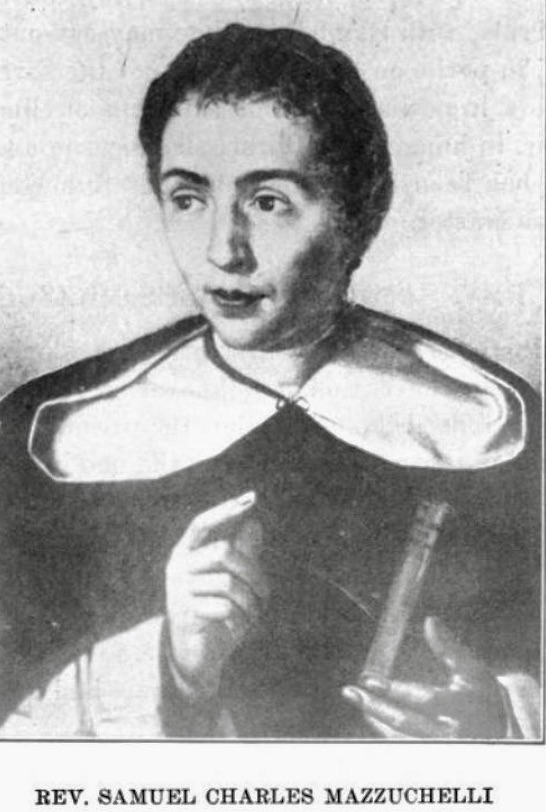
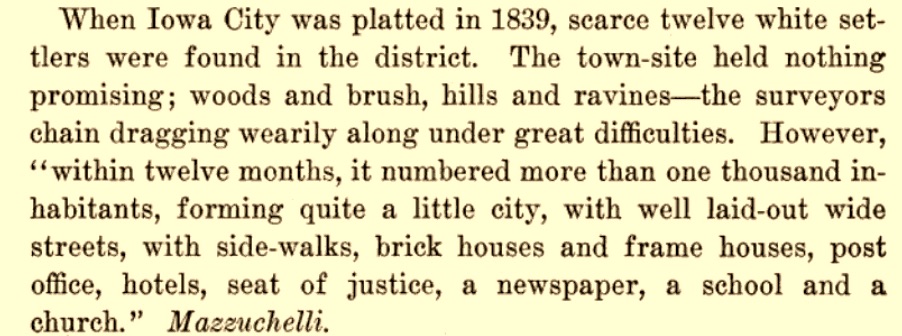
One of our earliest settlers – Father Samuel C. Mazzuchelli – wrote the following about Iowa City’s first year of existence (May 1839 – May 1840)…
While the good priest mentions brick houses, it actually wasn’t until late in 1840 when Iowa City’s first brick-maker – Sylvanus Johnson – had enough inventory to build a brick building. So, until then, the only way to construct a home or business of any kind throughout Johnson County was to use logs – cut fresh from the woods surrounding the city.
Interestingly, in J.B. Newhall’s 1841 classic – Sketches of Iowa, or The Emigrant’s Guide, we find this intriguing quote that came from Newhall’s May 1840 visit to Iowa City – “Five days ago, my house was in the woods growing.”Read more here.
Records indicate that Iowa City’s very first log cabin – a two-story job – was built in the summer of 1839 for Matthew & Salome Ten Eyck and their family, and was located on the southwest corner of Iowa Avenue and Dubuque Street (see map below).
According to Iowa City historian, Irving Weber, the Ten Eyck two-story cabin was built with “good sized hewn logs” and it served as a small lodge/tavern as well. It’s reported that in August of 1839, Iowa Territorial Governor Robert Lucas, his daughter, and niece, spent the night at the Ten Eyck cabin, climbing up the ladder and sleeping in the loft. Here is that story as told in the 1924-1925 Johnson County Old Settlers Association (OSA) Yearbook…
Other city records indicate that the Ten Eyck cabin hosted the first worship services for Iowa City’s newly-formed Methodist church in 1839, and that the building stood for about twenty years – being used for a variety of purposes – before it burned to the ground in March 1861. Sadly, this was a fate awaiting many wooden buildings in Iowa City during our city’s first 50+ years. Read more about Iowa City’s earliest buildings that are still here.
Building a log cabin was no simple task. First logs of equal length and size had to be made and rolled or dragged to the spot selected for the cabin. Sometimes the pioneer hewed the logs square, sometimes they were left round. Then the corners had to be notched or saddled so that the logs would fit close together. When the logs were ready neighbors came for a “house raising.” A strong man stood at each corner to fit the logs together as they were rolled or lifted into place. When the walls were eight or ten logs high, the gables were formed by placing the side logs in three feet and by using shorter end logs until the peak was reached. The roof was made of clapboards held in place by poles laid across at regular intervals and fastened with wooden pins. The narrow spaces between the logs were filled with clay. Openings for a door and a window were sawed out after the walls were up. The hole for the window was closed with oiled paper, or glass if it could be secured. Sometimes greased deer hide was used for the window cover. The door was made of long clapboards spiked to a frame with wooden pins. It was hung with thongs of deer hide or wooden hinges. The door was held shut by a wooden latch on the inside. It could be opened from the outside by a leather string which ran through a hole in the door above the latch. At night the latch string was drawn in for protection, but during the day it was always hanging out as a sign of welcome to friends and neighbors. Perhaps you have heard the expression, “the latch string always hangs out,” which means that visitors are welcome. The pioneer used no nails in making the first log cabins. An ax, a saw, a frow, and an auger were all the tools he needed. A large open fireplace usually occupied one end of the cabin. This fireplace and chimney were built of smaller logs placed together in the same way that the walls were laid up. The fireplace might be lined inside with stones while the chimney was plastered inside and out with clay. Sometimes the cabin had no other floor than dirt packed down, but as soon as possible the dirt was covered with puncheons. These were logs hewn flat and smooth on one side and joined together for a floor. With a puncheon table pinned to the logs near the fireplace and a large one-legged bed built in a corner the cabin was ready to be occupied. Mahan & Gallagher
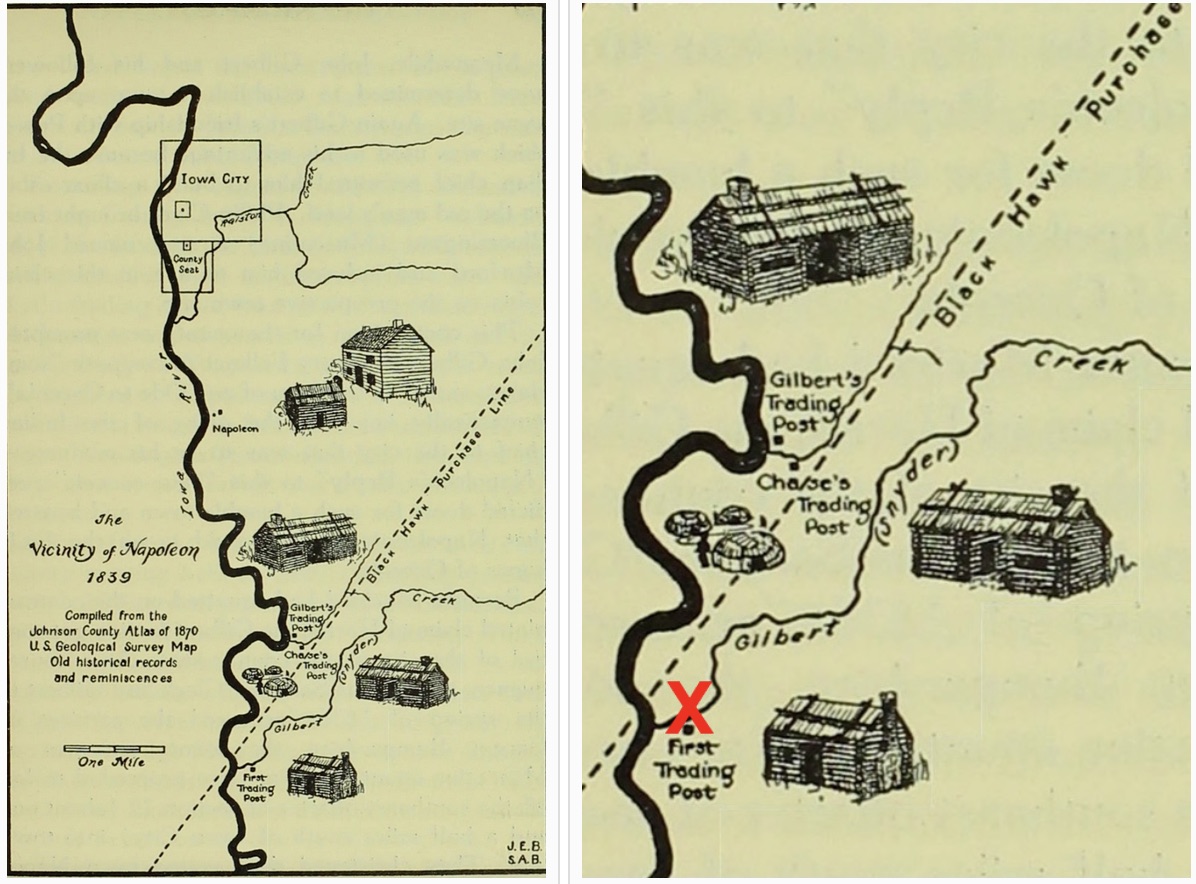
As we report elsewhere, the first three – well-documented – log cabins/trading posts built in Johnson County are dated back to a five-to-seven year period prior to Johnson County’s formation in December 1837. Below is a map of the area where these three cabins were built – near today’s Sand Road – where fur-traders – Stephen “Sumner” Phelps, his brother-in-law – Wheaton Chase, and John Gilberteach operated successful trading posts – working alongside the Meskwaki tribes who lived on the land long before any white man arrived.
The first log cabin (the furthest south on the map – above) was a very simple one-room cabin – probably very similar to a claim cabin (which we will describe later) and was used by Stephen “Sumner” Phelps whenever he paddled his canoe up the Iowa River to trade with the Sauk & Fox (Meskwaki) tribes. You can read more here, but we believe Sumner started coming to this area in the early 1830’s – possibly as late as 1832 – following the Black Hawk war which resulted in the Meskwaki tribes being pushed westward from their homes on the Mississippi River. In 1836, John Gilbert arrived on the scene – replacing the transient Sumner Phelps while working for The American Fur Company, thus becoming the first white settler to make a permanent home here. In 1837, Gilbert decided to leave American Fur, setting up his own trading post – locating it several miles further north of Phelp’s original post on the Iowa River. It’s this new double-cabin of Gilbert’s that served as the primary gathering place for Johnson County residents beginning in January 1838. You can read more here. Finally, in response to Gilbert’s new endeavor, the American Fur Company sent Sumner Phelp’s brother-in-law – Wheaton Chase – to close the old trading post while opening a brand new one – locating it directly south of Gilbert’s business! It’s these three log cabin-trading posts that served as the beginnings of Johnson County.Above – The double cabin of pioneer trader John Gilbert (log cabin #2) is seen in a depiction from the cover of the 1909 yearbook of the Old Settlers Association of Johnson County.
The original Black Hawk Purchase in 1832 (yellow on map above) opened the door for pioneers from the East to flood into, what is today, eastern Iowa, and the second Black Hawk Purchase of 1837 (blue on map above) opened up a narrow strip of land further west of the original section – land that eventually became a large portion of today’s Johnson, Linn, and Washington Counties. As early settlers – like Philip Clark and Eli Myers – began moving westward into Johnson County, each farmer/pioneer would stake out a piece of land – in 40-acre parcels – and build, what was called, a claim cabin – which, in most cases, was a simple, lean-to building that was later either enlarged and improved (below) – or replaced completely with a one-room log cabin. Read more here.
Claim Cabin #1 – When commissioner Chauncey Swan returned from Dubuque in the latter part of June, 1839, to direct the surveys of new land for Iowa City, there was a claim cabin located just south and east of the planned location for the new capitol building (see map above). It turned out the claim cabin was occupied by Matthew Ten Eyck and his family – prior to building their permanent cabin that we discussed earlier. According to historical records, Swan used this claim cabin as his headquarters in Iowa City during the remainder of 1839.Claim Cabin #2 – In February 1839, pioneers Asaph Allen and George T. Andrews built a claim cabin on Johnson County land near, what is today, the southwest corner of Brown Street and Gilbert Street (see map above). By June, they had built a second cabin about 20 feet away from the original one, placed a roof over the space in-between, and before long, they had opened up Iowa City’s first hotel/tavern. Welcome to Iowa City! Click here to read about Iowa City’s earliest hotels.Claim Cabin #3 – Soon after Johnson County pioneer – Frederick M. Irish – arrived here in 1838, he put a claim on land just north and east of what would become – in 1839 – Iowa City (see map above). Here, Irish eventually built a log cabin, and when Iowa City was named the county seat of Johnson County – October 8, 1839 – the city leaders met in Irish’s cabin from October 1839 until 1842. Read more details here. Hold on to this story – as we will tell you more about Irish’s log cabin in just a moment…
Sadly, over the years, most of the original log cabins of Johnson County have been lost. Fire, of course, was always a big danger that took many of them out, and by the 20th century, those log buildings that had survived had been removed to make way for new, modern construction.
Above is a picture – taken in 1926 by Iowa City photographer Fred W. Kent – when an older Iowa City home at 514 N. Gilbert Street – built in the 1860’s – was being torn down. Much to the surprise of the demolition team and the present owner (John Lechty), this log cabin dating back to 1839/1840 was found within the framework of the larger home that was being torn down! Apparently, it was a very common practice in the 1860’s-1880’s to built a larger home around an older, existing log cabin – including it in the building project! This log cabin pictured above was described as “a one-room affair, built up of roughly hewn logs mortised together at the corners and the cracks filled with mortar.” Fortunately, Kent took this photograph so we have a reminder of what these original log cabins looked like!Interestingly, F.M. Irish’s 1839 log cabin – mentioned earlier – is still standing today! But, like the story above – this treasure lies deep within the layout of the home you see pictured above. When Irish moved from his log cabin into a larger home he had built close-by (1849), he maintained ownership of this original property – today’s 1310 Cedar Street – until October of 1860. At that point, William Hamilton purchased the cabin, and It was during that time of ownership – in the 1860’s – when Hamilton built a larger home (see pic above left) around Irish’s original log cabin, and yes – it remains even today (see pic above right) with the dining room area actually being the original log cabin of Frederick M. Irish! This amazing fact means that F.M. Irish’s log cabin of 1839 is still in existence today, making it (with an asterisk) the oldest surviving residential property in Johnson County – older, yes, than even Old Capitol! Read more here.
By the 1840’s, small log cabins were springing up across Johnson County. Above: Christopher C. Fuhrmeister – and his wife Caroline – built this log cabin in the late 1840’s in Big Grove Township – near Solon – and in the early 1900’s, this photograph of the cabin was taken.
Over the next two years (1887-1889), Wieneke’s idea of building one cabin expanded, so following the 1889 annual reunion – on September 28, 1889 – a team of pioneers began the construction of two log cabins on the Johnson County Fair Grounds – located near East Iowa City on farmland that, today, hosts City High School (see map below)…
Here (below) are some of the many construction details as spelled out in the OSA Yearbook from that 23rd Annual Gathering in 1889…
It’s believed that this is a photograph of the two log cabins built on the Johnson County Fairgrounds in 1889 – two years after the Fairgrounds moved to the east side of Iowa City. As the OSA yearbook states, the smaller cabin (on the right) is “made of logs unhewn, and with bark untouched” and represents the very earliest log cabins built in Johnson County. The cabin (on the left) is larger in size (16 x 20 feet and one-and-one-half stories high), is made of hewn logs, has a 6-foot porch on the west side, and represents a more “modern” log cabin that pioneers would have built after they were more “settled” on this new land in Iowa City. Both cabins were first celebrated at the Annual OSA Reunion held in August 1890.Historian Clarence Ray Aurner (below) lists some of those early pioneers who were involved in the building process of these two cabins. Below, he also describes the difference between the two – with the smaller one being called a “log cabin” – while the larger is called a “log house”. In the 1894 OSA yearbook, the two structures are differentiated by calling one the “crude” cabin vs. the larger “dude” house!
Regardless of their difference in size, these two log cabins proudly stood at the Johnson County Fairgrounds from 1890 to 1918.
It’s interesting to find that nearly all of the OSA yearbooks between 1890 and 1912 point to these two cabins and their contents (see list above) as being the centerpiece of each annual Old Settlers’ Reunion.
Records show that immediately following the 1912 reunion, the members of OSA began looking at a possible change in the location of their annual reunions. After meeting at the Johnson County Fair Grounds since 1887, the option became available to begin meeting in Iowa City’s new City Park located on the west side of the river. Of course, one of the primary objections to the move was the fact that the two icons of the OSA – the two log cabins would have to be left behind! In order to make the move more attractive, it was decided that a new log cabin would be built in City Park – a double log cabin that would be designed to serve as a replica of John Gilbert’s 1837 Trading Post. The OSA yearbook for 1912-1914 tells us more…
Construction on the new double log cabin began on May 31, 1913, was well under way by the time of the 1913 reunion in August – which was held, for the first time, in City Park – and completed in full by the 1914 gathering. Here are more details from the OSA Yearbook…
Here are some modern-day photographs of the larger log cabin in City Park today. A true beauty!
Records indicate that in the years prior to the OSA moving to City Park (1913), the two log cabins originally built at the Johnson County Fair Grounds (1889) – while wildly popular with reunion-goers – were deteriorating rather quickly. In 1900, we find this request (below left) from Gilbert R. (G.R.) Irish reminding OSA members that their annual dues were vitally important in maintaining the condition of the two cabins at the fairgrounds. In 1915 – two years after the OSA had moved over to City Park – we find this report (below right) praising the new log cabin at City Park, and indicating that OSA would continue to maintain the two old cabins at the fairgrounds.
In 1918, the Johnson County Fair Grounds had a change in ownership, and as a result of that, it was determined that the two 1889 log cabins needed to be removed. As you can see from the report below, the OSA decided that only one of the cabins – the log “house” – was salvageable. Thus, the larger one-room cabin (pictured below) – built with hewn logs in 1889 – was moved across the river to City Park – where it stands to this day.
Here’s a salute to the two log cabinsinupper City Park in Iowa City – both of which were listed in the National Register of Historic Places on June 25, 2013. Pictured below (right) are two important “Ebenezers” – reminders of Our Iowa Heritage here in Johnson County – the Log Cabins and the Remembrance Stone placed by the Pilgrim Chapter of the Daughters of the American Revolution (DAR) in 1939. Read more here.
In 2018, the City of Iowa City began a total restoration of both cabins, and today, they are good to go for another 50+ years!
September 28, 1889 – A team of old-timers begin the construction of two log cabins on the Johnson County Fair Grounds – located near East Iowa City on farmland that, today, hosts City High School.
June 25, 2013 – The two Johnson County Old Settlers’ Association Log Cabins – located in Upper City Park in Iowa City – are listed in the National Register of Historic Places.DYK-December 19, 2023
Kudos to the amazing resources below for the many quotes, photographs, etc. used on this page.
FYI – Sadly, over the years, many resource items concerning the City Park log cabins have included a few details that are not accurate. First of all, most reports don’t mention that there were two log cabins built at the Johnson County Fair Grounds in 1889 – not just one. Secondly, the original two cabins never moved locations to a second “fair grounds”, but remained at the Johnson County Fair Grounds until 1918, when the larger cabin was moved to City Park, while the smaller one was torn down.