


Today, the Franklin Printing House building (see above left) – located at 115 South Dubuque Street – stands as one of Iowa City’s oldest remaining downtown business buildings. Built in 1856, this three-story red-brick icon (sometimes called the Koza Building) is one of only a handful of commercial properties (see pic below of 115 S. Dubuque and 111 S. Dubuque) that date back to the days prior to the Civil War, and is the sole surviving commercial building that was built for newspaper work and associated with two early city newspapers – The Iowa Capital Reporter and The Iowa City Republican.


On this page, we’d like to tell you more about The Franklin Printing House building and introduce you to its original owners – Richard H. (R.H.) Sylvester (pictured above right) and Aaron G. (A.G.) Tucker. So, to start, let’s explore this rare postal letter and cover (below) postmarked on January 27, 1858 in Iowa City, and written the day before…



Iowa City Jan. 26 1858
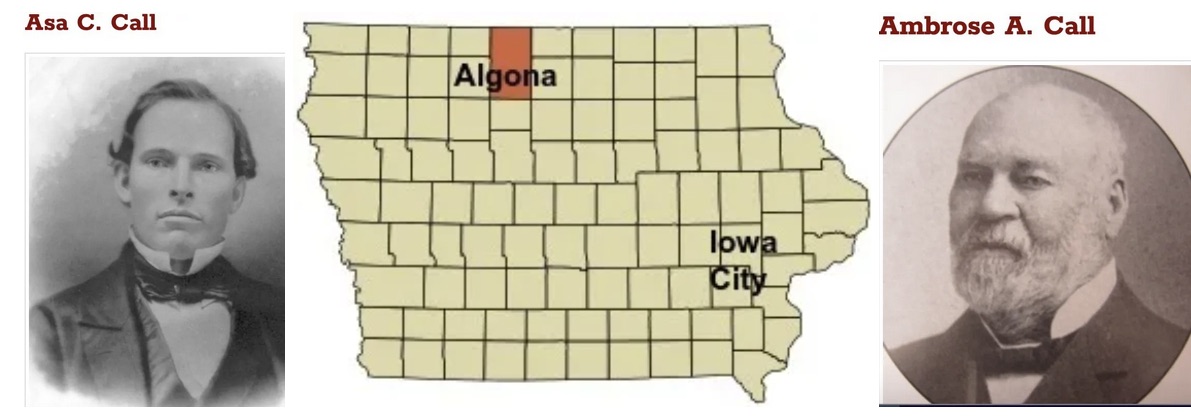
Dear Sir: Will you please inform me what is my tax on that lot of mine in Algona, as I don’t want it sold! Meeting Asa Call when the Call brothers first came through Iowa City on their way to north-central Iowa in 1854, Sylvester, a real estate investor, had stayed in touch with Call, purchasing land in Kosseth County as the Call brothers were developing their new community of Algona.
Haven’t you anything new to say in the Reporter about your county and town? As the owner and editor of The Capital Reporter, Sylvester was looking for Call to provide him with the latest investment news from Kosseth County, and possibly run some land investment ads in the Iowa City newspaper.
We have been suspended for a few weeks but resume soon, and will publish with pleasure such statistics & c (such) as might prove of general interest to the people or of any advantage to you. We are not certain what Sylvester is referring to when he speaks of the newspaper being “suspended for a few weeks”, but we do know that running a local newspaper (and print shop) was a risky endeavor, which is why Sylvester was diversified financially, working as a lawyer and real estate investor as well as his ownership of The Capitol Reporter and The Franklin Printing House. Interestingly, Sylvester had contracted with the State of Iowa to print all state-related governmental records as produced by the state legislative in Iowa City. When the capital moved from Iowa City to Des Moines in the fall of 1857, that profitable business contract with the state obviously took a nosedive as well. It could very well be that Sylvester’s business dealings in Iowa City – like many others – hit some hard times when the state government left Iowa City. Read more details here.
Truly yours, R.H. Sylvester


Richard H. Sylvester was born to Henry H. & Elizabeth Hubbard Sylvester on April 17, 1830 in Charlestown (Sullivan County), New Hampshire. Sadly, Richard’s mother, Elizabeth – the sister of New Hampshire’s Governor and U.S. Senator, Henry Hubbard – died when Richard was born, and soon afterward, his father Henry – a staunch Democrat – moved to Washington D.C. where he ended up serving in the Andrew Jackson, Martin Van Buren, and James Polk administrations.


After graduating from Phillips Exeter Academy back home in New Hampshire, R.H. Sylvester entered Yale College, but left at the beginning of his junior year to study law with his cousin Edmund L. Cushing, the Chief Justice of New Hampshire. Moving westward, Sylvester finished up his law studies at the University of Michigan, was admitted to the bar, and by 1852, had moved westward to Iowa City, accepting a new position as a legislative debate reporter with the Democrat-leaning newspaper – The Iowa Capitol Reporter.
By 1854, Sylvester had bought out the controlling interest in the newspaper (see ads above), and before leaving Iowa City for a new editorial job in St. Louis (1862), the successful businessman made a huge impression in Iowa City, not only as a strong-willed newspaperman, but also by serving two terms as county Superintendent of Schools, and as Treasurer for the City of Iowa City. More on Sylvester’s eventful time in Iowa City later…


Sadly, we don’t know nearly as much about Sylvester’s business partner – Aaron G. (A.G.) Tucker – who was born on November 30, 1830 in Otsego County, New York. His biographical data tells us that he was a “pioneer newspaper man and capitalist”, coming to Iowa City in the mid-1850’s, and teaming with R.H. Sylvester during the 50’s to run both The Franklin Printing House and a second Iowa City short-termed newspaper called The Daily Crescent. Later in life, after Sylvester had departed for St. Louis, Tucker served as the local Iowa City agent for the Rock Island Railroad for twenty years – most likely in the 1870’s and 80’s.

As we mentioned earlier, The Franklin Printing House was built in 1856, expressly for the purposes of housing The Iowa Capital Reporter.
Read more about early Iowa City newspapers here.


“In a word the “Franklin,” built expressly for our own use, well adapted to the carrying on of the great Philosopher’s immortal art — “heaven born” like his own famed lightning — is about the best establishment all things considered, to be found west of Chicago … Here goes for another voyage in another craft – the staunch new ‘Franklin’! Who goes with us?”

The State Reporter‘s offices were located on the main floor of the new building, the composition room on the second floor, and printing press in the basement. So, over the next four years (1856-1860), R.H. Sylvester and A.G. Tucker successfully ran three companies out of their new “craft” – The Franklin on Dubuque Street: The Capital Reporter, The Crescent, and The Franklin Printing House.


The reason? Slavery.
You see, in the 1850’s, across America, there was a growing movement of young men and women who could no longer stay silent when it came to the issue of slavery. The Whig Party had shown signs of being anti-slavery, but was hesitant to make it into a big issue. The Democrat Party, on the other hand, decided to stand firmly with their brethren across the South and, for the most part, be the party that supported the economic benefits that came from keeping blacks enslaved. But, as you can read from Sylvester’s letter (below), while remaining aligned with many of his Democratic friends, he has decided to throw his support behind the new “Wide Awake” movement led by a young Illinois statesman named Abraham Lincoln. You can read more about this movement which eventually birthed the Republican Party here. Read more about the Wide Awake Clubs here.


With R.H. Sylvester selling out his interest in both The Reporter and The Franklin Printing House (1860), others needed to find a way to keep the Democratic Party’s publishing interests alive, re-locating the The Reporter to another office and re-naming it: The State Democratic Press. Yet, it wasn’t until July 1864, when John P. Irish stepped in, purchasing The Press and renaming it The State Press, when the newspaper truly re-established itself, becoming a major news source for the people of Iowa City well into the first part of the 20th century. By the late 1860’s, Irish had built a new building for his State Press – locating it directly across Dubuque Street from The Republican! By the 1870’s, The State Press had opened up its own printing shop as well, running big ads (like the one below)…


You can read more about John P. Irish here.

As for The Franklin Printing House, the building on Dubuque Street immediately changed hands in 1861, taken over, surprisingly, by Sylvester’s long-time political opponents, the owners of The Iowa Weekly Republican, who remained there until 1871, when the paper moved to a larger location. This left the three-story building at 115 S. Dubuque to become the home to a series of different saloons through the turn-of-the-century. After being occupied by a variety of other businesses (1900-1910), the building finally became the home of John V. Koza’s Meat Market and McCollister’s Grocery (see below) beginning around 1912 and continuing for 40+ years! Read more about the grocery stores of downtown Iowa City here.

The Franklin Printing House building was listed on the National Register of Historic Places on April 10, 1986, and in 2021, was also included as a contributing property in the Iowa City Downtown Historic District. Read more here. Today, these two iconic buildings on S. Dubuque Street (111 & 115) remain as beautiful reminders of days gone by.


As we mentioned earlier, Aaron G. (A.G.) Tucker (1830-1911) remained in Iowa City for the rest of his life, spending nearly twenty years as the local Rock Island Railroad agent. Tucker died on October 17, 1911 at the age of 80 and is buried with his wife, Margaret E. Dodder Tucker, in Oakland Cemetery in Iowa City.


As for Richard H. (R.H.) Sylvester (1830-1895), in 1879, this St. Louis-based newsman finally returned to Washington D.C., taking a major editorial role with the brand new publication –The Washington Post, and over the next decade, became one of the best known journalists in our nation’s capital.


At his passing, on September 2, 1895, at the age of 65, Sylvester’s death was reported in numerous papers across the east coast. He is buried with his wife, Martha Woods Sylvester in Rock Creek Cemetery in Washington D.C.

Here’s to R.H. Sylvester, A.G. Tucker, and their lasting work: The Franklin Printing House building at 115 S. Dubuque Street in Iowa City. Godspeed!

January 26, 1858 – From his office in The Franklin Printing House, Iowa City pioneer businessman R.H. Sylvester corresponds with Asa C. Call – founder of Algona, Iowa.
July 25, 1860 – The Iowa State Weekly Reporter gives its readers the shocking news: Long-time editor – R.H. Sylvester – the staunch Democrat who had become the voice of the party in Iowa City during the 1850’s – has decided to step down because of his party’s refusal to address the wrongs of slavery.
September 2, 1895 – Iowa City pioneer newsman – Richard H. Sylvester – owner of The Capital Reporter and The Franklin Printing House dies, at age 65, in Washington D.C.
April 10, 1986 – The Franklin Printing House building is listed on the National Register of Historic Places.
Kudos to the amazing resources below for the many quotes, photographs, etc. used on this page.
Franklin Printing House, Wikipedia
R.H. Sylvester, Iowa Capital Reporter, December 13, 1854, p 1
Removed – To Our Friends, The Daily Reporter, September 12, 1856, p 2
Franklin Job Printing House, Daily Crescent, August 19, 1857, p 1
My Valedictory, J H Sylvester, Weekly Iowa State Reporter, July 25, 1860, p 2
Office of the County Superintendent, Weekly Iowa State Reporter, July 25, 1860, p 2
Removal, The State Press, April 3, 1861, p 3
Democratic State Ticket, The State Press, October 4, 1862, p 3
The State Press Job Printing, The Daily Press, April 9, 1874, p 3
Aaron Tucker Dies, Mt. Ayr Journal, October 26, 1911, p 3
A.G. Tucker, Twenty Years Ago In Iowa City, Iowa City Press-Citizen, July 26, 1935, p 8
Richard H. Sylvester pic -1895, Washington Post, Wikimedia Commons
Funeral of Major Sylvester, Washington Post, September 4, 1895, p 7
Wellknown Journalist Dead, Buffalo News, September 2, 1895, p 6
Richard H Sylvester, Find-A-Grave
Click here to go on to the next section…
Click here for a complete INDEX of Our Iowa Heritage stories…