


In 1854, two young adventurers – brothers from Cayuga County in New York – made their way westward to Johnson County, Iowa. Settling in Iowa City, Manly Tooker (M.T.) Close (age 25) came first, in May 1854. Seven months later, in December 1854, Manly’s younger brother – Chalmer Dodge (C.D.) Close (age 22 & pictured above) followed. We are not certain of the timetable, but family records also indicate that M.T. & C.D.’s parents: Samuel & Samantha Dodge Close soon made their way to Iowa City as well.


Family records indicate that the Close Brothers – M.T. & C.D. were “in the ice business” in 1855, and one year later – in 1856 – opened a very successful Candle Factory on Maiden Lane – just north of Prentiss Street.


Adding a soap and lard oil factory in 1858, the Close Brothers expanded their business to include today’s 521 South Gilbert Street, where the core of the Close family enterprises remained until 1898.

At the outbreak of the Civil War (1861), the supply of Southern-grown cotton seeds decreased, forcing the market price of flax seed to skyrocket. Since a number of popular products could be made from flax seed – including linseed oil and flax straw, which is used to make linen and high-quality paper – many Iowa farmers began switching over to growing flax in their fields.

The Close Brothers quickly recognized this shift in the market, and wisely transitioned their factory on Gilbert Street into a Linseed Oil Mill, calling it, for the first time, M.T. Close & Company. Below are articles from Iowa City newspapers: (left) December 19, 1866, and (center & right) August 10, 1870 that point to the great significance of the Close Brother’s Linseed Oil Mill…


In 1865, Manly (M.T.) Close invested $45,000, expanding the family operations by establishing a water-powered Paper Mill on the Iowa River – very near the site of today’s Coralville Dam (see pics above). Using the flax straw produced at their Linseed Oil Mill on Gilbert Street, the Close Paper Mill – at its peak – employed fifty employees, producing six tons of paper every 24 hours. You can read more about early Coralville mills here.

Tragically, a chemical imbalance in one of the mill’s large storage tanks caused a massive plant explosion around 9 p.m. on the evening of July 23, 1875, killing six workers, and closing the mill permanently.


While the July 1875 paper mill disaster was a huge setback, Manly’s brother – Chalmers (C.D.) Close – kept moving forward with the Close Linseed Oil Mill back on Gilbert Street in Iowa City, eventually inviting his young son, Sylvester, to join him, even after the company was acquired by the National Linseed Oil Company in the late 1880’s.


More about the Close Linseed Oil Factory building later, so now we turn our attention to…


Built in 1874 at a cost of around $15,000, the Close Mansion is located at the corner of Gilbert and Bowery Streets (538 S. Gilbert Street) in Iowa City – just across Gilbert Street from the 521 S. Gilbert location of the Close Linseed Oil Factory (see map below).


“It is significant that Close built his opulent home next to his industrial ventures,” Laurence Davis Lafore wrote in the 1973 National Register application for the Close House. “This may indicate that there was no clear distinction between ‘work’ and other aspects of life.” In addition to facilitating a short commute, there was another clever advantage to the home-work proximity: steam pipes were run under Gilbert Street between the mill and the mansion, providing the Close home with steam heat!
In case the 14-room house still wasn’t warm enough for the Close family, it had eight fireplaces, four on the first floor with marble mantles and huge walnut mirrors above them, and one in each of the four second-floor bedrooms. A walnut staircase winds up the building’s three stories, in addition to a basement (including a cistern) and an attic that leads to a widow’s walk and cupola with a great view. There was a second-floor balcony, three bathrooms, a servant’s quarters, a library, a billiards and chess room and a spacious carriage house and horse stable.

C.D. Close and his wife, Helen Stevens Close were married in 1869, and raised their three daughters (Emma, Alice & Katherine) and son (Sylvester) in the mansion. Daughter Emma Close went on to marry an heir to another local entrepreneurial family, Hal Stewart of the Stewart Shoe Store family. Three generations of the Close family called the mansion home, but it briefly housed the Acacia Fraternity, from 1923 to 1929, before returning to the Close-Stewart family’s possession. The house was then sold to the county on April 24, 1941, for $4,800, becoming the Johnson County Department of Social Services.


By its 100th birthday in the 1970s, the Close Mansion was practically unrecognizable (see above). Its most distinctive features — the widow’s walk, glassed-in cupola, balcony, ornate entrance columns — had been removed, and the interior had fallen into disrepair. “The Close House, now the property of Johnson County, is deteriorating and subject to imminent abandonment and perhaps destruction by the County,” read the National Register application.


Fortunately, it was the May 31, 1974 approval of this application to the National Register of Historic Places that saved the Close House from demolition, yet it was Charles and Sheryl Skaugstad – who bought the house in an auction on March 21, 1980, for $174,000 – that restored its character. The Skaugstads spearheaded an extensive restoration process, following the historic preservation guidelines of the National Register and Iowa City Historic Preservation Commission. Crystal chandeliers, vintage wallpaper, beautiful wood floors, functional kitchen and bathroom fixtures, a new 26-foot cupola for the roof — these renovations helped bring a sense of history and elegance back to the Close House, which the Skaugstads called “The Mansion.”

In January 2019, the Skaugstads moved their interior design showroom to a new location in Coralville, and by 2021, the Close House was back on the market, listed for $1.35 million by Blank & McCune and boasting 7,572 square feet of commercial space. The Close Mansion currently houses Public Space One, a community driven, non-profit contemporary arts center, and as we mentioned earlier, was placed on the National Register of Historic Places in May 1974, and it is also included on Iowa City’s List of Historical Landmarks.
Now, let’s explore one more aspect of the Close family influence in Iowa City…


Sadly, fifty-seven year old C.D. Close died of pneumonia in the spring of 1890. His wife, Helen wasted little time in cultivating his legacy; and by summer, she had donated $10,000 in C.D.’s memory to the building of a new multi-purpose YMCA & YWCA (Young Men & Women Christian Association) facility, located very near the State University of Iowa (SUI) campus. Obviously, with Mrs. Close’s gift being the single largest donation toward the $35,000, two-plus-story building, it was named: Close Hall.
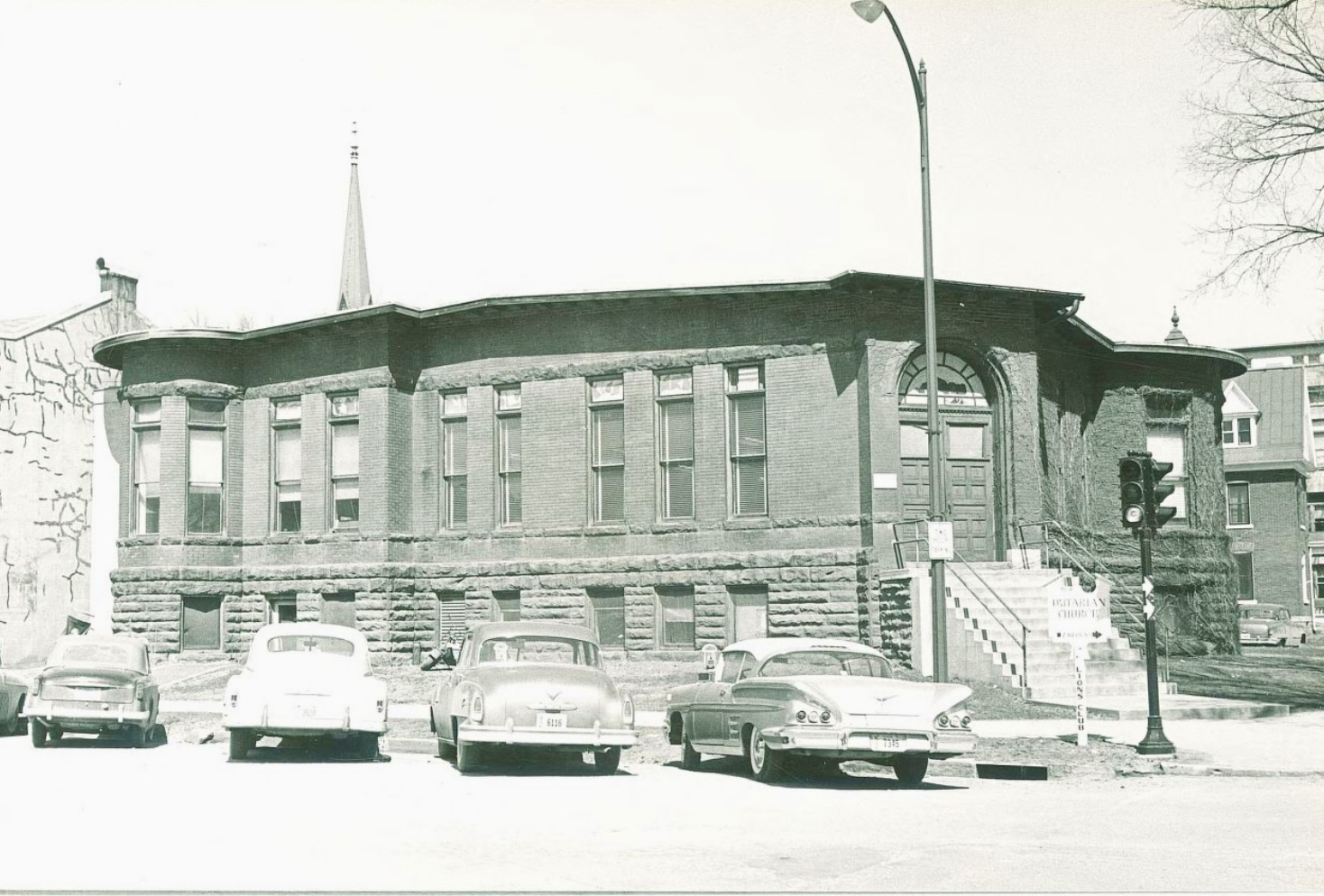
Made of red brick, and part of the SUI Red Brick Campus, Close Hall was completed in 1891. The building contained offices and recitation rooms on the first floor while the second floor housed literary societies as well as additional offices. The basement of the building housed a full-sized gymnasium for inside sports.


Location: Close Hall was located on the northwest corner of Iowa Avenue and Dubuque Street, directly west – across Dubuque Street – of the Hall of Pharmacy & Chemistry. Both buildings were designed by Professor Charles D. Jameson of the SUI Engineering Department.


Iowa physical education teacher, Dr. Henry F. Kallenberg, reduced the teams to five players on a side, and the modern version of basketball was born. Kallenberg came to Iowa from Springfield College, where he was a classmate of Dr. James Naismith, the man credited with inventing the game. Sadly, the Maroons won, 15–12, to secure modern college basketball’s first-ever win. But for Hawkeye fans, Close Hall is celebrated as the birthplace of Iowa basketball with the team calling it home until moving into the new armory located adjacent to Iowa Field in 1905.


In 1924, Close Hall became the home for the SUI School of Journalism – housing classrooms, news gathering offices, and yes, even linotypes – typesetting machines – and printing presses in the basement! It would be from these presses in the basement of Close Hall that The Daily Iowan, The Hawkeye, Frivol, Iowa Literary Magazine, The Transit, and The Journal of Business would all be printed. Did you know that George Gallup (above), creator of the Gallup poll, served as editor of The Daily Iowan in the early 1920’s – working out of Close Hall.


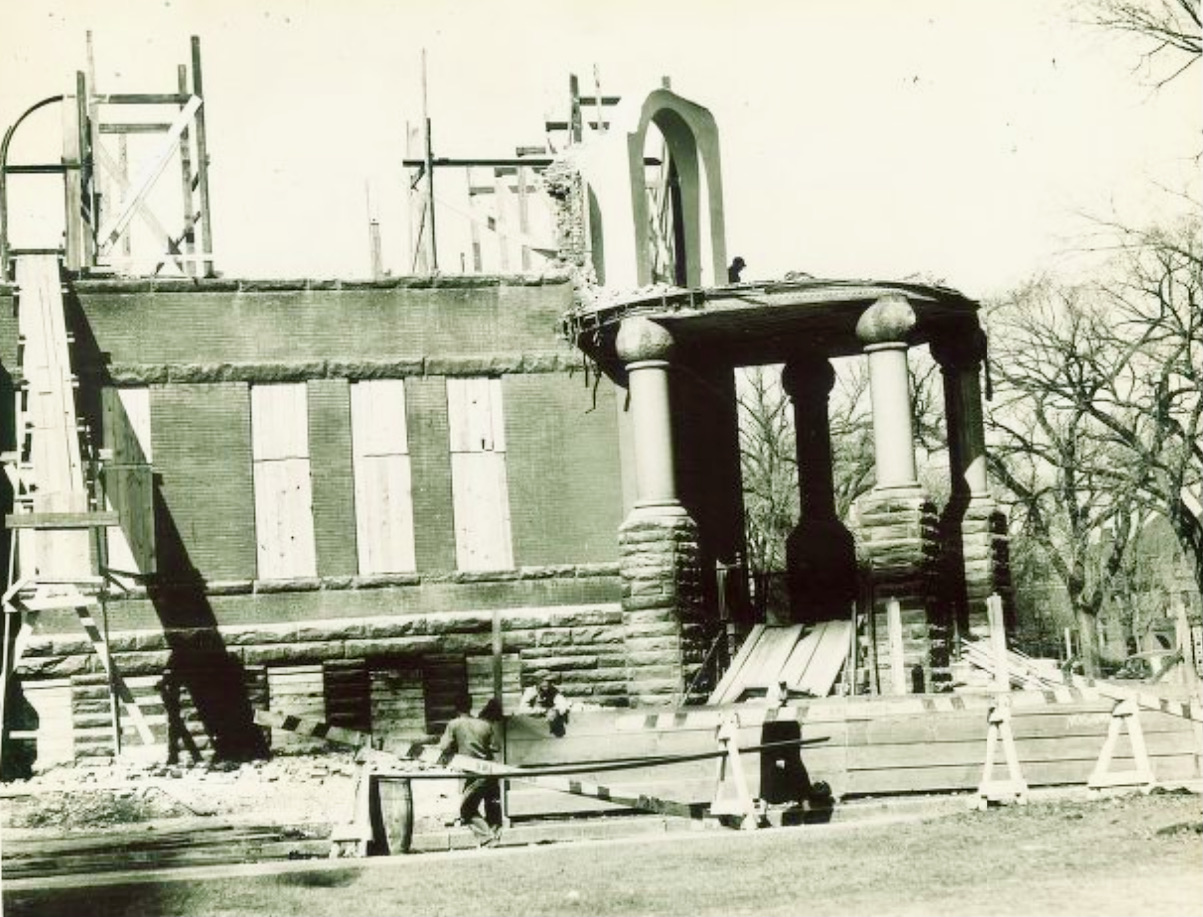


Although regarded by some as a peculiar architectural monstrosity and eyesore which should be removed forever from the campus, Close Hall was still used well into the 1960’s to house the University Printing Service. Close Hall has a strong Boller connection – being the work home of my dad, George Boller’s printing job that brought us to Iowa City in 1966. It’s also the place I had my first part-time job while I was in high school. Read more here.



Sadly, of the four major Close Family facilities built in the Iowa City/Coralville area between the 1860’s and 1891: Close Linseed Oil Factory (early 1860’s), Close Paper Mill (1865), the Close Mansion (1874), and Close Hall (1891), only the Close House remains as it was originally built.
As we mentioned earlier, the Close Paper Mill in Coralville was destroyed by an explosion in 1875, Close Hall – on the corner of Dubuque and Iowa Avenue – was partially destroyed by a fire in 1940, surviving until 1968, when it was replaced with the UI Biology Building. As for the Close Linseed Oil Factory located at 521 S. Gilbert – after C.D. Close died (1890), the National Linseed Oil Company (which had purchased it in the late-1880’s) shut down the plant in 1898. The building was then bought by the Close family friend – Thomas C. Carson, who converted the mill into a grain elevator and warehouse. The building sold again in 1920, becoming a sheet metal and roofing business; and in 1926, a carpentry shop. In the 1930’s, it became a bottling firm, oil heater and sheet metal manufacturing plant, and finally the home of O’Brien Electric Company. Over time, the historic facade, floors and features had been stripped away, and in 1995, the South Gilbert Warehouse, as it was known, was removed from the National Register of Historic Places due to “loss of integrity.” Since then, various owners have used the building for restaurants and other retail outlets.


Samuel Close (1802-1883) and his wife Samantha Dodge Close (1808-1881) were married in 1823, and at some point after 1854, moved to Iowa City to join with their two sons – M.T. and C.D. Close.


Manly Tooker (M.T.) Close (1829-1903) moved to Iowa City in 1854, partnered with his brother, C.D. in a variety of businesses, and became involved in a number of local endeavors: 1) joined with his friend, Thomas C. Carson, and four others, in organizing the Iowa City Gas Company (1857) and 2) the Iowa City Electric Company (1886). His son, Manly Close, Jr. served as mayor of Coralville in 1896.


Chalmers Dodge (C.D.) Close (1832-1890) and his wife Helen Stevens Close (1846-1920) married in 1869 and had four children: Emma (1869-1961), Alice (1872-1953), Sylvester (1877-1942), and Katherine (1879-1972).


Without a doubt, between 1854 and 1920, the Close family played a very important role in the life and expansion of Iowa City. To the entire family, we say Godspeed!


On June 16, 2026, we shared the story of Iowa City’s Close Family with the good folks of Friends of Historic Preservation, gathered for their annual meeting at the Close Mansion. You can watch that 35 minute presentation here.

Kudos to the amazing resources below for the many quotes, photographs, etc. used on this page.
Candle Factory, Iowa City Republican, October 21, 1856, p 3
The Flax Product, Iowa City Republican, December 19, 1866, p 1
Manufactures – Close Bros, State Democratic Press, August 10, 1870, p 3
Close’s Mill Blown Up, Daily Press, July 24, 1875, p 3
Coralville Mill explosion, History of Johnson County, Iowa, 1883, pp 436-437
The Linseed Oil Company, Iowa City Board of Trade (ICBT), November 1, 1880, p 16
G.D. Close & Co’s. Oil Mills, Iowa City Republican, June 21, 1887, p 3
M.T. Close, Irving Weber, Iowa City Press-Citizen, February 9, 1979, p 21
Close House (Iowa City, Iowa), Wikipedia
Old Close Mansion has new look, Iowa City Press-Citizen, September 23, 1980, p 9
Samuel Close obit, Iowa City Daily Republican, October 11, 1883, p 4
Samantha Dodge Close, Find-A-Grave
Manly Tooker “M. T.” Close, Find-A-Grave
The Late G.D. Close, Iowa City Daily Republican, April 23, 1890, p 4
Chalmer Dodge Close, Find-A-Grave
Mrs. Close Is Called Beyond, Iowa City Press-Citizen, May 10, 1920, p 3
Helen Stevens Close, Find-A-Grave
Click here to go on to the next section…
Click here for a complete INDEX of Our Iowa Heritage stories…