


Our story of Iowa’s School for the Deaf actually begins in 1812, when the Connecticut native Mason F. Cogswell conducted a survey on how many deaf persons lived in his home state. That survey turned up 84 people, none of which were educated, thus establishing the great need for a school. By 1815, Cogswell and several partners started to raise money while another partner – Thomas H. Gallaudet – was sent to France for seven months in order to learn European methods in teaching deaf students. Upon his return, Gallaudet contracted the teaching services of Laurent Clerc, and on April 15, 1817, the Connecticut Asylum for the Instruction of Deaf and Dumb Persons was opened in Hartford, Connecticut, with the first student being Alice Cogswell (Mason Cogswell’s daughter); Gallaudet, serving as the first principal; and Clerc, employed as the school’s first teacher. Later, the school’s name was changed to the American School for the Deaf (ASD). Which brings us now to to the stories of two unique Iowa pioneers…


So, let’s start our Iowa pioneer story with…


Edmund Booth was born on August 24, 1810 in Longmeadow, Hampden County, Massachusetts (see maps above). Edmund became partly deaf and blind in one eye at the age of four from an attack of meningitis, and at the age of eight, he became totally deaf, but never lost his ability to speak. In 1828, at the age of 17, Booth entered the American School for the Deaf in Hartford, Connecticut with Laurent Clerc as his teacher. Upon his graduation (1832), Booth was appointed as an instructor in the school – a position he held for seven years, resigning in 1839 on account of failing health.


In his prime, Edmund Booth stood 6 feet, 3 inches tall, weighed 210 pounds, and wore a long, full beard. Hoping to recover his health in outdoor life, and find his fortune in, what was then regarded as, the far west, Booth emigrated to Jones County, Iowa (see maps above). At that time, the nearest house to the place he chose for his future home, was a mile and a half distant. But gradually, a flourishing town grew up around him which he named Anamosa – a Native American word meaning White Fawn. In 1840, Booth built the first frame house erected in Jones County, and in that same year, he married Mary Ann Walworth, who had been one of his deaf pupils back in Hartford, Connecticut.


In 1841, Edmund Booth was elected county recorder, a position he held for four terms, and soon, he became an enrolling and engrossing clerk with the Iowa House of Representatives in Iowa City. It is reported that both he and his brother – Representative C.H. Booth – became “deeply touched by the pitiable or piteous state of many of the children of early day Iowa, who were robbed of the power of hearing, and, sometimes were voiceless.” So, in a decision which would lead to much more in the 1850’s, the two brothers effectively used their influence with the State Legislature (1846) to better the condition of these unfortunate ones, and, as a result, a number of those afflicted with hearing loss were given financial opportunities to study at the Illinois School for the Deaf.


Anamosa was Edmund Booth’s residence for the remainder of his life, except for the five years he spent in California during the Gold Rush era – which began in 1849. Returning in 1854, Booth became the editor, and eventual owner, of a local newspaper – The Anamosa Eureka, and it was in this role the deaf-and-blind-in-one-eye newspaper man helped start the Iowa School for the Deaf (ISD) in Iowa City. More on Booth and his work later, but now, allow me to introduce you to ISD’s other founder…


William Edwin Ijams was born in West Rushville, Fairfield County, Ohio (see maps above) on December 16, 1830. He attended college, first at the Ohio University, followed by additional studies at Washington & Jefferson College in Washington, Pennsylvania.

After graduation (1852), William Ijams took a two-year teaching assignment at the Illinois School for the Deaf in Jacksonsonville, Illinois (see map above). And, it’s here, he built many new relationships with numerous deaf students who had traveled eastward from Iowa. It’s our guess that it was during this time, Ijams also met the deaf advocate from Anamosa – Edmund Booth. Which brings us, now, to…


As we mentioned earlier, in 1849, Edmund Booth, the deaf entrepreneur and businessman, left his wife and their two young children in Anamosa, Iowa for a five-year stint in California, hunting for his fortune in gold. One biographical report, written in The Annals of Iowa (2005), tells the story this way…
When Edmund went to the California gold fields as a Forty-Niner, Mary Ann (his wife) remained on the Iowa frontier with their two young children. Edmund was gone for almost five years, during which time Mary Ann single-handedly raised the children, took care of their farm, bought land with money Edmund sent to her, had a house built, and handled all financial and family affairs. This would be a heavy burden for any woman alone, but Mary Ann had the additional handicap of deafness. She succeeded remarkably. (After) Booth returned to Anamosa in 1854, he soon became the manager for the abolitionist John E. Lovejoy’s weekly broadsheet (The Eureka). As editor, and later owner, (Booth) endorsed abolition and demanded civil rights for African Americans. (He) also supported woman suffrage and temperance.
It’s surmised by his biographers that Edmund Booth’s deafness made him much less tolerant of the discrimination suffered by African Americans and women, and that while Booth didn’t experience it too much himself, he was certainly cognizant of the discrimination suffered by others, and his empathy was definitely fueled by the experiences of his deaf wife, Mary Ann, while he was away in California (1849-1854).

So, in 1854, the activist, Edmund Booth, who had worked in the late 1840’s to see that deaf students were supported by state funding to study in Illinois, took up the cause of bringing a school for the deaf here in Iowa. And, while the details are now lost to history, we know that William E. Ijams – who was teaching at the Illinois School for the Deaf in Jacksonville, Illinois – relocated to Iowa City, and on November 17, 1854, opened an independently-run school for the deaf with the hope that state funding might follow. Below are advertisements in local Iowa City newspapers announcing the opening of Ijam’s new school…


With the hands-on help and political clout of Edmund Booth, the Fifth General Assembly of Iowa, on January 24th, 1855, enacted Senate File No. 51 – forming the Iowa Institute for the Deaf and Dumb.
A list of the Board of Trustees of this new organization looks like a who’s who for Iowa City: Willam Crum – one of the the city’s first editors and publishers, Samuel J. Kirkwood – Iowa’s Civil War Governor who had just settled in Iowa City that year, Hugh D. Downey – businessman, banker, and a former member of the Territorial Legislature of Iowa, William Penn Clarke, abolitionist and reporter of the Supreme Court of Iowa, J.P. Wood – local businessman, and Elljah Sells – a member of the 1st and 4th General Assemblies from Muscatine County.


The Iowa Institute for the Deaf and Dumb opened on February 3, 1855 with William Ijams serving as principal, Perry Barnes hired as teacher, and Ijams’ mother – Mrs. M. A. Ijams – as matron (see list below left). In 1855, there were 301 deaf people in Iowa, and twenty-one pupils, ranging in age from 12 to 28 years old, were admitted the first year (see list below right), to be educated at the expense of the State. Thirty-four students followed the next year (1856), and forty-four were present at the date of the first biennial report on December 3, 1856. Over the next ten years, the number of pupils gradually increased, so that during the 1866-1867 school year, seventy-five students were in attendance.


Prof. Talbot’s 1867 report also addressed the on-going problem with rented facilities in Iowa City. Which leads us now to…


As you can see from the 1867 report (above), Prof. Talbot reports…The Institution now occupies its fourth set of premises (having been three times removed to gain larger accommodations).
In an attempt to recover a list of facilities used by ISD (1854-1870), we’ve uncovered a more recent historic publication (The Legacy of the ISD, Ronald E. Sutcliffe, 2004) which indicates that the school might have had up to five different Iowa City locations (see map below), confirming the phrase “fourth set of premises” as mentioned by Talbot in 1867. These numbers can be better explained by the quote found in Sutcliffe’s book (see below) that indicates that there were three buildings in use between 1855 and 1858.


So, assuming Ronald E. Sutcliffe is right, let’s look at these three Iowa City buildings ISD used between 1854 and 1858, and then the final two rental properties used between 1858 and 1870…


For those unfamiliar with Iowa City, the Goosetown neighborhood has an extensive historic past. Located just northeast of downtown Iowa City, it is affectionately named Goosetown because the Bohemian immigrants who settled there in the 1850’s commonly kept geese in their yards.


It’s our guess that when William E. Ijams started the first deaf school in 1854, and continuing, quite possibly for another two or three years, two private homes in the Goosetown neighborhood were used to house the students and classes. There are no records indicating where these two houses were located, but it might be that these homes belonged to either Ijams and/or one or two of the men listed earlier on the first Board of Trustees.

When Ronald E. Sutcliffle states that the school was housed in “a small frame building on Jefferson Street near Linn Street in the Bohemian community, Goose Town“, it’s possible, as we said earlier, that the original records were referring to one of the neighborhood homes, yet when the text states “on Jefferson Street near Linn Street”, technically, we are at least one block away from the southern edge of Goosetown. Thus, it’s our educated guess that between 1854 and 1858, Superintendent Ijams rented rooms in Mechanics Academy – which (see map below) sat on Linn Street just off Jefferson. Opening in October 1842, this iconic building housed many of Iowa City’s first educational endeavors, including the State University (1855-1866), and during the time frame we are looking at (1854-1858) the owners of the building were facing bankruptcy, so renting out some inexpensive rooms to other businesses (such as ISD) would have been a win-win for both organizations. You can read more here about Mechanics Academy.


As Ronald E. Sutcliffe states (see above, and the 1867 report from Supt. Talbot would substantiate), in June 1858, ISD moved out of its three small buildings in and near Goosetown and took over the large, three-story hotel – The Park House – which still stands today at the northwest corner of Dubuque and Jefferson Streets in Iowa City. Built in 1852, this was Iowa City’s finest hotel, and since it was located so close to the Capitol Building, many statesmen and politicians made it their home until disaster hit in 1857 when the state capital was moved to Des Moines. Near bankruptcy, we can see how Supt. Ijams was able to secure this nice property for the school, as the owners preferred a small rental income rather than falling into foreclosure. In 1862, after ISD moved on, St. Agatha’s Women’s Seminary moved in, and indeed, made major strides in education for women over the next 40+ years. You can read more here.


As Supt. Talbot gently stated in his 1867 report, the State of Iowa was never very generous when it came to supplying the necessary funding ISD needed to rent adequate facilities in Iowa City. According to Ronald Sutcliffe’s report (above), when the owners of The Park House doubled the annual rent from $300 to $600, Supt. Ijams, in 1861, was forced to move the school once more, this time just west of The Park House into two adjacent, three-story buildings that, at the time, went by the name: The Public House. Much of this block of Jefferson Street was owned by St. Mary’s Catholic Church, and we’re sure the church gave ISD the very best deal they could on this valuable city property that later would house The Iowa City Academy.

Historian Ronald E. Sutcliffe does a great job of giving us more details (see below) of these years (1861-1870) when IDS rented their final property in Iowa City…


So, as Supt. Benjamin Talbot states in his 1867 report (see above)…the want of suitable buildings has been a constant drawback. History shows that this frustration became so great for the founding superintendent – William E. Ijams – that he decided to turn in his resignation in 1863. Three years later, In 1866, the 11th General Assembly decided to pull the plug on Iowa City and passed an act relocating IDS to Council Bluffs. Four years later – in 1870, when a new building was completed, the Institution finally made its move westward.


So, whatever became of our two Iowa City founders?

William Edwin Ijams married Elizabeth Culbertson on Nov. 6, 1856 in Johnson County, Iowa, two years after starting Iowa’s School for the Deaf in Iowa City (1854). Elizabeth was the daughter of the Rev. James Culbertson – the founding pastor of First Presbyterian Church at Zanesville, Оhio, and records show that she taught at the school in Iowa City during William’s last year here: 1862-1863.
As we mentioned earlier, William E. Ijams, in 1863, left the school he started, somewhat out of frustration about the State’s lack of funding for facilities, but, as it turned out, the greater reason was that William also felt a strong call to pastoral ministry. His training back at Washington & Jefferson College in Pennsylvania (1852) qualified him for the ministry, so by the fall of 1864, the Ijams had moved back to Pennsylvania where William took some final seminary classes, and started his first pastorate in Clearfield, Pennsylvania. From there he moved to Danville, Pennsylvania, remaining about three years as pastor of the Mahoning Presbyterian Church, followed by another three year assignment at the Green Street Church in Germantown, Philadelphia.
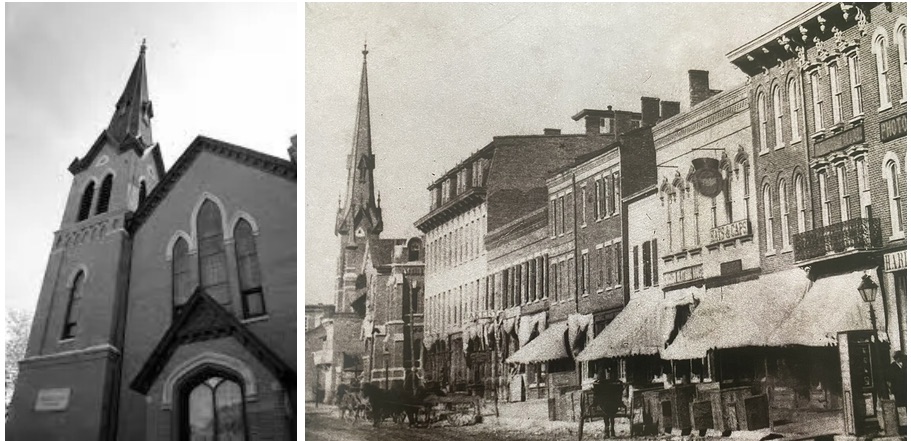
After a one year sabbatical, the Ijams returned to Iowa City, where William pastored the Congregational Church of Iowa City (September 1871-January 1874), which interestingly enough, had just opened their new church building (see pic above) directly across Jefferson Street from The Public House on December 9, 1869.
Finally, in 1874, the Ijams headed west to California; with William pastoring for a short time at the Presbyterian Church of Alameda, and then, until January 1883, the Green Street Church of San Francisco. As William’s health declined, the couple moved back east to Knoxville, Tennessee, where he occasionally preached at the Second Presbyterian Church of Maryville (1886-87).


Sadly, Rev. William E. Ijams died – age 62 – at the residence of his nephew, Dr. Lewis R. Culbertson in Zanesville, Ohio, on April 12, 1893 and is buried at Oakland Cemetery in Iowa City.


It’s believed that Elizabeth Culbertson Ijams, after Williams death, relocated back to Iowa, since when she passed away on October 22, 1912 – at age 82 – she, too, is buried at Oakland Cemetery in Iowa City.

(I) had the honor of an intimate acquaintance with the deceased, and knew much of his brilliant qualities of his mind and of his generous heart. He was gifted with great eloquence, was a fine logician, and filled all his charges thoroughly. Above all other qualifications he was a most earnest worker, never neglecting his slightest duties, and ever ready to aid the distressed. His mild and unostentatious manner endeared him to all with whom he came in contact, and his friendships lasted throughout a long and useful life. The good fruit he has sown will be multiplied a thousand fold, and his name will be known is many places.


As we mentioned earlier, when Edmund Booth returned to Anamosa, Iowa (1854) after five years in California during the Gold Rush, he began working for, and then eventually owned the Anamosa Eureka. The Eureka was a prominent abolitionist newspaper, and under the direction of Booth, became a powerful tool in spreading the anti-slavery message across eastern Iowa. Booth retained his position as owner/editor until his death (1905), though beginning in 1868, much of the daily duties were done by Booth’s oldest son, Thomas E. Booth.
As a journalist, Booth wrote numerous articles for the Annals of Iowa and other periodicals, and it was through Booth’s strong influence, the first steps were taken by the State of Iowa for the education of deaf children. Edmund also founded the Iowa Association of the Deaf in 1881 – a year after he chaired the first-ever National Association of the Deaf convention in Cincinnati, Ohio in August 1880. In that same year, he received an honorary degree of Master of Arts from Gallaudet College.
Edmund’s wife, Mary Ann, was born in 1817 in New Hampshire, and lost her hearing due to a bout with meningitis when she was four years old. She went on to receive an education at the Asylum for the Instruction of Deaf in Hartford, Connecticut, and after completion of her studies (under the tutelage of her future husband) moved westward with her family to Anamosa, Iowa.

Mary Ann Walworth Booth died on January 25, 1898 at age 80, and Edmund Booth died on March 29, 1905, at age 94, and both are buried at Riverside Cemetery in Anamosa.


THE BLIND. – Mr. Bacon, Principal of the Blind Asylum, assisted by his Musical professor Mr. McCittigan, gave another very pleasing and satisfactory exhibition of the advancement and scholarship of inmates under his charge. Read more here.
The interest manifested in these institutions and the success thus far attending their progress, lead us to hope for further provisions towards their permanent and more suitable organization, and as a citizen of Iowa City, and one who assisted, however humbly, in setting the wheels of the Deaf and Dumb Asylum in motion, feel that no more than justice would be done the city, by its location here together with the institution for the Blind, which is already well under way.
You can read more about the large number of higher education institutions formed in the earliest years of Iowa City here…
Click here to access our Rich Stories of Diversity Timeline…


December 16, 1830 – William E. Ijams – the teacher who helped start Iowa’s first School for the Deaf in Iowa City is born in West Rushville, Fairfield County, Ohio.
November 17, 1854 – William E. Ijams – who was teaching at the Illinois School for the Deaf in Jacksonville, Illinois – relocates to Iowa City, and opens an independently-run School for the Deaf.
December 20, 1854 – In the Iowa Capital Reporter, Editor R.H. Sylvester reports on the city-wide exhibition held in Old Capitol where students from both the School for the Deaf and the School for the Blind give impressive public presentations.
January 24, 1855 – With the hands-on help and political clout of Edmund Booth, the Fifth General Assembly of Iowa enacts Senate File No. 51 – forming the Iowa Institute for the Deaf in Iowa City.
February 3, 1855 – The Iowa Institute for the Deaf opens in Iowa City with William Ijams serving as principal, Perry Barnes as teacher, Ijams’ mother – Mrs. M. A. Ijams – as matron, and twenty-one pupils, ranging in age from 12 to 28 years old.
April 12, 1893 – William E. Ijams – the teacher who helped start Iowa’s first School for the Deaf in Iowa City – passes away at age 62 in Zanesville, Ohio.
March 29, 1905 – Edmund Booth – the deaf-and-blind-in-one-eye newspaper editor who helped start Iowa’s first School for the Deaf dies at age 94 – the oldest newspaper editor in America!
Kudos to the amazing resources below for the many quotes, photographs, etc. used on this page.
American School for the Deaf Oldest School for the Deaf in America, Whitney Bryant, July 3, 2009
Deaf and Dumb ad, Iowa Republican, October 4, 1854, p 3
Deaf and Dumb Institution ad, Iowa Capital Reporter, October 11, 1854, p 3
News About Town, The Iowa Capital Reporter, December 20, 1854, p 2
Prof. Benjamin Talbot pic, American Annals of the Deaf, Vol. 44, No. 3 – April, 1899
A Fact a Day About Iowa City: A School for the Deaf, Iowa City Press-Citizen, December 21, 1931, p 8
A Fact a Day About Iowa City: Result of Efforts, Iowa City Press-Citizen, June 17, 1950, p 4
Young Edmund Booth pic – Harry Lang post, Deaf History FB
Edmund Booth – Deaf Pioneer, Harry G. Lang, Gallaudet University Press, 2004
Edmund Booth – Deaf Pioneer, The Annals of Iowa, Volume 6, Number 1 (Winter 2005), pp. 78-80
Edmund Booth, Oldest Editor In America, Dead, Cedar Rapids Gazette, March 30, 1905, p 1
The Oldest Editor In The Entire County, Des Moines Register, April 2, 1905, p 25
Mary Ann Walworth Booth, Find-A-Grave
Rev William Edwin Ijams, Find-A-Grave
Rev. Wm. E. Ijams Obituary, Iowa City Daily Republican, April 20, 1893, p 3
Elizabeth A Culbertson Ijams, Find-A-Grave
Elizabeth A. Ijams, Iowa City Republican, October 31, 1912, p 4
The Iowa City Newman Center history, Iowacatholic.org
Iowa School for the Deaf, Wikipedia
Click here to go on to the next section…
Click here for a complete INDEX of Our Iowa Heritage stories…