Recalling pleasant things and taking the time to dwell on them.
Fifty Locomotives Of The M&M Railroad.
The Mississippi & Missouri Railroad was Iowa’s first railway system. With its headquarters in Davenport, the M&M had lofty goals of building three lines in Iowa – the first running east/west from Davenport to Council Bluffs via Iowa City, the second running south from Muscatine to the Missouri border via Oskaloosa, and the third running north from Muscatine toward Minnesota via Marion/Cedar Rapids.
On this page, we offer you an extensive overview of 50 – of what was believed to be a total of 75 – steam locomotives, built in the 1850’s and early 1860’s for the Mississippi & Missouri (M&M) Railroad. These were the engines that pulled M&M’s many passenger & freight cars around the State of Iowa over its eleven years of service (1855-1866).
Records indicate that most, if not all, of these 75 locomotives made the transition when, in 1866, M&M was bought out by the Chicago, Rock Island & Pacific (CRI&P) Railroad. Sadly, none of these 75 CRI&P locomotives have survived to today, but the good news is that we do have actual photographs of eleven of those M&M engines that survived into the 1870’s. For the other 40 locomotives listed here, we provide what paperwork and newspaper clippings remain on these faithful servants of the rails. Enjoy the ride!
RISP = Listed in Rock Island Steam Power by F. Wesley Krambeck (2002), pp 7-9*
Here are the first seven locomotives of The M&M Railroad. All were manufactured in the East, shipped by rail into Chicago, transferred to The Chicago & Rock Island Railroad and then, delivered to the railroad yards in Rock Island, Illinois. Now came the hard part – placing these large ladies onto rafts and floating them carefully across the Mississippi River to Davenport! In all, six made the trip before the river froze over in December 1855. The 7th – The John A. Dix – took a dangerous sleigh ride over the ice in February 1856!
The Antoine Le Claire (#1) – The first locomotive to cross the Mississippi River at Rock Island. Built by Rogers, Ketchum and Grosvenor, Paterson, NJ – Arrived by rail in Rock Island on July 10, 1855 and was transported to Davenport, Iowa via flatboat on July 19, 1855 – A 25-ton engine, the Le Claire cost $12,000 and was highly decorated with red wheels, and a bronze bust of Le Claire in base relief on the sand box with the name ‘Le Claire’ inscribed in gold letters. Below – historian Dwight L. Agnew tells us more about this special day…
Here’s yet another telling of the Antoine Le Claire story from railroad historian H.A. Nutting…
You can read more about Antione Le Claire – the Iowa pioneer who helped name Iowa – here.The one photograph remaining of The Antoine Le Claire (circa 1870s) was taken after the Chicago & Rock Island (C&RI) Railroad bought out the M&M line. Below: In June 1864, The Le Claire had a severe accident as it was traveling between West Liberty and Attalissa. The Daily Davenport Democrat gives us the details. In April 1882, the CRI&P sold The Le Claire to another railroad in Kansas. The Muscatine Weekly Journal tells us more… The Iowa (#2) – Built by Norris Locomotive Company, Philadelphia, PA, and purchased by The Galena & Chicago Union (G&CU) Railroad in 1852. Records indicate that the G&CU – the first railroad in Illinois – was never able to complete its goal of running a line from Chicago to Galena and was eventually bought out (1864) by The Chicago & North Western (C&NW) Railroad. It’s surmised that The Iowa was sold or leased to M&M in 1855 as a part of a liquidation by the financially-troubled G&CU.
The second engine in M&M’s growing inventory, The Iowa arrived in Rock Island in mid-August and was ferried over the Mississippi on August 21, 1855.The Iowa was one of the two locomotives used on August 25, 1855 (along with The Antione Le Claire) to help pull the excursion train from Davenport to Walcott (12 miles) – the first such train adventure in Iowa. Read more here. Below, the August 21, 1855 (left) and August 22, 1855 (right) editions of The Rock Island Daily Republican offer us updates on the M&M Railroad while also giving us updates on the arrival of The Iowa.
According to a July 2, 1898 article (above) from the Muscatine Saturday Mail, The Iowa was used primarily for construction purposes – a smaller work engine brought in to work on laying track from Muscatine north to the Wilton ‘Y’ Junction. Read more here. While some reports claim that The Iowa was the first locomotive west of the Mississippi, the facts show that The Iowa arrived in Davenport on August 21, 1855, preceded by The Antoine Le Claire on July 19, 1855.These two pictures (above) of The Iowa (circa 1870) were taken after she ended up in Linn County, Iowa, being rebuilt (1864) & owned by the C&NW. The 1903 Sunday Democrat was mistaken, calling The Iowa the “third in line.” The Iowa was, indeed, the second locomotive to cross the Mississippi in 1855, but the article is correct in calling The Iowa the first “coal burning locomotive” – The Antoine Le Claire and The John A. Dix were both wood-burning engines.
On this page, we offer some short newspaper blurbs (see below) taken from the February 1, 1903 article – Some Old Locomotives and Their Histories – appearing in The Davenport Sunday Democrat. Here’s what that article had to say about The Iowa…
The Davenport (#3) – Built by New York Locomotive Works, Rome, NY – This rare letter (above) from New York, dated August 1, 1855 to T.C. Durant and H. Farnam, states that the engine is on its way to Rock Island. In the August 21, 1855 edition of The Rock Island Daily Republican (below left), we find that the M&M ordered 12 locomotives from Breese & Kneeland –another name used for the New York Locomotive Company. The Davenport – mentioned as arriving in Chicago in the October 27th edition of The Republican (below lower right) – is the first of those engines coming from back east.
While no exact date has been found, we assume The Davenport arrived in Iowa via flatboat in August 1855. Built for a cost of $9,500, the engine was originally named The T.C. Durant – honoring the railroad baron, Thomas C. Durant (see below) – but was changed to The Davenport prior to its arrival. Sadly, no photographs of The Davenport exist, but it is recorded that the locomotive was used on November 20, 1855 – combined with The Muscatine to pull the six-passenger-car excursion train from Davenport to Muscatine.Henry Farnam (above left) and Thomas C. Durant (above right) formed a contracting company when they both worked for the Chicago & Rock Island (C&RI) Railroad. In 1853, the two men received a commission to raise capital and manage construction for the newly-chartered Mississippi and Missouri (M&M) Railroad. Over the next few years, Durant & Farnam become highly visible partners, raising funds and making purchases for the M&M.
Below, The Davenport had quite a historic run with the M&M. The 1903 article from the Sunday Democrat tells us more…
The Muscatine (#4) – Builder was most likely Breese & Kneeland – Jersey City (New York Locomotive Works) – Arrived in Davenport via flatboat from Rock Island in October 1855.While no photographs of The Muscatine have been found, records indicate that the engine was also used – alongside The Davenport – on November 20, 1855 in bringing a six-passenger-car excursion train from Davenport to Muscatine. Read more here.The Oskaloosa (#5) – Builder was most likely Breese & Kneeland – Jersey City (New York Locomotive Works) – Arrived in Davenport, Iowa via flatboat in November 1855.Sadly, no photographs have been found of M&M’s Oskaloosa, however, we do know – based on newspaper accounts – that she must have traversed the Mississippi prior to the winter months of 1855-1856, because we know The Oskaloosa pulled the first excursion train – seven passenger cars – into Iowa City on January 3, 1856. Read more about the Grand Railroad Festival here.The A.C. Flagg (#6) was named for Azariah C. Flagg – New York politician and Treasurer of the Chicago & Rock Island Railroad. The builder of the locomotive dedicated to him was Rogers, Ketchum and Grosvenor, Paterson, NJ. – the manufacturer of M&M’s first engine – The Antione Le Claire. Most historical records indicate that there were six locomotives brought over from Rock Island on flatboats prior to the seventh locomotive – The John A. Dix – which was transported over the ice during the hard winter of 1855/1856.Historian Robert S. Farnsworth (see above) believed between July and November 1855, there were six M&M locomotives brought over the Mississippi on flatboats: The Antoine Le Claire, The T.M. Isett (Isxett), The A.C. Flagg, The James Grant, The Oskaloosa, and The Muscatine. We know with certainty that Farnsworth’s list is correct in stating The Le Claire (#1) , The Oskaloosa (#5) and The Muscatine (#4), but it fails to mention the two engines we’ve discussed earlier: The Iowa (#2) and The Davenport (#3). At this time (2024), based on manufacturing dates, we believe the sixth locomotive to cross the Mississippi would not be The T.M. Isett or The James Grant, but The A.C. Flagg.The John A. Dix (#7) – Built by Rogers, Ketchum and Grosvenor, Paterson, NJ – the same makers of M&M’s first locomotive – The Antoine Le Claire. According to the newspaper report (below) from November 29, 1855, the 28-ton John A. Dix was ready for shipment to Rock Island by early December. Records aren’t clear when she arrived in Rock Island, but The Dix arrived – with much fanfare – in Davenport, Iowa by crossing over Mississippi River ice on February 16, 1856. Named for the New York politician (below right) who was the first president of M&M Railroad, records indicate that The Dix was the 7th M&M locomotive to cross over into Iowa – and the uniqueness of its crossing was the big story – since it all happened over a frozen Mississippi River. You can read the details here.In this brief article (above) found in the November 29, 1855 edition of The Daily Davenport Gazette (above), we find that The John A. Dix was sitting on the track of the Central Railroad in New York, apparently ready for shipment, along with No. 38 – The Nebraska.Above: In the February 18, 1856 edition of The Daily Davenport Gazette, we find the report of The John A. Dix being “dragged over on the ice” on Saturday, February 16th.Records indicate that The John A. Dix – which would have looked very similar to its earlier wood-burning prototype, The Antione Le Claire – had a severe accident in 1857 (see below), and as a result, had a major overhaul that transformed the engine from wood-burning to coal (see 1872 article above left). Thus, the pictures we have of The John A. Dix (above right) were obviously taken after that transition occurred. Below, the article from the 1903 Sunday Democrat gives us more about The Dix (No. 77).
RISP = Listed in Rock Island Steam Power by F. Wesley Krambeck (2002), pp 7-9*
On April 21, 1856, the long-awaited railroad bridge over the Mississippi River was opened. A work project that took years to complete, the Chicago & Rock Island Railroad bridge was the first to span the Mighty Mississippi, and now that it was open, trains could easily reach Davenport, and as you can see from the list above, ten M&M locomotives made their debut appearances in Iowa in April/May 1856.The Des Moines (#8) – Builder was most likely Breese & Kneeland – Jersey City (New York Locomotive Works). It was reported in a newspaper article (1896) that The Des Moines was the first M&M locomotive to cross the Mississippi using the first bridge built over the river – April 21, 1856.
Historian F. Wesley Krambeck reports that two other M&M locomotives manufactured by Breese & Kneeland – The Kansas (#9), and The T.C. Duran (#10) – and The Mahaska (#11), manufactured by Rogers, Ketchum and Grosvenor, Paterson, NJ., arrived in Davenport via the new Mississippi River bridge as well.
And while we don’t have any pictures of The Des Moines or these other engines, we do have a lot of information on the Rock Island Bridge Company, which was formed by many of the same businessmen that invested in the C&RI and M&M Railroads. Read more here.
Now, allow me to tell you about the six other M&M locomotives that were involved with the earliest crossings over the Mississippi River bridge in April of 1856…
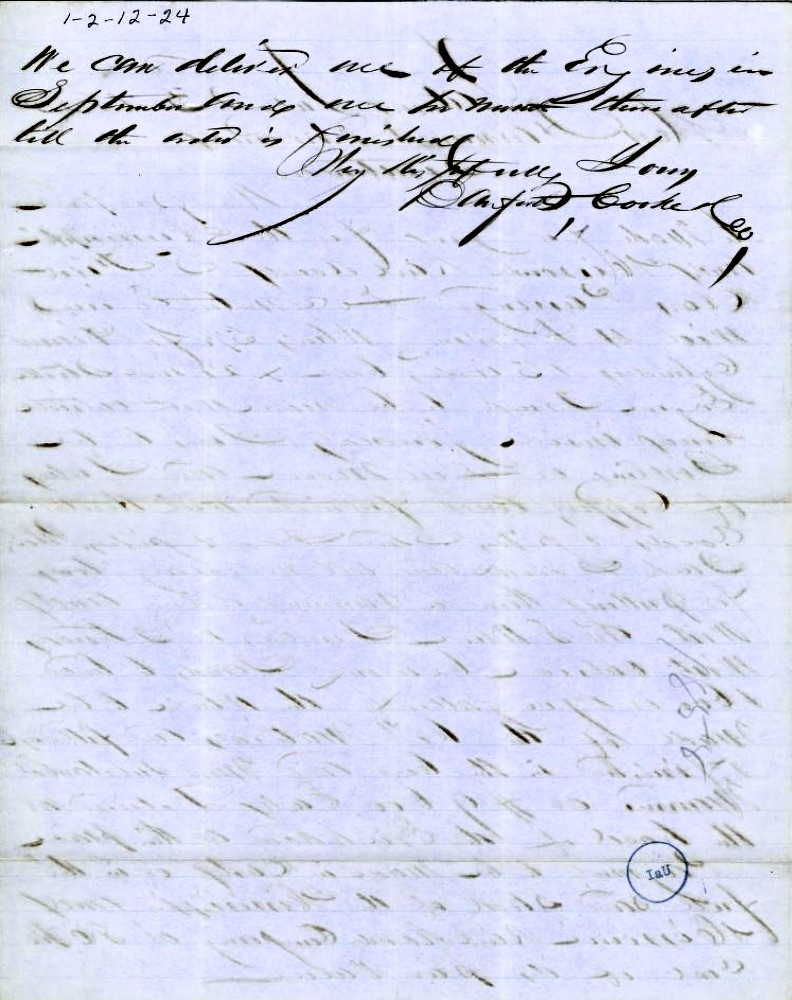
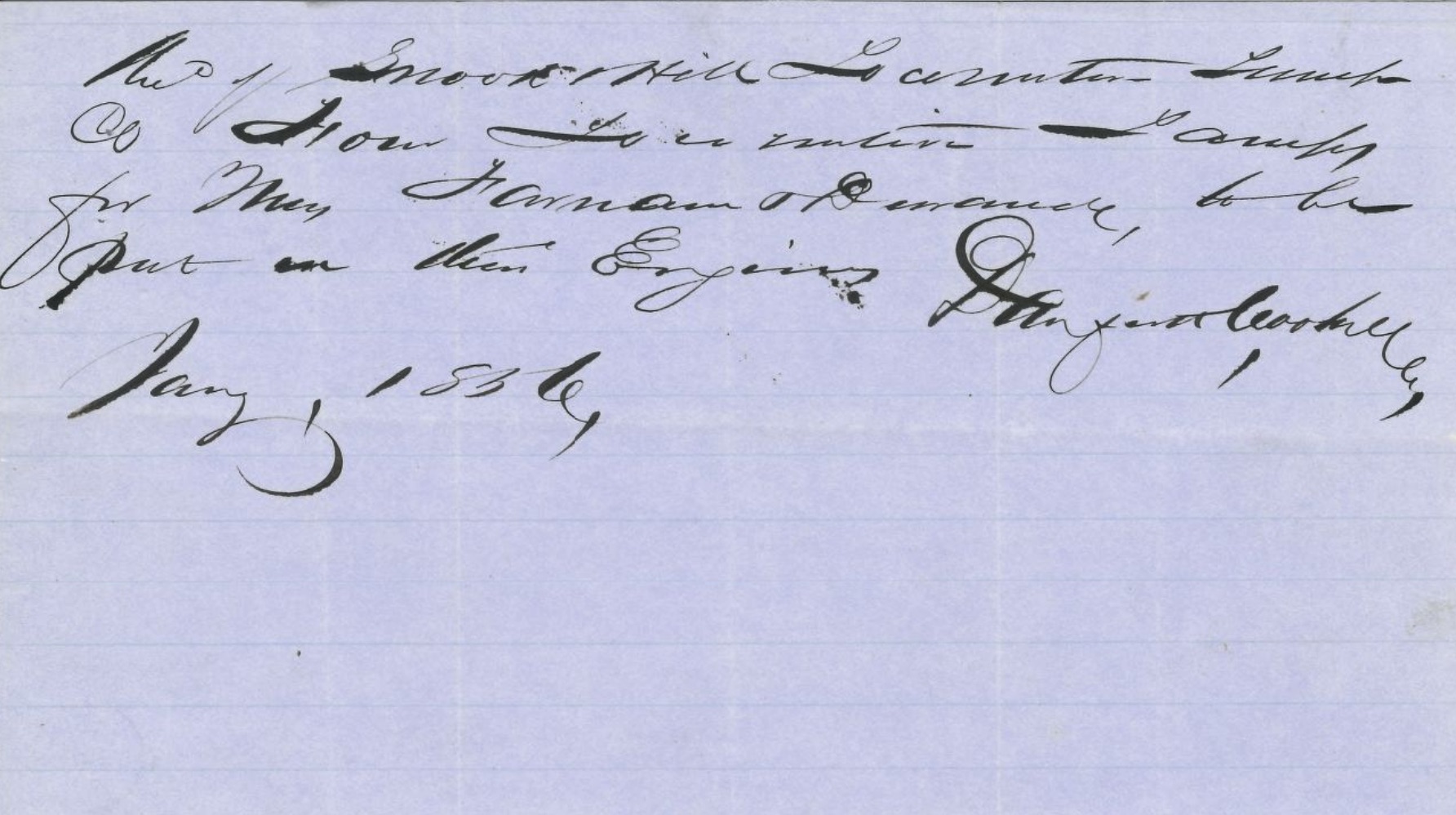
It’s obvious from the M&M Railroad records that Henry Farnam and Thomas C. Durant – after one year (1855) of buying engines from several sources, which includedBreese & Kneeland of Jersey City (New York Locomotive Works) – found one locomotive manufacturer that met all of their needs. Beginning with this letter (below) from July 23, 1855, M&M Railroad purchased at least one dozen locomotives from Danforth, Cooke & Company in Paterson, New Jersey over the next five years…
On July 23, 1855, Danforth, Cooke and Company in Paterson, NJ writes Henry Farnam & Thomas Durant, telling them that they can make “5 passenger locomotives” for the Mississippi & Missouri Railroad, with the guarantee that “we can deliver one of the engines in September.” Below is a second 2-page letter – dated August 20, 1855 – further clarifying the quote for the five locomotives…
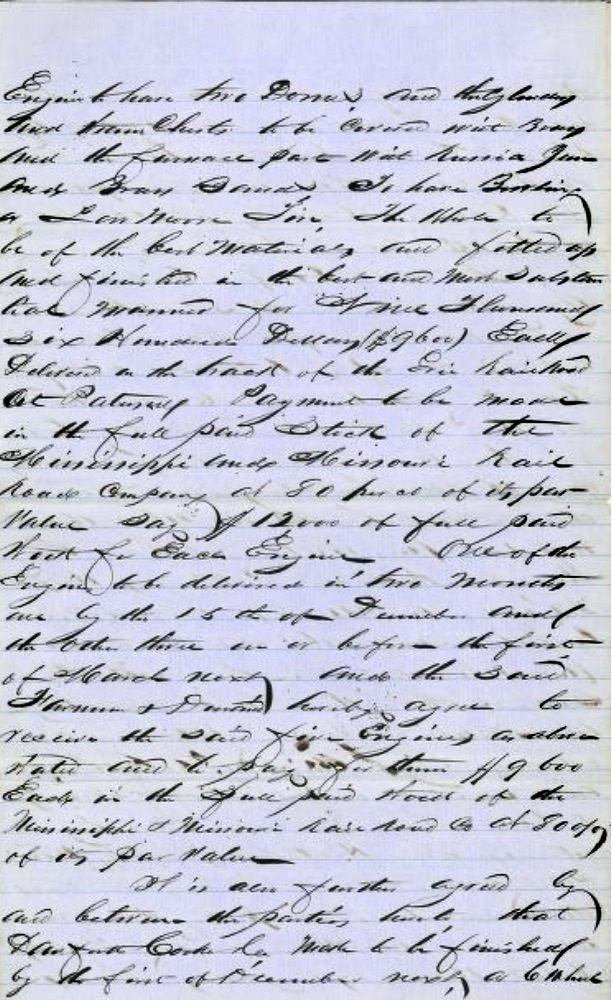
On September 8th, 1855, this letter (below) from Danforth, Cooke and Company confirms the sale price of $9,600 for each of the 5 locomotives being ordered by the M&M Railroad. And from what we can tell, the first engine was scheduled to be delivered by December 15, 1855, the second would arrive within five months (February 1856), and the other three would arrive before the first of March 1856…
Now, allow us to introduce you to those first five Danforth, Cooke & Co. locomotives, plus a sixth engine that arrived in the spring of 1856 as well…
The Nebraska (#12) – Interestingly, while M&M purchased this engine – also known as #38 – from Danforth, Cooke and Company, Paterson, NJ, she was technically outsourced to William Swinburne – a long-time locomotive manufacturer and trusted associate of Danforth, living in Paterson, NJ. According to family records, Swinburne operated his own manufacturing shop from 1851-1857. It’s believed that Danforth, Cooke & Co. had over-committed itself in producing locomotives and with the M&M expecting its first of five engines by December 15, 1855, the manufacturing order for engine #1 was shipped out to Swinburne. The Albany Journal (above) reports on “No. 38” – which, of course, is M&M’s Nebraska locomotive – looking to be shipped in late November 1855. According to paperwork, The Nebraska was turned over to the NY & Erie RR for shipment on December 24, 1855.We assume she arrived in Rock Island in January 1856 and was brought over to Iowa once the Mississippi River Railroad Bridge opened in April 1856.This brief article found in February 18, 1856 edition of The Daily Davenport Gazette indicates that M&M Locomotives #38 – The Nebraska and #14 – The Des Moines are in Rock Island waiting to be delivered to Davenport when the Mississippi River bridge is completed.In the May 7, 1856 edition of The New York Times, an article from The Chicago Tribune reports on the “Fast Railroad Time” where three engines: The Fountain City, The High White, and The Nebraska pulled twenty-seven passenger cars from Toledo to Chicago in record time. Here, The Nebraska is credited to the New York Locomotive Works (Breese & Kneeland). As we mentioned earlier, M&M did purchase locomotives from them as well, but it’s very possible the Tribune had their facts wrong on The Nebraska, but with William Swinburne being the true “manufacturer”, it’s possible that New York Locomotive was, indeed, involved as well.
The Daily Davenport Gazette reported on December 8th, 1855 (above left), that the M&M construction crew was making good progress, with the line only 12 miles east of Iowa City. The article also mentions that a locomotive was on order – one that would be “named after the capital of the State” and be the engine used to pull the first train into Iowa City.
Sadly, The Iowa City (#13) didn’t make it to Iowa in time to be the engine used to pull the first M&M passenger train into Iowa City. The Oskaloosa (#5) (mentioned earlier) had that honor on January 3, 1856. You can read the details here.
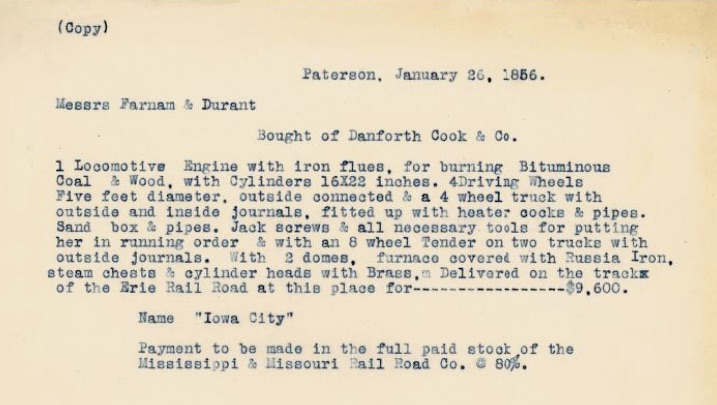
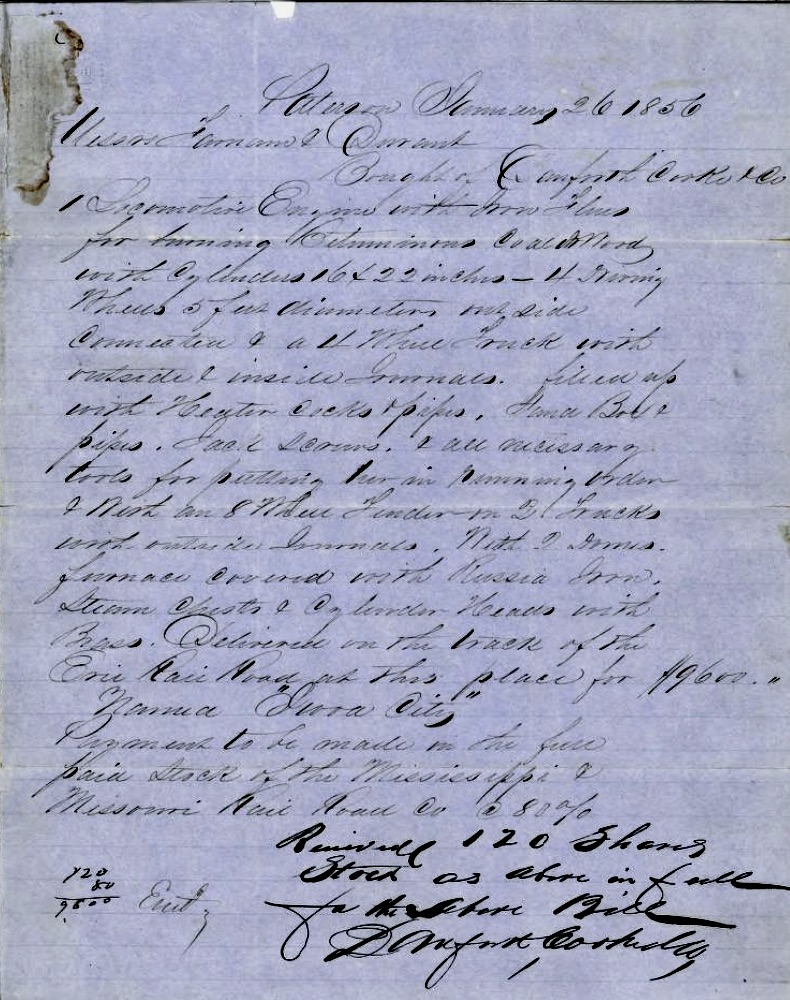
The Iowa City (#13) – Built by Danforth, Cooke and Company, Paterson, NJ – The second of five engines ordered, The Iowa City cost $9,600, and was delivered to William M. Kasson & Son on January 26, 1856 (see below), and, most likely, arrived in Rock Island in February, 1856 – just as Danforth, Cooke & Co had promised. It is uncertain if The Iowa City was transported to Davenport via the ice (like The John A. Dix) – one newspaper report from 1936 states that it was, but it can’t be proven. More than likely, The Iowa City came into Iowa after the Mississippi River Railroad Bridge opened in April 1856.
Unfortunately, no pictures of The Iowa City exist, but below is more paperwork for the purchase of engine…
Some believe this locomotive (pictured above) to be The Iowa City based on the fact that the photograph appeared in the 1924 Iowa City High School Red and White Yearbook with the caption – “Our First Locomotive”. This phrase was either 1) mistakenly identified, or 2) the writers were referring to the first Chicago, Rock Island & Pacific locomotive (1852) – The Rocket. You can read more about The Rocket (which is, indeed, pictured above) here.The Samson (#14) – Built by Danforth, Cooke and Company, Paterson, NJ . The third of five engines ordered, The Samson was a switch engine and cost $9,600. It was delivered to William M. Kasson & Son on March 5, 1856, just a few days after it was promised (March 1). We assume The Samson arrived in Davenport, Iowa via the new river bridge in April 1856.Sadly no photographs of The Samson have been found.
Below, the 1903 article from The Sunday Democrat gives us a bit more about The Samson (#14) and its big brother – The Dexter (#48)…The Missouri (#15) – Built by Danforth, Cooke and Company, Paterson, NJ – The fourth of five engines ordered, The Missouri cost $9,600, was completed by March 25, 1856 (see letter below), and delivered to William M. Kasson & Son on April 4, 1856, one month after it was promised (March 1). We assume The Missouri arrived in Davenport, Iowa via the new river bridge.Sadly no photographs of The Missouri have been found.
The Henry Farnam (#16) – Built by Danforth, Cooke and Company, Paterson, NJ – The locomotive – the fifth of five engines ordered in 1855 – was delivered to William M. Kasson & Son on April 25, 1856 – nearly two months after it was promised (March 1). We assume The Farnam arrived in Davenport, Iowa via the new river bridgeSadly no photographs of The Farnam have been found.The Clark Durant (#17) – named for Thomas C. (Clark) Durant. Built by Danforth, Cooke and Company, Paterson, NJ – The sixth engine ordered in 1855, The Durant cost $9,600, and was delivered to William M. Kasson & Son in April, 1856. We assume the enginearrived in Davenport, Iowa via the new river bridge.Sadly no photographs of The Durant have been found.
RISP = Listed in Rock Island Steam Power by F. Wesley Krambeck (2002), pp 7-9*
In the fall of 1856, M&M purchased seven locomotives from the Lawrence Machine Shop in Lawrence, Massachusetts.
This article (above) from the 1903 Davenport Sunday Democrat mentions TheC.W. Durant (#24) – not to be confused with The Clark Durant (#17), which was built byDanforth, Cooke and Company. The six other locomotives coming from Lawrence, Massachusetts were The William Walcott (#18) – named for the M&M Director, The Council Bluffs (#19), The South Pass (#20), TheEbenezer E. Cook (#21) – named for the M&M Investor, The James Grant (#22) – Scott County’s best-known judge and investor in M&M (read more here), and The James I. Sheffield (#23).
RISP = Listed in Rock Island Steam Power by F. Wesley Krambeck (2002), pp 7-9*
Over the first half of 1857, M&M purchased fourteen new locomotives, and as you can see from the graph above, six different manufacturers were used:
Taunton Locomotive in Taunton, Massachusetts: Three engines with unknown names – (#25), (#30), and (#31)
Mason Machine Works in Taunton, Massachusetts: The Gypsy (#26)
Swinburne, Smith & Company in Paterson, New Jersey: The J.F. Tracey (#27), The I.N. Cobb (#28), and The F.H. Tows (#29)
Schenectady Locomotive in Schenectady, New York: Two engines with unknown names – (#32), and (#33)
Lawrence Machine Shop in Lawrence, Massachusetts: Two engines with numbers only – No. 17 (#34), and No. 18 (#35)
Rogers Locomotive in Paterson, New Jersey: No. 39 (#36), The T.M. Isett (#37) – named for the Muscatine banker, Thomas M. Isett, and The Omaha (#38)
RISP = Listed in Rock Island Steam Power by F. Wesley Krambeck (2002), pp 7-9*
We come to the final set of M&M locomotives: one dozen engines from at least six different manufacturers.
The first two on our chart come from Danforth, Cooke & Company and we have more details on both locomotives: The Sunset (#39) and The N.B. Judd (#40) below.
Next up is The Washington (#41) built by The New Jersey Locomotive Works, and The John E. Henry (#42) from Rogers Locomotive.
Three unknown engines (#43), (#44) from Taunton Locomotive, and (#45) from Mason Machine Works. The Col. Davis (#46) and The M. Kasson (#47) from The Lawrence Machine Shop.
We conclude with three locomotives: The Dexter (#48), The Transit (#49), and The Chicago (#50) – all with no manufacturing records that we’ve found.
Historian Robert S. Farnsworth mentions The Sunset (#39), The Transit (#49), The N.B. Judd (#50), and The Washington (#41) in this report.As we have shown you earlier, between December 1855 and April 1856, Danforth, Cooke and Company of Paterson, NJ produced at least six engines for M&M Railroad. Now, here on December 20, 1856, is yet another letter of agreement for four more locomotives – with delivery expected between April and August 1857. Below are the records of two of those four locomotives…The Sunset (#39) – Built by Danforth, Cooke and Company, Paterson, NJ – The locomotive was delivered to William M. Kasson & Son on June 12, 1857, and arrived in Davenport, Iowa during the summer of 1857.
The N.B. Judd (#40) – Built by Danforth, Cooke and Company, Paterson, NJ – The locomotive was delivered to William M. Kasson & Son on June 30, 1857, and arrived in Davenport, Iowa during the summer of 1857. This locomotive was named for Norman B. Judd of Chicago – M&M’s financial solicitor.
So, there you have it! Five years (1855-1860) – Fifty M&M Locomotives…
RISP = Listed in Rock Island Steam Power by F. Wesley Krambeck (2002), pp 7-9*
* Kudos to Rock Island Steam Power by F. Wesley Krambeck, William D. Edson, and Jack W. Farrell (2002). It’s this resource (below) from pages 7-9 that helped us assemble much of our list of 50 M&M locomotives…
Note that Krambeck states of his list (above) – taken from one recorded in 1857 – “much of the data conflicts with builder’s records”, thus in some occasions, when other records indicate such, we have chosen to override Krambeck’s dates of arrival. Note that Krambeck’s list contains 47 locomotives – failing, for unknown reasons, to mention The Antoine Le Claire (#1), The Dexter (#48), and The Transit (#49) in his listings.
In 2026, our researcher – Gary Mohr – came across two additional charts (above) as published in an October 1922 publication celebrating the 70th anniversary of the Rock Island Railroad. Both lists date back to around 1856, and the one on the left lists 15 engines (13 by name) that currently are in service, but offers no railroad name. By the looks of the list, we’d say that this chart represents 15 locomotives we’ve identified (from a list of 24) as being used by the M&M Railroad around 1856. It’s important to note here, that while this listing aligns with our other records on the 13 named engines, there are two exceptions. #12 is listed as a different engine than the Samson (which is designated as #12 in other listings), and #58 is an unidentifiable engine not shown on other M&M engine lists dating from 1855-1856. Interestingly, records do indicate that between 1860 and 1866, M&M did purchase 25 additional engines to add to its original 50, with each of them given numbers (#51-75).
As for the second list (on the right), we find 52 engines (18 by name) that are currently in use for the Rock Island Railroad in October 1856. As you scan this chart, you’ll see that the final 11 engines listed here are M&M locomotives we’ve identified earlier – all purchased in 1856.
Thus far, on this page, we’ve identified 50 locomotives that are in use (or have been in use) by the M&M Railroad between 1855 and 1860. Interestingly, it appears from the letter below (September 13, 1860) that M&M was still looking to add at least four more engines from Danforth, Cooke & Company…
On September 13, 1860, M&M is placing yet another order for four more locomotives from Danforth, Cooke and Company in Paterson, New Jersey. Apparently, the planned delivery is for March, April & May of 1861, though with the outbreak of the Civil War, we doubt that this delivery schedule was accomplished. Records do indicate, however, that the M&M added another 25 locomotives to their fleet between 1857 and 1866.
In that 1903 Davenport Sunday Democrat newspaper article (above), we find a brief explanation about the 1864 M&M transition from locomotive names to numbers, and with the growing list of engines – 75 by the time we get to 1866 – we certainly see why it made sense to go with numbers vs. staying with proper names.
In 1866, the cash-strapped M&M Railroad finally was bought out by The Chicago, Rock Island & Pacific Railroad. At that time, all 75 of M&M’s locomotives became the property of the Rock Island. See details from historian F. Wesley Krambeck below…
According to Krambeck, when the CRI&P Railroad took possession of the M&M locomotives, they were given numbers – #1 to #63, and #77 to #89. This numbering system would have included all 50 of the M&M locomotives we describe on this page (1855-1859), plus another 25 engines which must have been added to the M&M fleet between 1857-1866.
The CRI&P finally reached Council Bluffs in May 1869, completing the state-wide railroad line first envisioned by the M&M Railroad back in 1853.Click here for more on the Rock Island Railroad history in Iowa City.Here’s a tip of the old hat to the M&M Railroad and its fifty locomotives that helped shape Iowa’s transportation history!
August 21, 1855 – The Rock Island Daily Republican reports that the Mississippi & Missouri Railroad has now received enough iron railing in Davenport to complete the railroad to Iowa City.
August 22, 1855 – The Rock Island Daily Republican reports that the Mississippi & Missouri Railroad locomotive – The Iowa – along with The Antione Le Claire will pull an excursion tour train from Davenport to Walcott (12 miles) – the first such train adventure in Iowa!
August 25, 1855 – The M&M Railroad’s second locomotive – The Iowa – is one of the two locomotives (along with The Antione Le Claire) to help pull the excursion tour train from Davenport to Walcott (12 miles) – the first such train adventure in Iowa!
November 29, 1855 – The Daily Davenport Gazette reports that The John A. Dix is sitting on the track of the Central Railroad in New York, apparently ready for shipment, along with No. 38 – The Nebraska – to the M&M Railroad in Iowa.
January 26, 1856 – The M&M Railroad’s new locomotive – The Iowa City – built by Danforth, Cooke and Company in Paterson, NJ – is delivered to William M. Kasson & Son who completes its transit to Rock Island and Davenport.
February 16, 1856 – The M&M Railroad’s locomotive – The John A. Dix – arrives – with much fanfare – in Davenport, Iowa by crossing over Mississippi River ice.
September 13, 1860 – M&M Railroad places its final order for four additional locomotives from Danforth, Cooke and Company in Paterson, New Jersey.
Kudos to the amazing resources below for the many quotes, photographs, etc. used on this page.
A special thanks to Gary Mohr of Ames, Iowa – history researcher par excellence who contributed so much to this page!